America’s redistricting wars have expanded beyond even the Republican Party’s wildest imagination.
Thanks to captive state legislatures and prostrate judiciaries, what began as a GOP attempt to mitigate midterm election losses has morphed into an existential clash over the meaning of representation.
Gerrymandering—the practice of designing a legislative district exclusively to gain a partisan advantage—is among the oldest practices in the American republic.
It is named for one of the country’s founders, Elbridge Gerry, who went on to become the fifth vice president of the United States.
In 1812, while serving as governor of Massachusetts, Gerry pushed through legislation redrawing senatorial districts in a way that gave disproportionate representation to the Democratic-Republicans (the antecedent to today’s Democratic Party).
The shape of one of these districts, which resembled a salamander, inspired a newspaper to coin a new word.
In recent decades, gerrymandering has largely been the preserve of Republicans. During Barack Obama’s two-term presidency, the GOP gobbled up nearly 1,000 state legislative seats, turning competitive bodies into conservative supermajorities that changed the character of state government.
While Democrats also engaged in gerrymandering—supposedly in the name of “fairness”—they mostly ignored state legislative elections, convinced that the White House and Congress were the most important levers of power.
More fundamentally, Democrats consistently underestimated the lengths to which their Republican opponents were willing to go for power.
This failure has been particularly glaring since President Donald Trump took control of the GOP a decade ago, at which point securing, entrenching, and expanding power became the only item on the party’s agenda.
Fighting fire with fire
Last year, after multiple Republican-led states passed or attempted to pass new congressional maps aimed at increasing the GOP’s electoral advantage before this November’s midterms, the Democrats decided to fight fire with fire.
In a rare display of raw partisanship, California passed, through a popular referendum, the Election Rigging Response Act—legislation that squeezed out all but a few Republican seats in the state’s congressional delegation.
But in this fight, Democrats are again missing both the forest and the trees.
For starters, not all their forays into gerrymandering have delivered the desired results.
Disenfranchising citizens who had already cast ballots was unprecedented and lacked any justification
When Virginia passed a ballot measure aimed at securing ten of the state’s 11 seats in the House of Representatives for the Democratic Party, it was overturned by the state’s Supreme Court on technical grounds. The delegation’s 6-5 split remains in place.
The judiciary then dealt the Democrats an even bigger blow. Challenges to gerrymandered maps have often cited the 1965 Voting Rights Act, which aimed to safeguard people’s ability to exercise the right to vote.
But the US Supreme Court has spent the last decade gutting the Act, and last month, the Court’s conservative majority put the final nail in its coffin by effectively nullifying Section 2, which prohibits racial discrimination in voting practices or procedures.
Within minutes of the ruling’s announcement, several Republican states were at work dismantling majority-Black districts. Louisiana’s Republican governor, Jeff Landry, went so far as to issue an executive order suspending the state’s congressional primary elections, which were already underway, so that districts could be redrawn.
Disenfranchising citizens who had already cast ballots was unprecedented and lacked any justification.
Landry simply issued the diktat—vaguely claiming the authority to “protect voter safety, participation, and the integrity of the process”—and local election officials complied, highlighting the vulnerability of America’s distributed, underfunded, and understaffed election processes.
The midterm campaign is shaping up
The midterm campaign is shaping up, yet again, to bring out the worst in both parties.
Around 10% of the 435 seats in the US House of Representatives are now considered “competitive” by Ballotpedia.
This is both bipartisan and intentional: both parties’ pitches to voters are weak.
Trump is deeply unpopular—owing not least to his war in Iran, which has exacerbated an affordability crisis—giving the Democrats a massive polling advantage with independent voters
Republicans are running on the fiction that the world is safer, the economy is stronger, and Americans are better off under Trump.
Democrats are once again running on process, promising to change the rules of the game through reform and legislation. The Democrats should be able to do better than that.
Trump is deeply unpopular—owing not least to his war in Iran, which has exacerbated an affordability crisis—giving the Democrats a massive polling advantage with independent voters.
But the party remains incapable of articulating a coherent vision for middle- and working-class Americans.
America’s most pressing problems will remain unaddressed
Making matters worse, for the past 18 months, the Democrats have consistently proven unwilling or unable to serve as a true opposition party.
As a result, even bold statements—such as House Minority Leader Hakeem Jeffries’ recent assertion that “We’re going to win in November,” and then “crush [the] souls” of the “far-right extremists”—lack credibility. (The Democrats doth protest too much.)
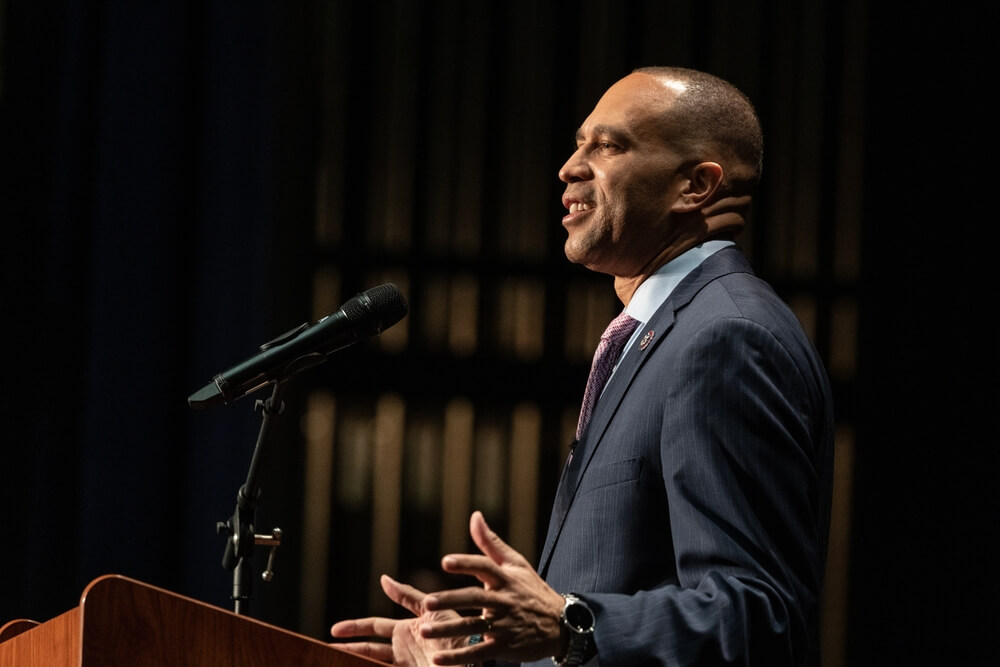 Even bold statements—such as Hakeem Jeffries’ recent assertion that “We’re going to win in November"—lack credibility
Add to this the judicial defeat in Virginia and the destruction of the Voting Rights Act, and it is not difficult to see why Democratic donors and activists are once again feeling deflated.
Of course, Republicans are not offering a compelling message to America’s middle and working classes, either.
Lacking an attractive program based on a coherent and constructive vision for the US, all that is left for both parties are tactics.
That is the bleak lesson of the redistricting wars. US voters, as usual, have only two options: bad and worse.
Whichever they choose this November, America’s most pressing problems will remain unaddressed.
Reed Galen is a co-founder of The Lincoln Project, and President of JoinTheUnion.us, a pro-democracy coalition dedicated to defending American democracy and defeating authoritarian candidates.
