As hyperscale data centres appear on planning maps beside villages, farmland and residential areas, who decides what technological progress looks like, and who pays the price?
The global AI race is often described through investment figures, semiconductor breakthroughs and the construction of ever-larger computing clusters.
In Scotland, it is becoming a much more tangible debate. Enormous industrial buildings, rising electricity demand, noise, landscape change and residents who fear their homes are being sacrificed for an industry whose benefits remain uncertain.
The proposed data centre campus near Auchtertool in Fife is a great example of what's happening. Developer ILI Group has proposed a facility with a 600-megawatt power capacity.
The project could be one of the world's largest data centres, with buildings around 35 metres high and a footprint that would forever alter the rural setting.
In August, more than 1,600 objections were reported. Other proposals, including facilities around Larbert and the wider Central Belt, have prompted similar opposition.
The controversy is that a building reaching 32 or 35 metres above the surrounding landscape would visibly change a place people chose for its character, space and relative quiet. Cooling equipment, lighting, construction traffic, and backup generators raise questions about how nearby residents experience the area day to day.
Why Scotland, and why now
Scotland has a few advantages in the digital infrastructure competition. It has substantial renewable electricity generation, a cool climate that can support efficient cooling, established universities and technical expertise, and opportunities to develop energy and digital infrastructure together.
The UK also needs computing capacity to support cloud services, AI training and inference, business applications and critical digital services. Data centres underpin far more than chatbots: banking, healthcare, logistics, communications and public administration all depend on them.
Renewable energy does not automatically make every development sustainable
During parliamentary debate in September, MSPs identified 23 proposed hyperscale data centres and 21 already in the planning system.
Their combined potential power demand was estimated at 7.3 gigawatts, compared with Scotland's winter peak electricity demand of about 4 gigawatts.
Scotland is confronting a strategic decision. It can attract capital, infrastructure and AI-related activity. But it must also decide which projects make economic and environmental sense, where they belong, and how to manage their cumulative impact.
Renewable energy does not automatically make every development sustainable. A country can be rich in renewable resources yet still make poor infrastructure decisions.
The imbalance between local costs and global benefits
Residents' strongest argument is as much economic as environmental: what does the community receive in return? A hyperscale data centre requires major capital investment and substantial construction activity.
Once operational, however, it can run with a relatively small permanent workforce compared with other industrial developments of similar investment value. Reporting on the Auchtertool proposal estimates about 120 permanent on-site jobs.
The benefits could extend beyond direct employment. Well-planned development can support local contractors, infrastructure improvements, technical training, research partnerships and wider investment.
It could help Scotland attract AI businesses and strengthen domestic computing capabilities.
Communities should not be expected to accept permanent disruption in return for vague promises of future prosperity
These new potential projects need enforceable commitments, credible demand and a strategy that links infrastructure to the wider economy.
If residents are to endure years of construction, altered views, persistent noise, or pressure on local resources while landowners, investors, and global technology companies capture most of the financial value, opposition is inevitable.
Communities should not be expected to accept permanent disruption in return for vague promises of future prosperity.
How far are we prepared to go to build the AI economy?
This debate reveals a wider tension in technological development. AI is treated as a strategic necessity, pushing governments to accelerate investment before fully understanding the economic and social consequences.
Assuming that because a technology is important, every facility proposed in its name must be built is risky.
A data centre can shape local land use and infrastructure for decades
The industry does need physical infrastructure. Models require computing power, computing requires electricity, and digital services need reliable facilities. Pretending otherwise is not a serious policy position.
It's equally unrealistic to imagine AI growth without a physical footprint. But necessity does not remove the obligation to choose carefully.
A data centre can shape local land use and infrastructure for decades. Developers and planners should consider whether its design can adapt to changing technology and community expectations.
They should also assess the human costs beyond property values. Rural quiet, access to open space, landscape character and a sense of control over one's home are legitimate elements of wellbeing.
They are hard to capture in a spreadsheet, but that doesn't make them economically or socially irrelevant.
A pause is useful. A better planning model is essential
In September, the Scottish Parliament backed a position calling for no decisions on new hyperscale data-centre proposals until national planning guidance is developed, alongside robust environmental assessments and consideration of neighbouring communities.
National guidance is expected by the end of the year. A pause alone isn't a solution; in my opinion, Scotland needs a few clear priorities to take a more effective approach.
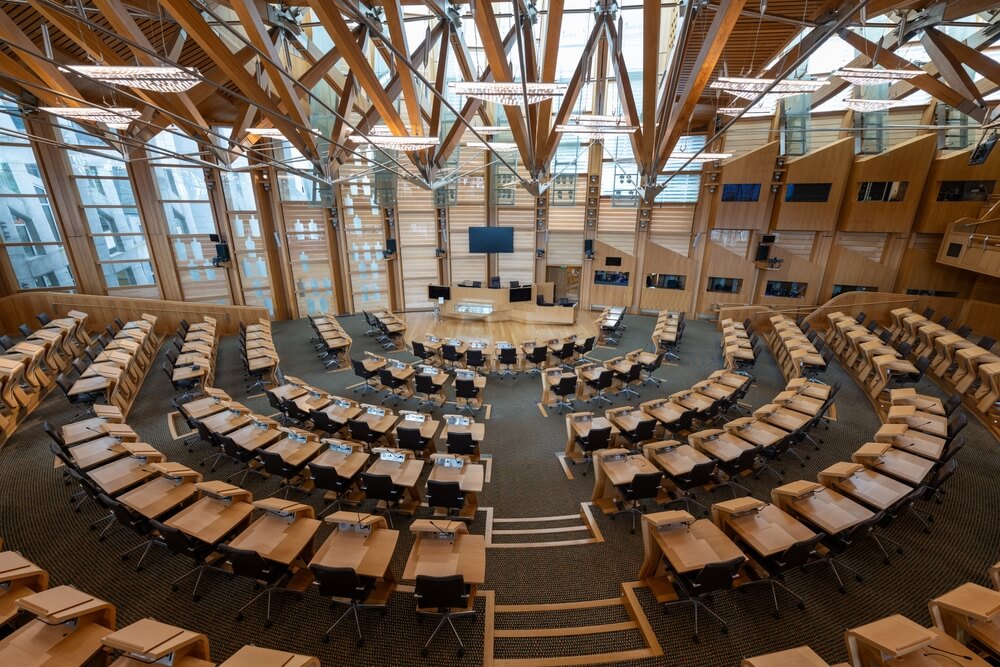 The Scottish Parliament backed a position calling for no decisions on new hyperscale data-centre proposals until national planning guidance is developed
First, have site data centres where grid capacity, industrial land, and transport infrastructure are readily available, while maintaining appropriate distances from residential and ecologically sensitive areas.
Second, developers should provide transparent estimates of energy demand, water consumption, backup power, emissions, and operational noise.
Third, planning agreements should set out the long-term advantages for residents.
Fourth, they should assess cooling efficiency and low-emission backup systems against site-specific conditions and commercial viability.
Fifth, and most importantly, communities need independent oversight of the initiative's scope and conditions.
Communities are not obstacles
Scotland's data-centre dispute is a growing pain of the AI economy, but calling it only a growing pain risks dismissing a legitimate failure of planning.
Every day, the industry moves faster because computing capacity has become a strategic asset. Public policy, infrastructure planning and community engagement have not kept pace.
The result is a familiar pattern: investment is presented as a national opportunity, while local people are asked to absorb the consequences before the benefits have been demonstrated.
A compromise could link investment to a clearer national strategy, stricter environmental standards and enforceable local benefits
A compromise could link investment to a clearer national strategy, stricter environmental standards and enforceable local benefits.
Just because a technically impressive facility can be built does not mean it will be a successful project. Scotland has the chance to show how that balance can work and serve as an example to other regions, but can it set emotions aside and focus on the solution?
If it gets the framework right, it can attract investment without treating communities as obstacles. But if it gets it wrong, the backlash could trigger a domino effect and fuel further opposition from other regions asked to host the infrastructure behind the next technological revolution.
