As the summer holidays come to an end and many enjoy their last few summer swims in the ocean, I knew it was the perfect time to discuss what lies beyond the beach. The next infrastructure frontier.
One of Earth's largest natural environments is the ocean, yet it sits outside the AI infrastructure conversation.
Underwater data centres, subsea fibre networks, marine sensors, autonomous underwater vehicles, and AI-powered ocean monitoring are converging into a new infrastructure category. Some ideas will fail commercially. Others will remain specialist applications. A few could become strategically important.
The opportunity involves rethinking where we build compute, how we cool it, how we connect continents, and how we collect data from one of Earth's least understood environments.
That makes subsea infrastructure part of the next chapter in technology. Let's dive in.
The data centre beneath the waves
Microsoft gave the industry one of its most interesting experiments with Project Natick.
Microsoft deployed a full-scale subsea data centre module in the North Sea as part of a research programme exploring whether underwater facilities could provide reliable computing close to coastal populations while using renewable energy and seawater for cooling.
The Northern Isles module contained 864 servers and 27.6 petabytes of storage. Microsoft reported a server failure rate one-eighth of its land-based control group during the experiment.
The idea makes sense from an intuitive engineering perspective. An enclosed pressure vessel can create a regulated environment for computing equipment; the ocean offers a massive thermal reservoir; water transfers heat much more efficiently than air; and offshore renewable power may be able to produce electricity nearby.
But we should not rush to declare underwater data centres the future. Microsoft ended Project Natick as an active programme in 2024.
The company said the experiment worked technically, but it decided not to build subsea data centres commercially. Microsoft also said its engineers would apply the lessons from Natick to other infrastructure.
Technical feasibility doesn't automatically create a viable business model.
Can the engineering and maintenance costs compete with sophisticated land-based cooling systems?
Data centres need hardware upgrades, maintenance, physical access, network redundancy, security, power infrastructure and predictable operating economics. The ocean complicates every one of those requirements. It doesn't mean the idea has disappeared.
An intriguing example is given by South Korea. In order to create a model of an underwater data centre at a depth of about 20 metres, Ulsan has started a programme with the Korea Institute of Ocean Science and Technology. The project's goal is to achieve a power use effectiveness of about 1.2 by combining modular servers with hybrid cooling.
In order to manage server operations and GPU infrastructure, SK Telecom joined the initiative in 2026. Commercialisation is the project's goal for 2031.
This development is more interesting because AI changes the economics.
AI workloads create enormous demand for electricity and cooling. Operators search for locations with available power, suitable cooling conditions, strong connectivity, and enough physical space. The ocean offers some of those resources.
Can the engineering and maintenance costs compete with sophisticated land-based cooling systems? We don't need underwater data centres everywhere. We need them where the economics make sense.
The ocean already carries our data
Subsea cables already form one of the most important foundations of the global digital economy.
The ITU says submarine telecommunications cables carry more than 99% of global data traffic. The organisation has also highlighted growing concerns about cable resilience, physical damage, repair capacity, and geographic concentration.
AI makes those networks even more important. Large AI models require massive data flows between regions, data centres, and cloud platforms. Hyperscalers increasingly participate directly in submarine cable projects. Industry analysis from IEEE notes that AWS, Google, Microsoft, and Meta now account for a substantial share of planned subsea cable deployments.
Google provides a useful example. In July, Google connected its Nuvem subsea cable between the United States and Portugal. The approximately 7,000-kilometre system uses 16 fibre pairs and offers a design capacity of around 384 terabits per second.
The subsea AI infrastructure story doesn't require servers underwater.
The cable itself already represents critical AI infrastructure.
Instead of building separate networks for every application, we can make existing infrastructure increasingly intelligent
But engineers are now exploring deeper. What if the cable could also become a sensor? Research from the National Oceanography Center shows exactly this possibility.
Scientists used distributed acoustic sensing on a 28-kilometre subsea fibre cable in the Western Ionian Sea. Instead of treating the cable purely as a communications asset, researchers turned it into thousands of virtual sensors that collect detailed acoustic and physical information from the seafloor. The researchers estimate that one fibre-optic cable can generate up to 86 terabytes of ocean data per day.
We already have infrastructure on the seabed. Now we can potentially use it to observe the surrounding environment.
Scientists can monitor seismic activity, ocean waves, underwater noise and marine conditions. Operators can monitor the condition of the cable itself. Governments can potentially use similar systems for maritime awareness.
ESA's DEEPSEA project takes this concept further by combining distributed acoustic sensing, AI and satellite data to monitor maritime activity around subsea cables.
One piece of infrastructure can therefore support connectivity, environmental monitoring and security intelligence. Instead of building separate networks for every application, we can make existing infrastructure increasingly intelligent.
The ocean becomes an intelligent environment
We know remarkably little about our oceans compared with the amount of data we collect about land.
The European Commission's Joint Research Center identified eight emerging technologies for ocean observation in 2026, including autonomous environmental DNA and RNA sampling, modular sensors, distributed acoustic sensing, deep-learning imaging and high-frequency plankton observation. The report also highlighted autonomous surface and underwater vehicles and AI as key enabling technologies.
Imagine an ocean where sensors continuously monitor temperature, pressure, chemical composition, biodiversity and acoustic activity. Imagine autonomous underwater vehicles moving between those sensors. Imagine satellites observing the surface while subsea cables monitor the seabed. Then add AI.
AI can combine these streams and identify patterns humans struggle to detect. It can help identify changes in marine ecosystems, analyse whale and other biological sounds, detect unusual vessel activity, monitor infrastructure, and forecast ocean conditions. We need to think beyond the traditional definition of connectivity. The next generation of connectivity could connect machines that live beneath the surface.
It creates opportunities for telecom operators, hyperscalers, energy companies, marine technology companies, defence organisations, environmental researchers, and governments.
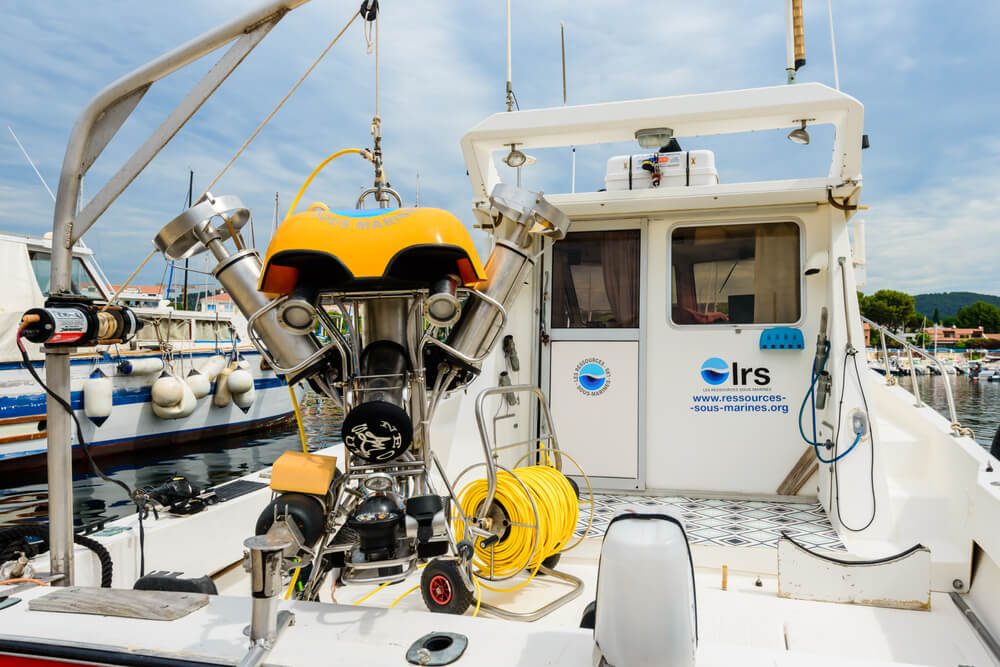 The subsea infrastructure opportunity extends far beyond underwater data centres. It includes cables, sensors, autonomous vehicles, AI, energy, marine robotics, environmental intelligence, and increasingly, security
It also creates very serious questions. Who owns the data? Who controls the infrastructure? How do we protect cables from physical and cyber threats? How do autonomous systems operate safely in international waters? How do we balance environmental monitoring with military and commercial interests?
Those questions will become more important as the technology matures.
The subsea infrastructure opportunity therefore extends far beyond underwater data centres.
It includes cables, sensors, autonomous vehicles, AI, energy, marine robotics, environmental intelligence, and increasingly, security.
Europe has already recognised the strategic importance of the underlying infrastructure. In June, the European Commission announced funding for regional cable hubs in the Baltic and Mediterranean and launched a €40 million call to strengthen submarine cable repair capacity.
We are moving from simply laying cables across oceans to building intelligent infrastructure around them. The next five years will bring more experimentation with underwater computing, more subsea sensing, more AI-powered marine monitoring, and greater investment in cable resilience.
Expect plenty of projects to fail. That's healthy! Technology markets need experimentation, and the key point is that the ocean now forms part of the infrastructure conversation.
The bigger opportunity could turn the ocean from one of the least connected environments on Earth into one of the most intelligent.
And if we can connect AI, subsea networks, marine sensors and autonomous systems responsibly, we could finally give ourselves the tools to understand the largest environment on our planet.
