In its regional policy, Moscow pays too little attention to the development of territories with a low proportion of ethnic Russians.
This problem is particularly acute in the North Caucasus, especially in Dagestan, Chechnya, Ingushetia and Karachay-Cherkessia.
Meanwhile, local national elites have become increasingly mired in corruption and abuses of power.
The Kremlin, however, does not appear to regard this as a serious problem, calculating that regional leaders who depend on the federal centre and are vulnerable to corruption allegations will demonstrate greater loyalty to Vladimir Putin’s policies.
Chechen leader Ramzan Kadyrov, for his part, has decided to use mobilisation as an instrument of pressure and punishment against people from the republic, including as a means of maintaining control over public sentiment online.
Kadyrov stated that residents of Chechnya whose behaviour “gives legitimate cause for criticism” would be given an “opportunity to prove themselves” on the battlefield in Ukraine as punishment.
He did not, however, specify which particular actions or conduct he had in mind.
The statement followed a meeting with Russian State Duma deputy Adam Delimkhanov, who reported on the activities of the Chechen leader's representative offices in Russia's regions.
Kadyrov also instructed officials to step up outreach to young people and intensify the propaganda activities of the Grozny and Vainakh television channels, citing the threat of destabilisation through the internet and the spread of fake images generated using artificial intelligence.
Against the backdrop of Kadyrov's reportedly record-breaking result in the September elections – an alleged 99.85% of the vote – his remarks reflect a broader system of tight control over Chechen society, relying on coercion and the manipulation of public sentiment.
Pressure on religious communities
Meanwhile, in Dagestan, regional political elites are seeking to curb the political and economic influence of religious communities by putting pressure on the leadership of the local Muftiate.
Aina Gamzatova, an adviser to the Mufti of Dagestan, appealed to Vladimir Putin, complaining about increasing pressure on the Muftiate from regional authorities and individuals close to Senator Suleiman Kerimov.
According to Gamzatova, people linked to Kerimov are seeking to consolidate their political and economic leverage in the republic while simultaneously weakening the Muftiate's position.
A telling indication of Dagestan's socio-economic backwardness is the level of pension provision
She also highlighted the religious organisation's financial difficulties and expressed concern about possible pressure on businesses owned by the organisation.
A telling indication of Dagestan's socio-economic backwardness is the level of pension provision.
The republic ranks last among Russia's regions in terms of average pension payments, which stand at approximately 18,900 roubles (USD 230).
By comparison, the average pension in Chukotka reaches 42,200 roubles (USD 480), more than twice the Dagestani figure.
Poorest-performing regions
The North Caucasus republics consistently rank among Russia's poorest-performing regions in terms of socio-economic indicators, particularly wages and pensions.
This situation reflects the region's persistent structural underdevelopment and the federal authorities' inability to effectively narrow living standard disparities across the national republics.
The low level of pensions in Dagestan clearly illustrates the profound socio-economic inequality between Russia's regions and raises questions about the federal centre's responsibility for perpetuating it.
Despite the existence of a unified state pension system, the average pension in the republic is only 18,900 roubles, compared with the national average of 25,500 roubles.
The federal authorities have failed to make significant progress in overcoming the North Caucasus's socio-economic underdevelopment
This gap is largely attributable to low wages and widespread informal employment – problems that federal economic and social policies have failed to address over several decades.
The situation facing Dagestani pensioners raises broader questions about social justice and the effectiveness of federal policies aimed at reducing disparities in living standards between Russia's regions.
Over decades, the federal authorities have failed to make significant progress in overcoming the North Caucasus's socio-economic underdevelopment.
As a result, low incomes throughout people's working lives directly affect their financial circumstances in retirement.
Land-grabbing schemes
Another example of systemic problems in regional governance is the alleged land-grabbing schemes and increasing tax pressure in Ingushetia under the leadership of regional head Makhmud-Ali Kalimatov.
These developments have intensified concerns about corruption and heightened social tensions.
According to media reports, over the past month, individuals close to Kalimatov have appropriated substantial areas of land allegedly intended for participants in the war against Ukraine.
The most attractive plots are reportedly being retained by individuals close to the republic’s leadership, while those who actually took part in the fighting are offered land near rubbish dumps or in other locations unsuitable for use. A close relative of Kalimatov is said to be overseeing the sale of the plots.
At the same time, the head of Ingushetia has chosen to shift part of the financial burden onto the population and businesses of the impoverished republic rather than address shortcomings in governance and strengthen oversight of his own inner circle.
During a meeting with tax officials, Kalimatov demanded that more than 700 million roubles (approximately USD 8 million) be additionally collected from the population.
The amount covers property, land and vehicle taxes, outstanding personal income tax payments and other levies.
The administration headed by Makhmud-Ali Kalimatov is attempting to shift the consequences of budgetary problems onto the population
This demand appears particularly cynical in light of the criminal case involving the biological brother of the head of Ingushetia, Magomed-Bashir Kalimatov, the former head of the local branch of Russian Post.
He is implicated in a case concerning the activities of an organised criminal group accused of embezzling more than 2 billion roubles (approximately USD 24.2 million) from the pension system using fictitious records and forged passports. Elderly people were among those affected by the scheme.
Residents of Ingushetia find themselves caught between two forms of systemic injustice: limited socio-economic opportunities and additional financial pressure from the republican authorities.
Instead of ensuring transparent and effective management of the budget and state resources, the administration headed by Makhmud-Ali Kalimatov is attempting to shift the consequences of budgetary problems onto the population.
In one of Russia's poorest republics, this only deepens social inequality and creates further grounds for public discontent.
Ingushetia has become a telling example of how the combination of clan-based connections, opaque allocation of state resources and mounting financial pressure on the population can threaten social stability.
The absence of adequate oversight of regional elites creates conditions in which state institutions can be used to serve private interests, while the republic's fundamental socio-economic problems remain unresolved.
The rights and freedoms of national minorities
The recent anniversary of the deportation of the Karachay people, carried out on the orders of the Stalinist leadership during the Second World War, has once again brought to the fore the issue of Moscow's historical responsibility and the protection of national minorities' rights in contemporary Russia.
Commemorative events were held in Karachay-Cherkessia to mark the 83rd anniversary of the mass deportation of the Karachay people, organised by the Stalinist regime in 1943 under the pretext that part of the population had collaborated with the Nazi occupiers.
As a result of the repression, approximately 70,000 Karachays were forcibly deported to Kazakhstan and other parts of Central Asia.
More than 43,000 people died during the deportation and in exile as a result of hunger, cold and disease.
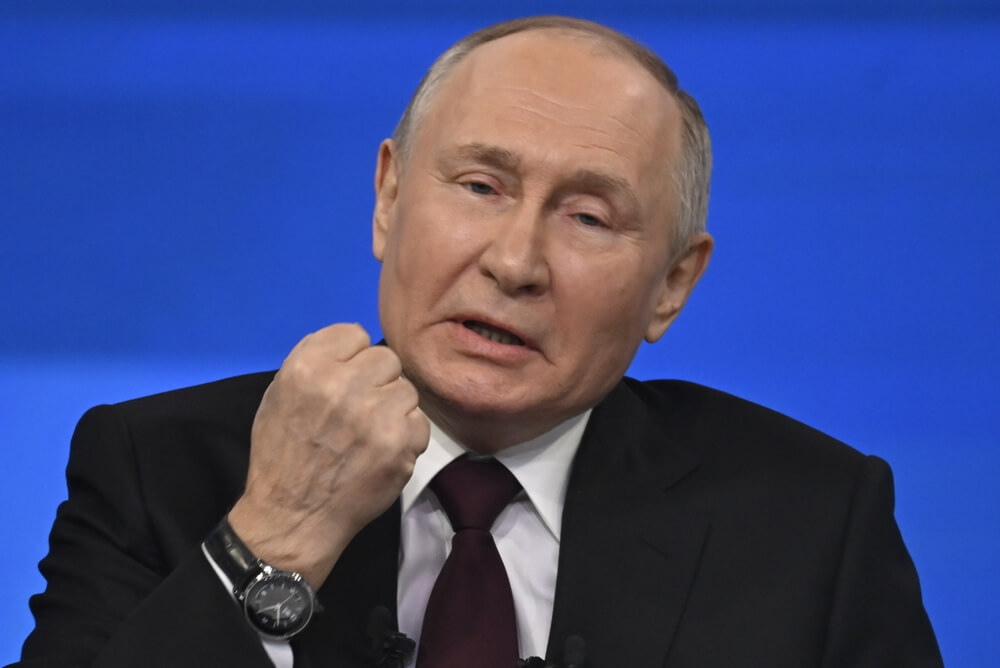 Vladimir Putin increasingly invokes Stalin as a symbol of a strong, centralised state
This year, a memorial gathering attended by hundreds of local residents, regional officials, clergy and representatives of public organisations took place near the memorial to the victims of deportation in Karachaevsk.
Representatives of the Karachay community emphasise that memories of Stalinist repression remain part of the history of virtually every family, while its demographic, cultural and social consequences continue to be felt decades after the deportees were allowed to return to their homeland in 1957.
Despite the official condemnation of Stalinist repression, serious problems persist in contemporary Russia under Vladimir Putin regarding the protection of the rights and freedoms of national minorities.
Pressure on civic activists, restrictions on political representation, and diminishing opportunities to preserve national languages reveal a striking contrast between the Kremlin's official declarations of respect for Russia's national minorities and Indigenous peoples and the actual policies pursued by the federal authorities.
In this context, Putin's attitude towards the Soviet historical legacy and the figure of Joseph Stalin is particularly revealing.
The Russian president increasingly invokes Stalin as a symbol of a strong, centralised state.
This politics of historical memory effectively contributes to normalising authoritarian practices and downplaying the crimes committed by the totalitarian regime.
At the same time, the situation in the national republics of the North Caucasus shows that the Kremlin's proclaimed respect for Russia's multinational character is not accompanied by adequate attention to the socio-economic development of these territories, the political representation of their populations or the protection of their rights.
Oleksandr Levchenko, a former Ukrainian diplomat, is a professor at the State University (Kyiv) and a member of the Academy of Geopolitics and Geostrategy (Kyiv).
