It isn’t easy being JD Vance.
Even on its best days, vice president of the United States is not a job to covet. It is a political waystation – an island between relative obscurity and the Oval Office, although plenty of V.P.s have never made it that far.
The position requires subversion of your political identity, even your worldview. Vance has found that out in ways he may have never expected when Donald Trump made him his Republican running mate two years ago.
Vance’s isolationist views and his reluctance for the U.S. to get involved in overseas conflicts were reasons Trump tapped him in the first place.
The Trump-Vance ticket ran on ending “forever wars” in the Middle East and bringing down consumer prices at home.
Today, the vice president has become perhaps the most vociferous defender of the United States’ actions in Iran, even as the peace deal he helped negotiate unraveled last week and the price of oil spiked anew.
Arguably no one in the Trump administration has his political fate tied to the war like Vance does – not even Trump, who will walk away from the presidency regardless.
It was Vance who last month was tasked to travel to Switzerland to personally sit in on the talks that led to a ceasefire.
He recorded a video for social media defending the agreement, further imprinting himself upon the outcome.
The deal he helped craft was roundly criticized at home for giving Iran too much. “If it works out, I’m going to take the credit,” Trump joked. “If it doesn’t work out, I’m blaming JD.”
Lindsey Graham, the hawkish Republican US senator whose death last weekend stunned Washington, was critical of the pact. “I think it’s going to fail,” he said at the time.
At this point, while Trump is largely concerned with history, Vance must worry about electability.
The face of an unpopular war
To that end, Vance has become the face of a deeply unpopular war. A Reuters/Ipsos poll taken near the end of June showed that just 1 in 4 Americans believed the war was worth the cost, and a majority didn’t expect the truce to hold. (They were right about that.)
That same poll showed Trump’s approval rating skidding to 34%, the worst of his second term. On the issue of cost of living, it was an abysmal 22%.
Republicans will attempt to defend their hold on both chambers of Congress in the midterm elections, the results of which will serve as another referendum on the administration’s popularity.
This week’s escalation of hostilities comes with those elections now just four months away.
Vance ostensibly will be on the road stumping for Republican candidates over that time, giving him an opportunity to explain himself further to voters.
The dust-up last week over the Strait of Hormuz may have validated Vance’s judgment
And even as the news for the administration has been largely negative, he has managed to position himself at times to keep himself politically viable.
As he has defended the United States’ conduct of the war, Vance has managed to insert some of his own skepticism into the proceedings, often suggesting that the Iranians could not be trusted to hold up their end of the agreement.
Trump, on the other hand, has toggled between praising the new Iranian leadership and condemning it. The dust-up last week over the Strait of Hormuz may have validated Vance’s judgment.
Meanwhile, Vance is doing other things more traditionally associated with a potential presidential contender.
He recently released a book, “Communion: Finding My Way Back to Faith” – a personal account of his conversion to Roman Catholicism – that is likely to endear him to the religious conservatives he would need to capture the Republican nomination in 2028.
Rubio’s benefit
His top rival for the nomination may be Marco Rubio, the former US senator, presidential candidate, and current secretary of state.
Despite his role as the nation’s top diplomat, Rubio has taken a back seat to Vance in terms of dealing with the Iranians – and given the toxicity of the war, that may be to Rubio’s benefit.
Rubio already has a deliverable to his credit: Venezuela. Toppling the Maduro regime was a priority for the Cuban-American resident of Miami.
The Washington Post reported last week that Rubio would convene an international summit concerning “the resurgence of transnational far-left terrorism”
And the relative success of that operation is likely to be remembered among Hispanic voters in South Florida, a key bloc in one of the nation’s most populous states.
Rubio also has signaled his support for going after left-wing activists such as antifa that the administration has branded as a danger to the country – a move that will sit well with Trump’s supporters.
The Washington Post reported last week that Rubio would convene an international summit concerning “the resurgence of transnational far-left terrorism.”
Uphill battle with the electorate
But should the war persist and inflation remain high, any candidate who emerges from the Trump administration may face an uphill battle with the electorate.
Americans tend to seek change over continuity, regardless of ideology. And vice presidents, in particular, have had difficulty stepping out from their president’s shadow.
That was true for Al Gore, who couldn’t evade the ethical turmoil that surrounded Bill Clinton.
The last vice president to be elected to the Oval Office directly after serving was George H.W. Bush in 1988
Joe Biden was often treated as an afterthought by the Obama White House, so much so that Obama looked to Hillary Clinton as his successor, not his #2.
And by the time Biden decided not to run for reelection in 2024, it arguably came too late for his vice president, Kamala Harris, to distance herself from the administration’s unpopularity.
In fact, the last vice president to be elected to the Oval Office directly after serving was George H.W. Bush in 1988. The previous occurrence was in 1836.
Keeping friction with Trump to a minimum
Both Vance and Rubio have been accused of shape-shifting their personas to adapt to the moment – with Vance setting aside his America First ethos to support the war and Rubio moving from the Republican mainstream to strike a more MAGA-friendly stance.
Questions about their authenticity would likely follow them into a general election.
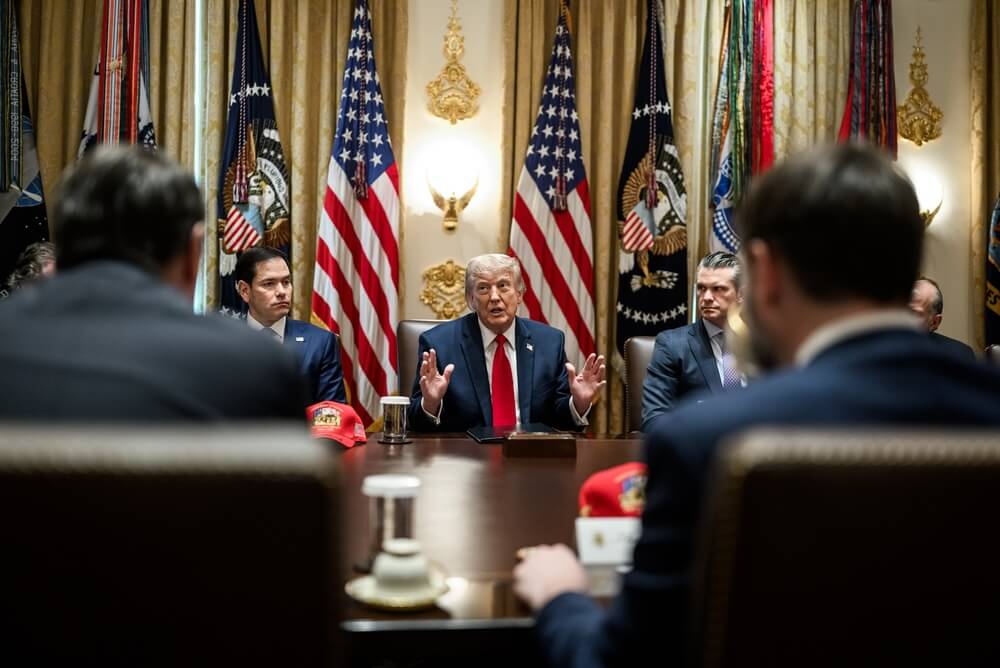 Both men will look to keep friction with Trump to a minimum; they know that falling out of favor with the president can have dire consequences
Vance’s advantage, besides having loyally served Trump, may lie with that MAGA base, assuming its isolationist faction forgives him for his Iran position.
Parts of that base still don’t entirely trust Rubio, recalling how critical he was of Trump when he ran against him for the presidential nomination in 2016.
But Rubio, a polished performer with a compelling life story, may ultimately appeal to a wider cross-section of voters than Vance – a conundrum the party will have to resolve.
Other Republicans, likely with fewer ties to the administration, are also sure to enter the race.
But right now, it’s Vance or Rubio’s nomination to lose. Trump – at least for now – isn’t expected to give his blessing to either, preferring they duke it out.
Both men will look to keep friction with Trump to a minimum; they know that falling out of favor with the president can have dire consequences.
Of course, the way to avoid such a divisive intra-party conflict would be for Rubio to agree to be Vance’s v.p. But after watching Vance these past two years, why would he want the job?
