Almost every major global health emergency has exposed the same flaw in the international financial system.
When disaster strikes, the institutions built to support affected countries must scramble to raise money for relief funds.
Twelve years ago, when the Ebola virus was ravaging Guinea, Liberia, and Sierra Leone, the world discovered that the International Monetary Fund—the global economy’s firefighter—had no instrument to provide debt relief during a public-health catastrophe.
The IMF did have a related mechanism for crisis response: the Post-Catastrophe Debt Relief Trust Fund, created in the wake of Haiti’s devastating 2010 earthquake to provide debt relief to countries struck by natural disasters.
But a fast-moving epidemic proved to be a different kind of emergency entirely, and the PCDR Trust had no mandate to respond.
The international community, however, adapted with unusual speed. In November 2014, then-US Treasury Secretary Jack Lew called on the IMF to cancel approximately $100 million in debt owed by the three Ebola-stricken countries, and then-Managing Director Christine Lagarde proposed an additional financing package to the G20 heads of state.
Within three months, the PCDR Trust was transformed. A new public-health window was added to its mandate, and existing resources were combined with leftover funds from the earlier Multilateral Debt Relief Initiative, resulting in the Catastrophe Containment and Relief Trust, a dedicated mechanism allowing the poorest countries to redirect fiscal resources from debt repayment to protecting lives.
DRC will need relief from existing obligations
The global fiscal strain of the COVID-19 pandemic, however, nearly exhausted the CCRT’s resources, leaving the trust running dry just as another Ebola crisis has erupted.
As of this week, over 2,000 deaths have been confirmed in the Democratic Republic of the Congo (DRC).
Beyond deaths, the United Nations Development Programme estimates that the outbreak could push almost one million people into poverty.
The DRC was among the countries that borrowed heavily from the IMF during the COVID-19 pandemic to support its economy
The DRC was among the countries that borrowed heavily from the IMF during the COVID-19 pandemic to support its economy. It now carries more than $3 billion in outstanding IMF debt.
While the country has not yet maxed out its borrowing capacity at the Fund, it will likely require additional financing as it confronts a combination of oil-price shocks, slowing growth, and now Ebola. It will need not just liquidity, but also relief from existing obligations.
The CCRT exists precisely for this purpose. Yet its available resources total only $120 million, whereas the DRC alone must pay the IMF almost $300 million in debt service in 2027.
The Fund’s primary instrument for disaster relief does not have sufficient funds to cover even one country facing a disaster, let alone the 30 others that could potentially apply for assistance.
Donor countries have previously shown a willingness to fund debt relief. During the COVID-19 pandemic, the IMF received $800 million in contributions, with the United Kingdom pledging $185 million and Japan $100 million within days of the pandemic being declared.
But successive rounds of donor pledges, however welcome, address symptoms, not causes.
Every time a major health crisis erupts, the IMF must again ask its shareholders to replenish an instrument specifically designed to respond to recurring shocks, causing political delays in delivering what should be an automatic, rapid stabilizer.
IMF Gold
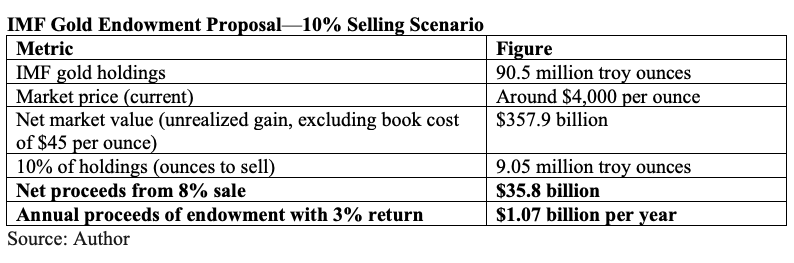
There is a better way. The IMF holds approximately 90.5 million troy ounces of gold, a legacy from the Bretton Woods era when member countries paid their quotas in bullion.
This gold sits on the books at a historical cost of $45 per ounce. At today’s market price of around $4,000 per ounce, it represents an unrealized profit of roughly $357.9 billion.
In its current state, the IMF’s gold generates no income. But if a small fraction were sold—incrementally, to avoid disrupting markets—the proceeds could seed a permanent endowment capable of funding the IMF’s subsidy accounts indefinitely.
The proposal is straightforward: sell a small portion of IMF gold, say 10%, and place the proceeds in a permanent endowment account.
At a modest 3% annual return, consistent with the yield assumptions underpinning other IMF instruments, a $35.8 billion endowment would generate over $1 billion per year in perpetuity.
That would be sufficient not only to fund the CCRT fully but also to subsidize the IMF’s entire concessional lending architecture—the Poverty Reduction and Growth Trust, the Resilience and Sustainability Trust, and any successor instruments—without ever again requiring the institution to solicit donor contributions.
Selling gold to support concessional lending is not a new idea. The IMF sold 12.94 million ounces in 1999 and 12.97 million ounces in 2009—almost three times this proposal.
In the past year, calls for another gold sale have come from many groups, including the V20, the G-24, the Jubilee Commission and 165 civil-society organizations.
The case is straightforward: a gold sale costs taxpayers nothing, creates no loss for the IMF and simply converts an idle, illiquid, non-interest-bearing asset into one that generates a permanent income stream for the world’s most vulnerable countries.
And with gold prices at near-record levels, there may never be a better time to make that conversion.
US leadership
Critics will argue that the IMF’s Articles of Agreement require an 85% supermajority for gold sales, making US congressional support essential—and thus uncertain.
But this is precisely an opportunity for the United States to show leadership. Ebola is no longer solely an emergency in African countries.
 The US government’s recent actions to respond to Ebola demonstrate policymakers’ recognition that the virus is a threat everywhere
The US government’s recent actions to respond to Ebola demonstrate policymakers’ recognition that the virus is a threat everywhere, and that a stronger DRC response would protect everyone.
To achieve that, the DRC should receive relief from upcoming IMF payments, giving it fiscal space to focus its efforts where they matter most: combating the epidemic and expanding the social safety net.
Moreover, an immediate donor-replenishment campaign should be initiated to replenish the CCRT. In parallel, serious negotiations on a gold endowment should begin to render the question of CCRT funding permanently moot.
The CCRT was born because US leadership decided that the machinery of international finance should not stand idle in the face of a humanitarian catastrophe. That was correct in 2014, and it should inspire action again in 2026.
Marina Zucker-Marques, a senior academic researcher with the Global Economic Governance Initiative at the Boston University Global Development Policy Center, is Commissioner for the Jubilee Report on Addressing the Debt and Development Crises.
