Astronomers were gripped waiting for confirmation that a SpaceX rocket slammed into the moon on 5 August, with the incident raising wider questions about how to deal with the 17,000 tonnes of orbital debris in outer space known colloquially as space junk.
The collision of part of a SpaceX Falcon 9 rocket that launched in January 2025 crashed into the moon at a speed of 5,400mph and a plume of sodium and lithium gas was visible for up to 10 minutes, said the European Southern Observatory. The rocket part was the height of a five-storey building and weighed four tonnes.
More than 25,000 objects larger than 10 cm are known to exist in space, and examples include derelict spacecraft, debris released during spacecraft separation from the launch vehicle, and solid rocket motor effluent, according to the US Space Surveillance Network.
Many scientists have urged the imposition of regulation to force action by the mostly private companies that have launched thousands of satellites into the skies in recent years. But this is a big ask from a world where the big powers cannot even grapple with global warming and other challenges facing humanity.
Orbital debris mitigation
Might it take mass casualties caused by a large piece of orbital debris surviving the extreme heat of re-entry and crashing back on to earth before companies and governments are forced to clean up and prevent the further littering of outer space?
There is a total of around 16,000 satellites in orbit. The debris from around 10,000 SpaceX satellites alone could kill or injure someone every two years by 2035 and such debris would also be capable of fatally damaging and downing an aircraft, said a 2023 study for the US Federal Aviation Administration, which handles licensing for private space companies.
But the FAA has paused proposals that would have forced space companies to remove spacecraft from where they pose a danger to Earth, so they are in line with rules already followed by the US government.
The FAA had previously put forward a number of options for what is called orbital debris mitigation, including a controlled re-entry of a rocket’s upper stage; moving it to a less congested orbit known as a graveyard orbit; sending it further into space on an Earth-escape trajectory; retrieving the upper stage within five years of launch; or performing an uncontrolled atmospheric disposal where it burns up upon re-entry.
The FAA said pilots should be prepared to “exercise extreme caution” when flying below the trajectory of commercial spacecraft
Not coincidentally, SpaceX owner Elon Musk overhauled some of the FAA’s procedures and work when he headed the Department of Government Efficiency last year. Blue Origin, owned by Jeff Bezos, has also criticised the FAA’s proposals and their cost.
In January, the FAA for the first time did issue an official warning to the aviation sector, saying pilots should be prepared to “exercise extreme caution” when flying below the trajectory of commercial spacecraft, some of which have the potential for “catastrophic failures resulting in debris fields.”
It also said aircraft operators and owners should train flight crews “on the impact of space launch and re-entry operations” and that “pilots should exercise extreme caution” around debris response areas (DRAs) designated in the aftermath of a space launch incident.
But many officials want the FAA to go further and force space companies to assume greater responsibility for their space junk.
“Ensuring a safe [National Airspace System] NAS while promoting commercial space operations by the private sector is a direct conflict of interest with the FAA’s delegated responsibilities to ensure a safe and efficient NAS,” wrote Steve Jangelis, aviation safety chair for the US Air Line Pilots Association, in a letter to the FAA Office of Commercial Space Transportation.
Space launches rising each year
Meanwhile, the number of space launches is rising each year. The UN Office for Outer Space Affairs said that 3,708 objects were launched into space from the US last year, compared with 984 in 2020.
There have been several near misses around the world in recent years. The failure of a SpaceX Starship launch in March 2025 resulted in falling debris and prompted temporary ground stops at major Florida airports.
SpaceX used to claim that all its returning satellites burned in the air
A Chinese three-tonne satellite came down last year over Tenerife, sending shock waves across the region before burning in the air.
Last January, UK mobile phone networks were asked by the government to check their emergency alert systems over worries that parts of a Chinese Zhuque-3 rocket would hit the country. In the end, debris came down either in the Indian or the Pacific Ocean.
SpaceX used to claim that all its returning satellites burned in the air before the company admitted that around 5% of the mass of some satellites might not disintegrate. Some experts say companies should use materials that decompose fully.
The risk of Kessler Syndrome
Many scientists are concerned about the risk of Kessler Syndrome, in which space junk reaches a critical mass in low earth orbit and causes so many collisions that this orbit band becomes unusable for up to thousands of years, making further spaceflight too hazardous.
There is no international regulation for commercial space activities. The UN Outer Space Treaty of 1967 forms the basis of international space law and bans weapons of mass destruction and claims of sovereignty by countries.
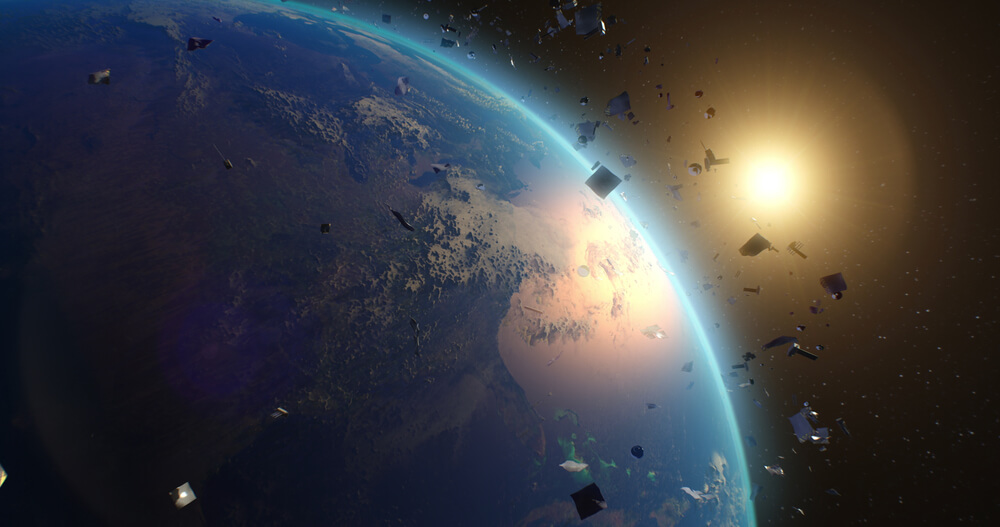 Many scientists are concerned about the risk of Kessler Syndrome, in which space junk reaches a critical mass in low earth orbit
Several jurisdictions, including the EU, UK, India, Japan and Canada, are discussing national debris mitigation goals under the UN Committee on the Peaceful Uses of Outer Space, which in 2010 began issuing guidelines on sustainability.
But Washington has attacked such talk of regulation, including an EU Space Law currently undergoing consultations, as placing “unacceptable regulatory burdens” on US space companies.
The proposed law would require companies to face fines and exclusion from EU markets if they did not tackle space debris and pollution.
It is hard to imagine the US agreeing to national regulation, let alone global co-operation with its Chinese and other competitors.
“I am a person that believes that we need some regulation, but we need to make sure that we revisit them very regularly,” Diane Howard, former director of commercial space policy for the National Space Council under President Joe Biden, told Reporting Texas. “That said, we are not in an environment anymore in the US that likes any regulation at all.”
