The meeting between the defence ministers of South Korea and Japan in Seoul showed how quickly the balance of power in Northeast Asia is changing.
Two countries that have struggled for decades to maintain political trust are now entering a situation in which they can no longer allow historical disputes to completely block military cooperation.
North Korea is accelerating its missile and nuclear programmes, its relationship with Russia is becoming more concrete, China is increasing pressure in the seas around Japan and Taiwan, and the United States is asking its Asian allies to assume greater responsibility for their own security.
In such an environment, Seoul and Tokyo must establish permanent military communication before a crisis, because any delay would mean that, at the most dangerous moment, they are still trying to build trust they do not yet have.
South Korean Defence Minister Ahn Gyu-back and Japanese Defence Minister Shinjiro Koizumi, meeting in Seoul, reaffirmed the goal of denuclearising the Korean Peninsula and agreed to continue defence cooperation, including resuming joint search-and-rescue exercises.
The agreement on search-and-rescue exercises seems limited, but it was carefully chosen for political reasons. Seoul and Tokyo are starting from an area of cooperation that can be justified without grand rhetoric and without reopening the most sensitive historical issues.
This approach does not eliminate mistrust, but it restores contact between the two militaries where the public can most readily understand the practical benefits: saving lives, communicating at sea, and avoiding misjudgements in a crisis.
This pace is probably the only sustainable one. Japan’s colonial rule over Korea from 1910 to 1945 continues to shape South Korea’s political relationship with Japan.
Disputes over forced labour, the sexual exploitation of women during the war within the Japanese military system, and the territorial dispute over Dokdo Island, known in Japan as Takeshima, regularly return bilateral relations to a state of mistrust.
Any government in Seoul must reckon with this legacy. There is a clear understanding in Tokyo that cooperation with South Korea must be fostered without pressure that would immediately provoke resistance in Seoul.
That is why Japan is seeking a broader security role in the region, while taking care that this does not appear to be a return to the old military posture that the South Korean public would not accept.
Pyongyang is changing the rhythm of the region
In recent years, Pyongyang has abandoned its old tactics of limited provocations that were intended to open up space for negotiations. North Korea is now developing missile, nuclear, artillery and drone capabilities with a much closer alignment with Moscow.
The war in Ukraine has given Kim Jong Un the opportunity to supply Russia with ammunition and other military support and, in return, receive political protection, money, energy, food, and possible access to expertise that could accelerate the development of North Korean weapons systems.
The consequences of such a relationship are felt in both Seoul and Tokyo. South Korea faces a stronger North Korean army on its own border, while Japan must reckon with missiles that can more easily reach Japan’s territory and the US bases within it.
South Korea therefore sees an immediate danger in North Korea's artillery, tactical missiles, drones and nuclear programme. The capital, military infrastructure and US forces on the peninsula are all within range of North Korean systems.
China's military presence is further narrowing the traditional gap between Seoul and Tokyo
Japan is witnessing the same development across the sea. North Korea has repeatedly tested missiles that pass over Japanese territory or fall into areas of immediate importance to Japanese security. Any increase in the range, accuracy and resilience of those systems alters Japan's risk assessment.
China's military presence in the East China Sea, around Taiwan and across the wider Indo-Pacific is further narrowing the traditional gap between Seoul and Tokyo.
The two countries may continue to dispute history and territory, but their armies would not operate in separate spaces in a real crisis. US bases in Japan, sea routes, airspace, civilian evacuation and the response to North Korean missiles would quickly draw Seoul and Tokyo into the same operational picture.
That is why renewing search-and-rescue exercises has concrete value. They verify who is calling whom, through which channel information is sent, how the movement of ships and planes is coordinated, who takes over managing the operation, and what is done when decisions must be made quickly.
It is not evidence of political trust, but the minimal level of military functionality between two states that would need to work side by side in a crisis.
In a region where a single misjudgement can quickly draw in US bases, North Korean missiles and Chinese interests, even limited military cooperation carries serious weight.
Logistics as the most sensitive boundary
The most sensitive issue remains military logistics. Ahn Gyu-back and Shinjiro Koizumi also discussed a possible agreement that would allow the exchange or supply of fuel, food, ammunition, and other equipment.
For military planners, it is a practical instrument. For the South Korean public, it is a much more difficult topic, as any discussion of Japan's military role in relation to the Korean Peninsula immediately revives historical memories and political resistance.
That is why Ahn carefully said that such a step would require understanding and persuasion of the citizens of both countries. That formulation shows the realistic limits of the current rapprochement.
Japan is seeking a greater security role in the region but must be careful how that role is perceived in South Korea
Seoul can accept improved communication with Japan, search-and-rescue exercises, the exchange of assessments on North Korea, and cooperation in relations with the United States. It is much more difficult for it to accept an arrangement that could be seen domestically as opening up space for Japanese forces in the Korean security environment.
The logistics agreement will therefore most likely be developed gradually within a narrow framework, initially through joint exercises, assistance in emergency situations, maritime security and limited crisis coordination.
Japan is seeking a greater security role in the region but must be careful how that role is perceived in South Korea. Cooperation is beneficial to Seoul, provided it does not appear to relinquish its historical wariness of the Japanese military. Washington needs a stronger bond between its two key allies in Northeast Asia.
Real progress will therefore be seen in the details: how often armies meet, what information is shared, how incidents at sea are resolved, and whether logistics cooperation remains tied to exercises and support scenarios or gradually moves closer to planning for a serious crisis. In these questions, the true scope of the relationship between South Korea and Japan is measured.
Seoul and Tokyo can no longer rely solely on Washington
The United States has long tried to stabilise cooperation with South Korea and Japan within a trilateral framework. The reason is simple: American deterrence in Asia is weaker if Washington's two main allies in the region cooperate only under US pressure or only once a crisis has already begun.
The agreements reached at Camp David opened up political space for more frequent coordination, but the political framework alone does not create military reliability.
This requires procedures, exercises, channels of communication and sufficient public explanation so that cooperation with the former occupier today makes sense in security terms.
The value of the meeting in Seoul lies precisely in the fact that cooperation between South Korea and Japan no longer appears to be merely an American project.
The two countries are beginning to talk more directly about what they can do bilaterally and within their broader cooperation with Washington.
The shift is not dramatic, but it is important. Coordination that depends entirely on America remains vulnerable to changes in the political mood in Washington. A more direct channel between Seoul and Tokyo reduces that risk.
American policy further increases the pressure. Washington is asking allies for higher spending, greater capabilities and a stronger willingness to shoulder some of the burden.
For Seoul, cooperation with Japan is politically uncomfortable but increasingly useful
South Korea is accelerating the development of drones and anti-drone systems and plans to train large numbers of military personnel to operate unmanned systems.
Japan is increasing its defence capabilities and adapting its policy to a more dangerous environment. In these circumstances, the relationship between Seoul and Tokyo becomes part of the basic functioning of the US deterrence system in Asia.
In this context, Japan can no longer remain on the sidelines. Any serious crisis on the Korean Peninsula would quickly involve US bases in Japan, sea routes, civilian evacuations, missile defences and Tokyo's decision on the level of support for the US response.
Because of this, Japanese security is becoming increasingly directly linked to developments on the Korean Peninsula, even when Seoul avoids publicly emphasising that connection for political reasons.
For Japan, therefore, cooperation with South Korea is a matter of crisis management rather than regional prestige. For Seoul, cooperation with Japan is politically uncomfortable but increasingly useful.
Information-sharing, naval coordination, evacuation, protection of supply lines and coordination with US forces cannot be improvised at the last minute.
Caution as the only viable path
The most realistic development of South Korea–Japan relations will not come from a grand political agreement that settles historical disputes. There is neither sufficient political foundation nor political will for such an outcome.
A slower model, in which security contacts expand below the level of major public commitments, is far more likely.
Search and rescue exercises, shared assessments, cooperation on drones, anti-missile defence, maritime security and logistics will develop more quickly than the political language that governments use to describe them.
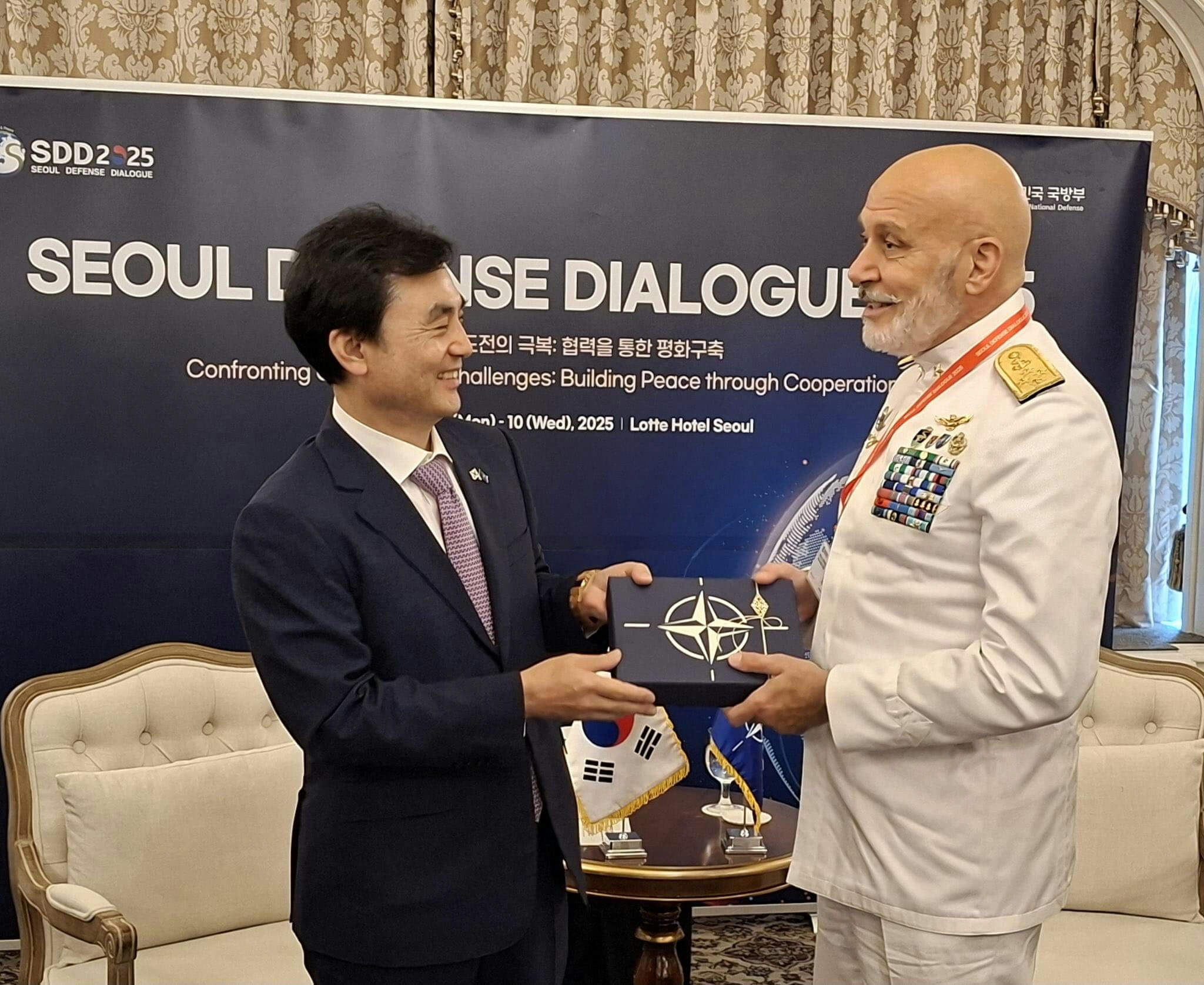 The region is entering a period in which the cost of non-cooperation exceeds the political cost of cautious cooperation - Ahn Gyu-back (left) with Adm. Giuseppe Cavo Dragone
This is an important distinction. Seoul and Tokyo will not become natural political partners any time soon. They can, however, become sufficiently attuned to avoid paralysis and misjudgement in a crisis.
In Northeast Asia, this would be a significant shift. The region is entering a period in which the cost of non-cooperation exceeds the political cost of cautious cooperation.
The future relationship between Seoul and Tokyo will therefore depend on both governments’ ability to develop military cooperation without a political concept of reconciliation.
Politically, it is more comfortable to keep cooperation at a technical level, using the language of exercises, procedures and crisis communication.
Yet that language already obscures a more serious change: both countries are becoming used to the idea that they will have to respond side by side in the next major crisis in Northeast Asia, even if they never grant each other full political trust.
This is the most important change. History will continue to constrain the language Seoul and Tokyo use to describe their cooperation, but military realities will push both governments towards more frequent engagement.
Every new North Korean missile test, every confirmation of deeper cooperation between Pyongyang and Moscow, and every intensification of Chinese pressure will narrow the scope for political hesitation.
South Korea and Japan may not seem natural partners for much longer. But in a crisis that engulfs the Korean Peninsula, Japanese bases, sea routes and the American presence in the region, they would act like states that no longer have the luxury of keeping one another at arm’s length.
