Iranian mining operations, drone strikes and missile attacks on shipping have reduced traffic through the Strait of Hormuz to extremely low levels, with only a handful of vessels attempting the transit each day.
Insurers have imposed sharply higher war-risk premiums and most shipowners have suspended voyages into the area altogether.
Iranian officials have made clear that navigation will remain unsafe as long as the conflict continues.
Under normal conditions the strait carries roughly 20–21 million barrels per day of crude oil, condensates and refined products, together with a large share of global liquefied natural-gas shipments, including all exports from Qatar, one of the world’s largest LNG exporters.
With that flow largely interrupted, the stability of global supply now depends on producers able to export without relying on Hormuz.
Saudi Aramco, the world’s largest oil company and operator of the largest crude-production system, runs the only network of sufficient scale to do so.
Operational constraints
Market prices have reacted, but not to the extent that a prolonged closure would imply.
Brent crude has moved above $100 per barrel, yet current pricing still reflects the assumption that shipping will eventually resume.
The immediate constraint is logistical rather than economic. When exports stop, crude accumulates in storage until wells must be shut in.
That process has already begun across several producers. Iraq reduced output as southern terminals became congested, followed by Kuwait as storage approached operating limits.
The reductions are not policy decisions but operational constraints caused by the inability to move hydrocarbons out of the region
Qatar has declared force majeure on part of its LNG shipments as loading schedules broke down. Iran has also massively curtailed production as export routes narrowed.
In the United Arab Emirates the pipeline to Fujairah can carry only about 1.5–1.8 million barrels per day, far below total output, meaning that roughly 40% of Abu Dhabi production will have to be shut in if the disruption continues.
These reductions are not policy decisions but operational constraints caused by the inability to move hydrocarbons out of the region.
Continuity of supply
Saudi Arabia is less exposed to the same bottleneck. Current production is around 10–10.1 million barrels per day, with exports currently averaging between 7.5 and 8.5 million barrels per day, including crude oil, refined products and condensates, depending on domestic refinery use and market conditions.
Maximum sustainable capacity is close to 12 million barrels per day, leaving at least 2 million barrels per day of spare capacity.
Saudi Arabia is also the largest crude exporter, so any change in its flows has an immediate effect on global supply.
The key difference in the present situation is that the kingdom built infrastructure designed to operate even if the Strait of Hormuz becomes unusable.
The core of that system is the East–West pipeline linking Abqaiq on the Gulf side to Yanbu on the Red Sea, a distance of roughly 1,200 kilometres
The core of that system is the East–West pipeline linking Abqaiq on the Gulf side to Yanbu on the Red Sea, a distance of roughly 1,200 kilometres.
The line normally carries about 5 million barrels per day and can be increased to around 7 million barrels per day in emergency operation, which is the case today.
Since the disruption began, throughput has been raised gradually, with exports sequenced according to tanker availability and contractual commitments.
The objective is not to maximise volumes immediately, but to maintain continuity of supply while storage levels, tanker positioning and terminal capacity are brought into balance.
Export capacity on the Red Sea is spread across several locations. Yanbu is the main crude outlet, with loading capability of roughly 4.5 to 5 million barrels per day after the expansion completed in 2018. Rabigh provides about 400,000 barrels per day of refining and export capacity, while Jeddah can handle roughly 100,000 to 200,000 barrels per day of petroleum products, allowing flows to be redistributed when Yanbu approaches its limits.
This western corridor gives Saudi Arabia a degree of flexibility that no other exporter in the region possesses.
Storage as a decisive factor
Storage has also been a decisive factor. Saudi Aramco is widely believed to control the largest commercial oil storage capacity in the world, with accessible inventories estimated at more than 200 million barrels, including domestic tank farms at Ras Tanura, Ju’aymah, Abqaiq and Yanbu as well as storage held overseas in Japan, South Korea, Europe and the United States.
By comparison, storage controlled by other large oil companies is significantly smaller, generally estimated at roughly 100–120 million barrels for Shell, about 80–90 million barrels for the Vitol terminal network, and around 60–80 million barrels for Trafigura and similar trading groups.
This scale has allowed Saudi Aramco to continue supplying customers even as exports through the Strait of Hormuz were disrupted, while storage across the region filled and other producers were forced to shut in wells.
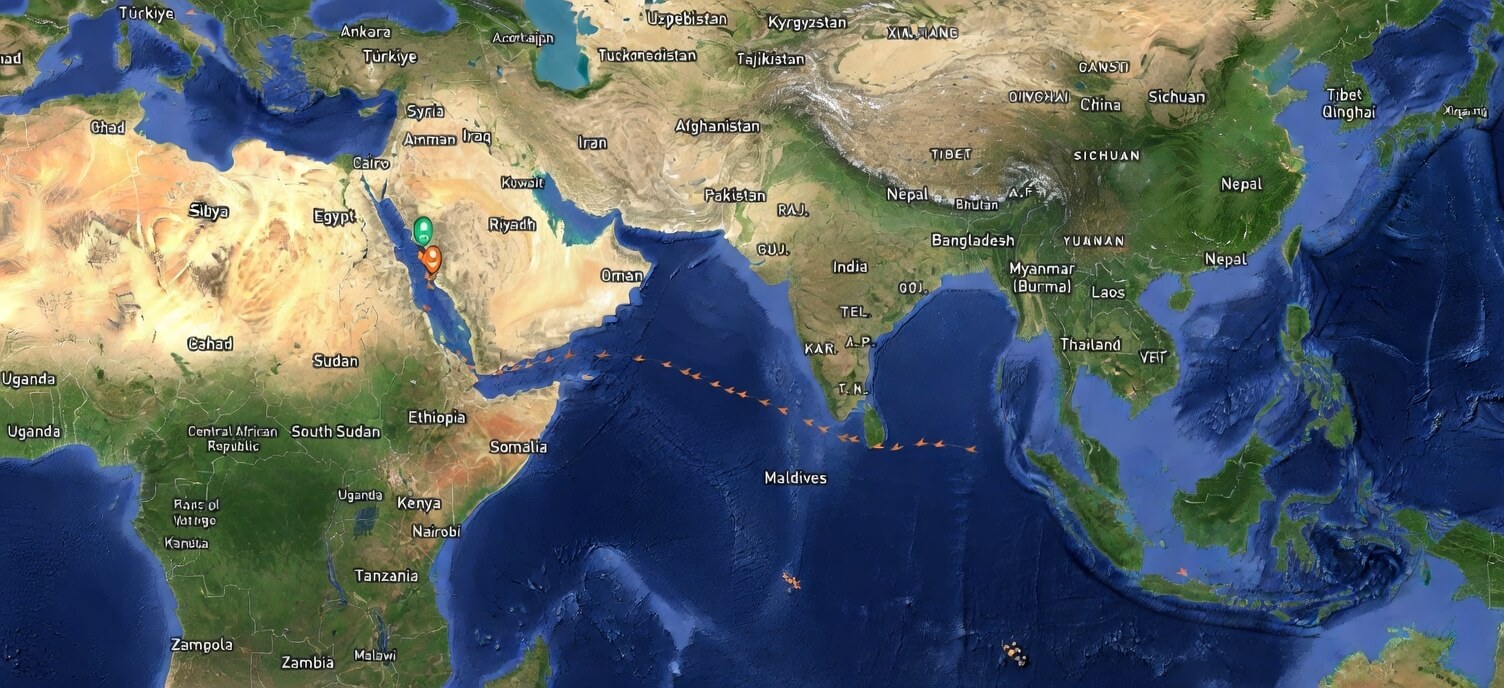 Tankers that would normally enter Hormuz are now being routed across the Arabian Sea, through Bab el-Mandeb and into the Red Sea to load at Saudi terminals
Global shipping patterns have changed accordingly. Tankers that would normally enter Hormuz are now being routed across the Arabian Sea, through Bab el-Mandeb and into the Red Sea to load at Saudi terminals.
This reorganisation has taken place within days, reflecting the need to match pipeline flows, storage levels and tanker schedules in real time.
The disruption also affects industries far beyond crude supply. Most global sulfur production comes from oil and gas refining, and sulfur is used to produce sulfuric acid, the most widely used industrial chemical in the world.
Sulfuric acid is essential for fertilizer production, metal processing and semiconductor manufacturing.
Copper, nickel and cobalt extraction depend on it, and high-purity sulfuric acid is used in wafer cleaning and etching in chip fabrication.
Because much of the refining and gas processing linked to these materials depends on exports through Hormuz, the interruption affects several supply chains simultaneously, including energy, agriculture, metals and electronics.
Saudi Arabia is absorbing shocks
Saudi Arabia has historically sought to limit extreme price movements, not because high prices are undesirable in themselves, but because stability over time is more valuable than short-term gains.
In the current situation the same logic is visible in operational decisions. Instead of increasing output abruptly, flows are being adjusted through storage, spare capacity and alternative export routes in order to keep the market functioning.
 Saudi Aramco is acting less like a normal oil company than like the central banker of the global energy market
Even with the East–West system operating close to its limits, the Red Sea corridor cannot fully replace the volumes that normally pass through the Strait of Hormuz.
Saudi Arabia cannot export its entire potential without access to the Gulf, and that constraint will continue to put upward pressure on prices.
What Saudi Aramco is doing is not a permanent solution, but a stabilising one. By using storage, spare capacity and alternative routes, it is slowing the shock to the global economy and preventing an immediate collapse of supply.
Without this system, the shutdown of Hormuz would already have produced a far more violent surge in prices and a far deeper disruption of trade.
In that sense, Saudi Aramco is acting less like a normal oil company than like the central banker of the global energy market — managing flows, absorbing shocks and keeping the system functioning under conditions for which it was never designed.
Dr Nawaf Obaid is a Senior Research Fellow at the Department of War Studies, King’s College London.
