Vladimir Putin is travelling to New Delhi for talks with Prime Minister Narendra Modi, encouraged by the current state of relations among the world's major powers, which largely favour Moscow.
The annual India-Russia summit therefore comes at an opportune moment for Putin, who now has more favourable options in the context of the ongoing war in Ukraine, particularly for keeping the isolated Russian economy afloat.
His meeting with Prime Minister Modi on Friday will provide an opportunity to urge New Delhi to remain neutral regarding Ukraine while being anything but neutral in its trade with Russia.
Putin has good prospects for this, not due to his own diplomacy, but rather because of a series of steps recently taken by the West – especially the United States – that have worked in his favour.
In the talks in New Delhi, Putin will aim to achieve several immediate goals. Chief among them is to keep his strategic partner, India, on its current path of massive imports of Russian crude oil.
Oil arrangements
Since Russian oil exports came under Western sanctions, India's imports have soared, rising from just 1% of total crude imports at the start of Russia's aggression against Ukraine to around 40% now.
Although the India-Russia summit was scheduled before Trump's latest "punishment" of India with a drastic increase in export tariffs, Putin's talks in New Delhi will come at an opportune moment for Russia.
India's imports of Russian oil rose in November to their highest level in the past five months.
This resulted from India's refiners' efforts to increase stocks of cheap Russian oil before US sanctions against two major Russian producers and exporters to India—Rosneft and Lukoil—took effect on 21 November.
Trump's punitive tariffs on India, in the form of an additional 25% on top of the existing 25% tariffs on all India's exports to the US, were intended to discourage Russia's largest oil buyer from funding its war budget.
Decline in India's imports of Russian oil is expected to be only temporary, not long-term or permanent
However, any decline in India's imports of Russian oil is expected to be only temporary, not long-term or permanent.
"Russian oil exports to India will drop in the short term but will pick up through new intermediatory companies that can circumvent the sanctions," said Sumit Ritolia, lead research analyst at energy intelligence firm Kpler.
These expectations are based on the sanction circumvention mechanisms with which many buyers of Russian oil, including India, already have considerable experience.
For procurement, India's importers will use intermediaries from entities not under US sanctions, as well as non-transparent trading channels, including the transport by Russian shadow-fleet tankers.
Despite the risk of secondary sanctions from Washington, New Delhi will find it difficult to give up Russian oil, which it has been purchasing at a steep discount since the imposition of Western sanctions.
Given this adjustment to the new US sanctions, which is already well under way, Putin will only need to further assure India's leader in New Delhi that Russia will remain a reliable supplier at extremely low prices.
Negotiations on Ukraine
The current peace negotiations on Ukraine provide Putin with strong diplomatic momentum ahead of his meeting with Modi, as he has influenced a highly favourable, even pro-Russian, direction for the negotiations dictated by Washington.
Putin can assist India's Prime Minister in "balancing" his stance towards Ukraine and motivate him to withstand Western pressure until the end of the peace process
At this point, Putin can assist India's Prime Minister in "balancing" his stance towards Ukraine and motivate him to withstand Western pressure until the end of the peace process.
New Delhi did not respond well to a recent article by Western European diplomats in India's press, which accuses Russia of aggression against Ukraine, Putin of "total disregard for human life", and urges India to "do more".
Intended to undermine Putin's visit, this article was described as "unacceptable and unusual" by India's Ministry of External Affairs, and "vicious" by former Foreign Secretary Kanwai Sibal.
"It is not an acceptable diplomatic practice to give public advice on third country relations. We have taken note of it," said a senior official of India's diplomatic service.
A warning to Western governments
Vladimir Putin, therefore, will not need to do much to persuade Prime Minister Modi to resist Western pressure regarding Ukraine, as Modi himself views the partnership with the US with increasing reservations.
His recent close relationship with Trump is deteriorating under the strain of drastic export tariffs, restrictions on the departure of students and highly qualified Indians to work in the US, and other barriers.
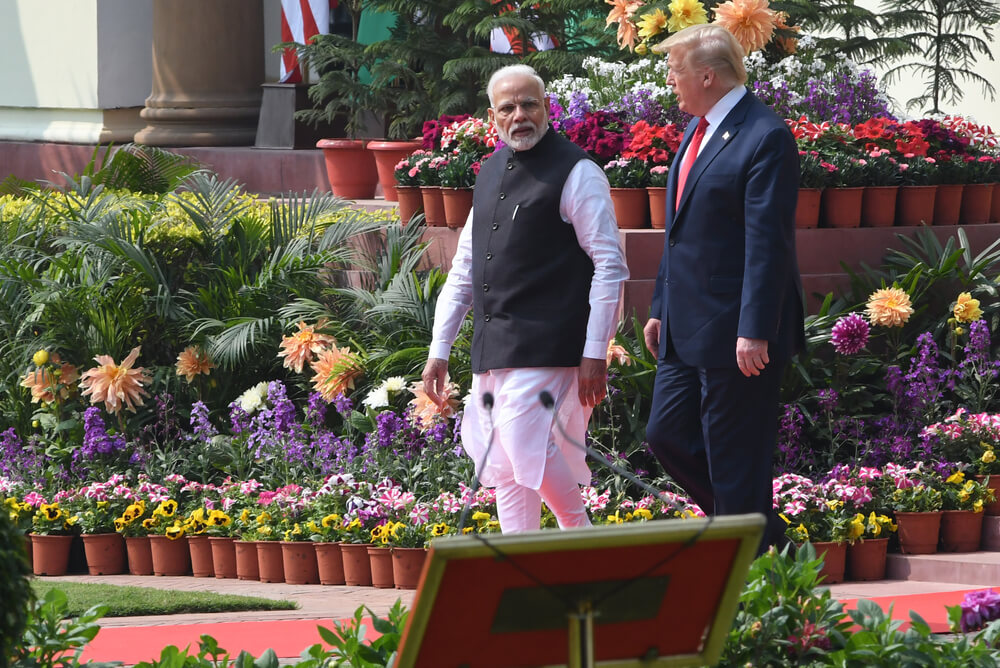 Modi's recent close relationship with Trump is deteriorating under the strain of drastic export tariffs
"India wants to maintain its relations with Russia, especially at a time when it sees the United States as unreliable and China as hostile," said Ian Bremmer, president of the political risk consultancy firm Eurasia Group.
Given the restrictions on India's exports to the US, Putin will be able to offer Modi not only verbal encouragement but also tangible economic concessions, which could help offset the losses of India's exporters. This applies primarily to the pharmaceutical industry, as well as food and machinery manufacturers.
New Delhi will welcome such offers, despite strained payments between companies from the two countries, as it seeks ways to reduce India's large foreign trade deficit with Russia.
The forthcoming talks between Modi and Putin will serve as a strong warning to Western governments that their ambitions for a strategic alliance with New Delhi and its pragmatic government are unlikely to be achieved through a series of economic and diplomatic pressures.
Putin could be a major beneficiary of the current constellation of relations between the US and Europeans on one side and India on the other, and he will seek to demonstrate this during his forthcoming visit to New Delhi.
