The interception of the Russian tanker Marinera off the coast of Iceland in January was reported in the international media as another episode in the conflict between sanctions and their circumvention.
In reality, the event marks a much deeper change. For the first time since the end of the Second World War, a major power openly intervened against a commercial energy vessel in the open Atlantic, while another power responded with the military escort of a civilian tanker across thousands of miles of ocean.
That precedent has wider significance. Energy transport – a pillar of global trade – ceases to be civilian logistics and becomes part of the military-strategic system of states. The line between merchant ships and military platforms is beginning to disappear.
This calls into question the maritime order established after 1945. For nearly eight decades, international trade by sea operated within what strategic literature calls the Pax Americana.
American maritime supremacy kept major trade routes open and prevented their closure, even when the states trading along them were politically or strategically opposed to the United States.
That system made globalisation possible: oil from the Middle East, goods from Asia, and industrial products from Europe could travel by sea almost independently of geopolitical conflicts.
That assumption no longer holds.
Russia and the militarisation of energy exports
Russia was the first country to systematically switch to military protection for commercial energy transport.
Western sanctions imposed after the Russian invasion of Ukraine created a vast "shadow fleet" – a network of tankers operating outside the Western system of insurance, financing and supervision.
Estimates from international maritime analytical centres indicate more than a thousand vessels are involved in that system, of which hundreds are formally sanctioned or under investigation.
For Moscow, this has become a matter of strategic survival. The export of oil and oil derivatives finances the state budget and the military apparatus.
Since 2025, Russian war frigates and submarines have occasionally escorted tankers through the Baltic Sea, the North Atlantic and the English Channel
When Western countries began to intercept tankers more aggressively or sanction ship owners, Russia responded with a new doctrine: military escort of energy convoys.
Since 2025, Russian war frigates and submarines have occasionally escorted tankers through the Baltic Sea, the North Atlantic and the English Channel. Incidents of electronic warfare – jamming of GPS signals and manipulation of AIS transponders – have been recorded in narrow waterways.
Such operations create navigational chaos for all other ships in the region, but through them Moscow sends a clear message: an attack on a tanker will be treated as an attack on the Russian state.
This tactic changes the nature of maritime space. Convoys once reserved for total wars are reappearing in everyday energy trading.
China's navy and the security of energy routes
Unlike Russia's response to sanctions, China's strategy has a much longer history.
Chinese strategists have discussed the so-called "Malacca Dilemma" for decades. More than three-quarters of China's oil imports pass through the Strait of Malacca, one of the world's most sensitive maritime bottlenecks. In the event of conflict with the United States or its allies, that passage could be blocked.
China has responded to this vulnerability with a long-term shift in military strategy. In the early 2000s, Chinese leadership began to emphasise the need to protect maritime supply routes, as most energy imports and key raw materials arrive by sea.
Beijing recognised the need for a country dependent on these routes to have a navy capable of operating far from its own coast.
China is no longer just a commercial user of global sea routes but a country that is increasingly openly building the capability to protect them independently
Over the last two decades, the Chinese navy has grown rapidly as a result. Today, it has the largest number of warships in the world, and its operations are no longer limited to the western Pacific.
Chinese warships regularly patrol the Indian Ocean, a base in Djibouti provides a permanent logistical foothold, and Chinese companies operate or have access to a range of ports from East Africa to the Persian Gulf.
This enables Beijing to gradually link trade and military presence. State-owned transportation and energy companies operate in an environment where China's navy increasingly provides surveillance and protection of key maritime routes.
The result is not a formal change in the international legal order but a new reality at sea: China is no longer just a commercial user of global sea routes but a country that is increasingly openly building the capability to protect them independently.
The Strait of Hormuz and the militarisation of energy transport
The crisis in the Strait of Hormuz at the beginning of this year clearly demonstrated how maritime energy transport has become part of states' military strategy.
After US-Israeli strikes on Iranian military targets, Tehran restricted navigation through the strait, through which about a fifth of the world's oil exports pass.
Dozens of tankers remained in the Persian Gulf as insurance companies suspended coverage for ships entering the war zone.
The United States responded by introducing direct military escorts for commercial ships and government guarantees for shipping insurance.
It became clear how expensive and ineffective the defence of such transport is compared to means of attack
In doing so, Washington effectively assumed the role of protector of its own energy flows, rather than its previous position as global guarantor of free navigation.
At the same time, it became clear how expensive and ineffective the defence of such transport is compared to means of attack.
Iran's fast boats, unmanned platforms and improvised drone systems can threaten slow and poorly protected tankers.
Western navies respond to such threats with sophisticated missile systems, the cost of which is many times greater than the means of attack.
The defence of energy trade at sea thus becomes increasingly expensive, while its vulnerability becomes ever more apparent.
Limits of international maritime law
The modern legal framework for maritime navigation is based on the 1982 United Nations Convention on the Law of the Sea (UNCLOS).
It was created at a time when there was a clear distinction between commercial and military navigation. Merchant ships transported goods as part of civilian trade, while navies operated separately from that system.
Today’s practice is increasingly eroding that division. Russia escorts some of its tankers with warships and treats the protection of energy transport as a national security matter.
The United States intercepts vessels it considers to be violating sanctions regimes. China is increasingly openly developing capacities to militarily secure the maritime routes through which its energy and raw material imports pass.
UNCLOS does not provide for situations in which warships of major powers are in direct dispute over commercial cargo on the open seas.
Traditionally, liability for maritime accidents has been covered by international P&I clubs, mainly based in London
The Convention regulates navigation, territorial waters and rights of passage but does not offer a mechanism for resolving such conflicts between states.
In parallel, the marine insurance system is also changing. Traditionally, liability for maritime accidents has been covered by international P&I clubs, mainly based in London.
However, in areas with military escorts or armed conflict, insurance companies are increasingly refusing to provide coverage, leading states to assume financial guarantees for their own ships.
Such developments raise a serious question of liability in the event of a major incident.
If a tanker collision or a large oil spill occurs in an area where the navies of several countries operate, it is difficult to determine who bears the legal and financial consequences.
This highlights how challenging it is for the existing legal framework to keep pace with the reality at sea.
Economic consequences
The militarisation of the main sea routes already has visible economic consequences. The cost of transporting energy is no longer determined solely by distance, demand and tanker availability.
War insurance premiums, the costs of military escorts and the additional safety equipment required for ships sailing through risk zones now make up an increasing part of the price.
This raises transport costs, which are gradually passed on to the energy market. In such circumstances, markets become more sensitive to political and military crises in narrow sea passages such as Hormuz, Bab el-Mandeb, or the Strait of Malacca.
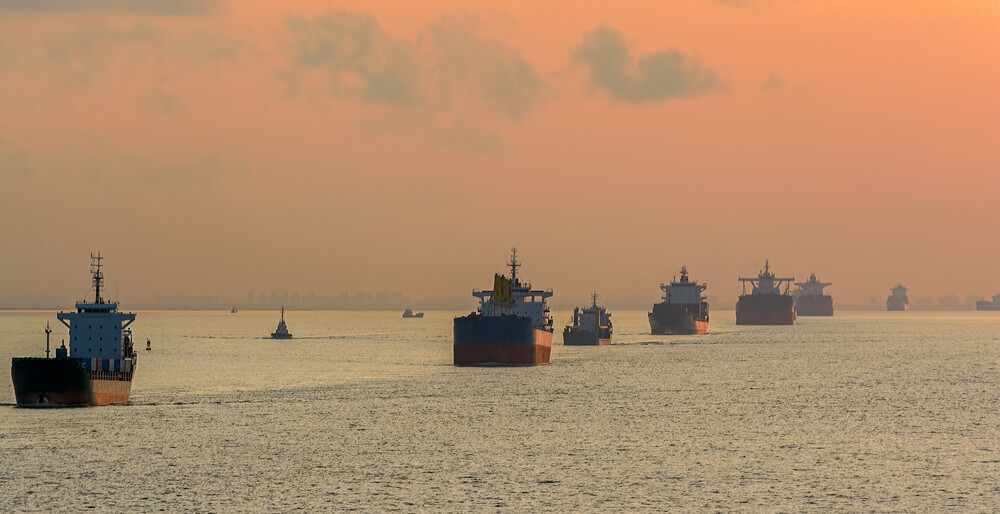 Merchant ship convoys and military escorts for tankers were once an exception reserved for major wars
The most exposed are countries without their own navy or political influence over these routes. European economies and many countries in the Global South depend on maritime corridors protected or controlled by other powers.
Their energy security thus becomes indirectly linked to decisions made by Washington, Beijing, Moscow or regional military powers.
An additional risk is that critical global infrastructure also passes through these maritime spaces. Undersea telecommunications cables carry more than 95 per cent of international digital traffic, and connect financial markets, communications networks and government systems.
In conditions of increased military presence and electronic warfare, their vulnerability becomes a serious security issue.
At the same time, new routes are opening that could become the subject of rivalry. The melting of Arctic ice allows for a longer navigation season along the Northern Sea Route, which Russia is seeking to bring under its control, while China is increasingly openly including that route in its own logistics and trade strategy.
All of this increases the likelihood of incidents with global consequences – from disruptions of energy flows to disruptions of digital infrastructure.
Merchant ship convoys and military escorts for tankers were once an exception reserved for major wars. Today, such practices are re-emerging in regular international trade.
Globalisation has not disappeared, but its infrastructure is increasingly dependent on the military protection of states.
The sea, once considered a neutral area of trade for decades, is again an arena of great power rivalry.
If this trend continues, free navigation will no longer be an international rule, but a privilege secured by military power.
