In February 2026, a series of precision strikes on Iran's nuclear facilities – primarily Natanz and Fordow – triggered a chain reaction that escalated from a military to an economic crisis of global proportions within days.
Tehran's response was politically predictable but economically devastating: closure of the Strait of Hormuz. In practice, this cut off the flow through the world's most critical energy artery.
About a fifth of global oil trade and around a third of liquefied natural gas deliveries pass through that narrow passage each day. The effect was immediate.
The price of crude oil broke the $120 per barrel mark within days, peaking at $126 on 8 March, the highest level since 2022. Analysts warned that a continued blockade could push Brent towards $135 and, in an extreme scenario, even higher.
However, the real shock was not just in the price. London's insurance market, led by Lloyd's, did not formally suspend cover for tankers in the region but made it economically unviable.
War risk premiums jumped from the standard 0.2 per cent to over 2.5 per cent of a vessel's value per transit and up to 5 per cent for ships with American, British or Israeli connections.
For a typical $138 million tanker, this meant an insurance cost of $10 to $14 million per voyage. At that point, the market ceased to function as a market.
It became clear that classical political mechanisms lacked the capacity to manage the crisis. The United Nations Security Council remained deadlocked. The G20 failed to articulate a unified response.
In the resulting vacuum, the initiative passed to institutions that do not make political decisions but have operational instruments at their disposal.
At the meeting of G7 energy ministers in Paris, informal coordination was established between three key actors: the International Monetary Fund, the International Energy Agency and the World Bank.
This coordination does not have a political mandate in the traditional sense. It does not make resolutions or attempt to influence the course of the conflict.
Its functions are different: crisis management through control of physical resources, financial liquidity, and social stability. In other words, managing the consequences.
IEA: limited time and controlled consumption
The initial response focused on the physical availability of energy. The International Energy Agency activated strategic reserves on an unprecedented scale in a single operation.
Approximately 400 million barrels were released, with the United States contributing over 40 per cent.
This measure was not intended to stabilise prices in the traditional sense. Its purpose was to buy time. In practical terms, such a volume represents about twenty days of normal global supply. This is the period during which decisions on further restrictions are made.
In crisis conditions, the objective is not to preserve growth but to maintain functionality
The IEA's key decision lay not in the quantity of oil released but in the distribution of consumption. Protocols were introduced that explicitly provided for the reduction of industrial activity in terms of energy use.
Sectors such as steel, petrochemicals, and heavy manufacturing entered regimes of restrictions or temporary shutdowns. Energy was redirected to military facilities, food transport, and critical infrastructure.
This is not a market-driven decision. It is an administrative redistribution of a scarce resource. In the European context, this amounts to de facto managed deindustrialisation in the short term. In Asia, it means the selective shutdown of export production to maintain the domestic system.
This model has a clear logic. In crisis conditions, the objective is not to preserve growth but to maintain functionality.
IMF: selective liquidity and monetary hierarchy
While the IEA manages the physical dimension of the problem, the International Monetary Fund oversees the financial system underpinning trade.
Under normal circumstances, global trade depends on a network of commercial banks that issue letters of credit and provide short-term financing for transportation. When logistical risks increase, this system stops functioning.
Rerouting via the Cape of Good Hope adds two to three weeks to transit times. Fuel, insurance, and delay costs become unpredictable. Confronted with such risks, banks withdraw. The result is a freezing of goods flows, even when physical delivery remains possible.
The IMF is responding by activating capacity through the New Arrangements to Borrow mechanism – a multilateral credit framework in which member states provide additional funds to the IMF to increase its ability to quickly approve large loans in crisis situations – amounting to around $500 billion.
The Fund does not act as a traditional credit institution but as an insurer of a system the private sector is no longer willing to support
These funds are not distributed automatically or evenly. Instead, access to dollar liquidity depends on an assessment of the stability and political reliability of each economy.
Countries with direct access to the US financial system or that are part of the inner circle of allies receive swap lines and favourable credit arrangements. For others, access to dollars becomes limited or prohibitively expensive.
In these cases, their currencies quickly lose value, borrowing costs rise, and import financing becomes uncertain. Thus, the global monetary system is effectively divided into countries with secured access to liquidity and those without.
Additionally, the IMF assumes the role of guarantor for letters of credit in commodity trade. Without this function, the global exchange of food, energy, and basic raw materials would cease.
In this respect, the Fund does not act as a traditional credit institution but as an insurer of a system the private sector is no longer willing to support.
World Bank: preventing social collapse
The third component addresses the social consequences of the crisis. Disruptions in energy supply directly affect food and fertiliser markets.
The closure of the Strait of Hormuz impacts supply chains that provide key inputs for agriculture, particularly in Africa and Asia.
The World Bank responds by channelling around 100 billion dollars to finance the import of basic goods. The focus is not on development projects, but on maintaining the minimum conditions necessary for societies to function. Food and fertiliser take priority over infrastructure and long-term investments.
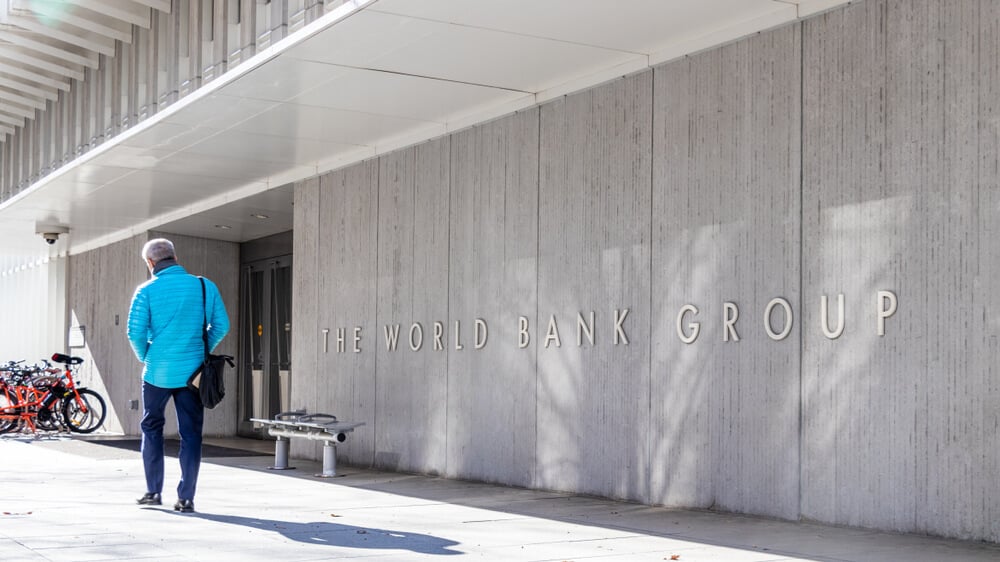 The World Bank responds by channelling around 100 billion dollars to finance the import of basic goods
Operationally, the Bank intervenes directly in key production zones. Morocco, a major phosphate exporter, and Indonesia, a significant fertiliser producer, serve as points of stabilisation.
The aim is to prevent a sudden drop in food production that could lead to famine in the most vulnerable regions within a few months.
This approach changes the nature of the institution. Instead of acting as a development bank, it functions as an instrument for preserving the social minimum.
Unplanned consequences and system adaptation
The crisis did not merely activate existing mechanisms; it also led to changes previously unimaginable in official politics.
One of the most striking examples is the attitude towards the so-called shadow fleet of tankers. For years, Western institutions sought to restrict the transportation of oil from countries under sanctions via this very channel.
Under the blockade of Hormuz, however, this channel becomes the only operational mechanism for the physical movement of oil.
The result is tacit tolerance. Sanctions formally remain in force, but their application is selectively relaxed. The system adapts to its own limitations.
Another change affects the technology sector. The growth of previous years, driven by the expansion of data centres and artificial intelligence, becomes energetically unsustainable under crisis conditions.
The just-in-time model, which kept global production at minimum inventory and maximum speed, no longer functions
The electricity consumption required to maintain such systems comes into direct conflict with basic needs.
In this context, priorities are redefined. Energy is redirected towards transportation, food production, and security structures.
The technology sector enters a correction phase, which is also reflected in financial markets, particularly among companies dependent on continued capacity growth.
The logistical impact is immediate and devastating. The just-in-time model, which kept global production at minimum inventory and maximum speed, no longer functions.
When shipping is delayed by two to three weeks and prices fluctuate daily, planning becomes impossible. Factories run out of components, delivery dates become non-binding, and contracts lose their meaning. Companies are forced to stockpile, seek alternative routes, and pay for safety over efficiency.
This is not a system disturbance; it is its breakdown.
Beyond politics: governance without legitimacy
What distinguishes this crisis is not only its scale but also the way it is managed. Key decisions are made not by elected political actors, but by institutions operating on a technical basis.
This does not mean that politics has disappeared. It remains in the background, through the conflict that caused the crisis. However, in the sphere of economic governance, the political process is suspended. Parliamentary debates and diplomatic negotiations cannot deliver oil, liquidity, or food in real time.
 Key decisions are made not by elected political actors, but by institutions operating on a technical basis - IMF
In this context, what can be described as technical power operates. Its legitimacy derives not from elections, but from its ability to manage a system under pressure. Its instruments are operational, and its goals are limited.
These goals do not aim for full recovery. They focus on a controlled reduction in activity to avoid total collapse – in other words, managing decline.
Such a model has a structural limitation. It cannot resolve the root cause of the crisis. Without unblocking the Strait of Hormuz, all measures remain temporary. Strategic reserves are being depleted. Financial capacities have limits. Social stability can only be maintained up to a certain point.
Estimates circulating within the institutions themselves suggest that a prolonged blockade by mid-year could push the global economy into a decline of around five per cent. This level of contraction exceeds the capacity of standard interventions.
In that scenario, the question is no longer how to stabilise the system but how to manage its restructuring.
The crisis of 2026 reveals something long suppressed in analytical frameworks. When the basic flows of energy and goods are interrupted, the political order loses its primacy. In its place emerges a set of institutions whose aim is not to shape the world but to prevent its uncontrolled disintegration.
It is not a permanent solution. But in the absence of a rapid military or diplomatic resolution, it is the only model that works at present.
