Andris Kulbergs’ landslide victory in the parliamentary elections on 3 October gives the Latvian prime minister the strongest mandate any party has won since independence in 1991, but also confronts him with a more demanding political task than the one he faced as interim prime minister.
He will have to translate support for strengthening defence and aid to Ukraine into a durable agreement that can withstand multi-year costs, dissatisfaction with living standards and disputes over the status of Russian-speaking citizens.
For a country bordering Russia, the durability of that agreement directly affects its ability to implement security policy.
According to the Central Election Commission, after almost all the votes were counted, Kulbergs’ United List won about 35 per cent of the vote and 42 out of 100 seats.
The party, which entered the Saeima (parliament) for the first time in 2022, has become the dominant force in Latvian politics, while New Unity, which led the governments of Krišjānis Kariņš and Evika Siliņa, collapsed: from 26 seats won four years ago, it fell to seven.
The Union of Greens and Farmers, one of Latvia’s oldest political forces, remained below the 5 per cent threshold. After decades of fragmentation, Latvia’s political centre has consolidated around a single party.
This concentration of power has another side. According to preliminary data, around 51 per cent of registered voters turned out, the lowest level since the restoration of independence.
The United List was therefore supported by slightly less than a fifth of the total electorate.
The record victory was achieved alongside record abstention, and among those who did not vote there is also a share of the dissatisfaction that the new government will have to address.
The opposition
The opposition consists of two forces that cannot simply be added together. Latvia First, led by Ainārs Šlesers, the second strongest party with 17 seats, is a populist and nationalist party that courted Russian-speaking voters during the campaign, but unlike Sovereign Power does not call for an end to aid to Ukraine.
Sovereign Power, which ran in the Jaunlatvieši alliance, named after the Latvian national movement of the 19th century, won 15 seats.
The government will have to distinguish opposition to aid to Ukraine from dissatisfaction with education, language policy or economic opportunities
It brings together politicians who refused to condemn the Russian invasion in 2022 and who oppose military aid to Kyiv and further increases in defence spending.
Its leader, Jūlija Stepaņenko, told Reuters that her voters want peace and that the war should not be fuelled through its financing.
Kulbergs has ruled out both parties as coalition partners, but the government will have to distinguish opposition to aid to Ukraine from dissatisfaction with education, language policy or economic opportunities.
A majority is still in the making
Kulbergs’ choice of partner will have consequences that go beyond the allocation of ministerial posts.
The most likely outcome is the continuation of the current coalition without the Union of Greens and Farmers.
The United List, the National Alliance with ten seats, and New Unity with seven seats would have 59 MPs, enough to pass the budget and important legislation even if some MPs from the coalition withhold support.
The Progressives, with nine seats, represent another possible option, because together with the United List they would have 51 MPs.
But it was they who brought down Siliņa’s government in May, when they withdrew their support after the Prime Minister dismissed their defence minister, Andris Sprūds, and they have been in opposition ever since.
For Kulbergs, they are primarily leverage in negotiations: the possibility of turning to the Progressives limits the demands of the National Alliance, with which the United List would have an equally slim majority of 52 MPs.
Relying on the National Alliance will have its price. That party advocates a firm stance towards Moscow and a strict policy towards the Russian minority, so a coalition with it would struggle to accept measures that would soften the implementation of language policy or offer new forms of support to Russian-speaking families.
The United List rose sharply in the polls after Kulbergs’ arrival at the head of the government in May.
During the campaign, Kulbergs promised stronger anti-drone protection
In the September survey by the SKDS agency, it had the support of 14.4 per cent of all respondents, while 18.7 per cent were undecided and 14.9 per cent did not intend to vote.
Among decided voters, its support was about a fifth. The rise from that level to 35 per cent is the result of undecided voters making up their minds, but also of low turnout, which increased the share of mobilised voters.
Kulbergs took power at the end of May, after the fall of the previous government following an incident involving Ukrainian military drones which, on 7 May, were diverted into Latvian territory by Russian electronic jamming and crashed on Latvian soil.
One struck an oil storage facility, and residents complained that the warning system was activated only an hour after the drone crash near Rēzekne.
Russian interference thus brought down a pro-Western government without a single vote from pro-Russian parties, and the result was a stronger pro-Ukrainian government.
It is also a warning for Kulbergs. During the campaign, he promised stronger anti-drone protection, and a new incident with similar failures could hit him as hard as it hit Siliņa.
Defence support also depends on living standards
The increase in military spending to 5 per cent of GDP already has a statutory basis.
On 26 March, the Saeima adopted amendments to primary legislation setting this minimum for each year from 2027.
For 2026, the defence budget is approximately €2.16 billion, or 4.73 per cent of GDP according to national methodology and the updated March estimate of the size of the economy, or 4.9 per cent according to NATO’s definition.
Kulbergs’ main task will be to secure funding for commitments already undertaken, and that funding is becoming increasingly difficult to find.
The general government deficit will rise to 3.3 per cent of GDP in 2026 precisely because of defence expenditure, alongside a fiscal rule stipulating that public debt must not exceed 55 per cent of GDP.
The Ministry of Finance has estimated that reaching the statutory minimum will require an additional €92 million in 2027 and more than €1.1 billion in 2030.
The new government also inherits two expensive projects. The first phase of the Rail Baltica railway could cost Latvia alone around €5.5 billion and, after indexation, up to €6 billion, prompting the government on 1 October to introduce a cap of €20 million per kilometre.
The future of the national airline airBaltic represents another unresolved liability.
Kulbergs does not promise more government spending
Kulbergs does not promise more government spending. When he presented the government’s programme on 28 May, with which he won the confidence of the Saeima, he placed budgetary stabilisation alongside security, ahead of all other goals.
After the election, he went a step further: the new government will have to make unpopular decisions, and only parties ready for reforms, reduced waste and fiscal discipline will enter the coalition. This is where the principal challenge of his mandate emerges.
The same voter who supports aid to Ukraine expects better healthcare, higher-quality schools and affordable utility bills, and it is precisely these services that are the first to be cut when defence and infrastructure projects demand more money.
Sovereign Power had already run its entire campaign along that fault line. At the same time, Latvia has significant support from allies.
The Canadian-led NATO multinational brigade brings together troops from 14 countries and this year reached full combat readiness.
Such a presence increases the military cost of any potential attack. The brigade, however, does not protect against stray drones, sabotage or the gradual loss of citizens’ confidence in their own state, and it was precisely such risks that brought down the government in May.
Political risk will increase if the opposition succeeds in attributing dissatisfaction with economic conditions to military funding and aid to Ukraine. Closed procurement processes, delays and poorly explained costs would then open the way for the entire policy to be challenged.
Moscow is counting on citizens’ dissatisfaction
The Russian-speaking population includes people of diverse origins, political beliefs and attitudes towards the war.
The strength of the Harmony party lay in its ability to bring together a broad spectrum of voters, from pro-European citizens to those close to Russian politics.
After Russia’s full-scale invasion of Ukraine, that coalition split, and Harmony failed to win a seat in the 2022 elections.
Today, the votes of those former supporters are spread across several parties and abstainers, so assessing their loyalty requires far more than data on the language they speak.
In its 2025 report, the State Security Service of Latvia identifies Russian intelligence services as the primary threat, along with activities directed against state infrastructure, aggressive intelligence operations and psychological operations aimed at influencing public opinion.
These are addressed through investigations and criminal proceedings. Public dissatisfaction with the work of the state is another issue, and a government that mismanages these problems risks leaving its own failings for Moscow to exploit.
There are already problems in education that the new government must address.
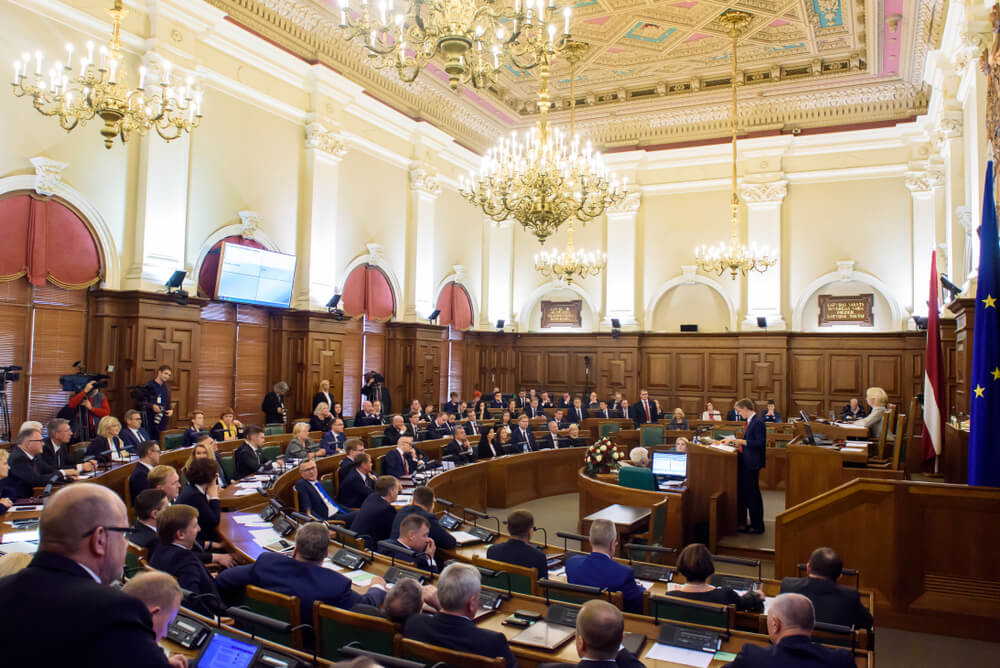 The biggest threats to the government’s stability lie outside Parliament: the cost of infrastructure projects, a new security incident, and austerity measures that would hit schools and hospitals
The transition to teaching in the Latvian language was carried out gradually, and was completed by September 2025.
According to the report of the Ministry of Education, which the government considered on 17 March, the transition in the 2024/25 academic year proceeded according to plan in about two-thirds of institutions, while improvement is needed in approximately one-third.
Of the €3.44 million allocated for teaching assistants, speech therapists and after-school teachers, €2.57 million was spent, and schools are complaining about a lack of qualified staff.
Families will assess the reform by how successfully their children learn and by the opportunities they have after leaving school.
If the coalition is built around the National Alliance, the scope for such adjustments will be narrower and the cost of failure higher.
Moscow could exploit citizens’ discontent if it turns into mistrust of the Latvian state and weakens support for its decisions on defence and aid to Ukraine.
Other European governments face a similar challenge as they increase military spending while citizens demand better public services, but few do so with spending at 5 per cent of GDP and with half the electorate not going to the polls.
Allies can count on continued support for Ukraine and a firm stance towards Moscow.
The most likely outcome is a government formed by the United List, the National Alliance and New Unity, assembled more quickly than is usual in Latvia.
Its first real test will be the 2027 budget, the first in which the statutory minimum of 5 per cent becomes mandatory, and it will come at a time when Rail Baltica and airBaltic are seeking additional funding.
The biggest threats to the government’s stability lie outside Parliament: the cost of infrastructure projects, a new security incident with lapses similar to those in May, and austerity measures that would hit schools and hospitals.
Kulbergs’ party is significantly stronger than its potential coalition partners, so the Prime Minister will hardly be able to shift responsibility for the failures of the government he leads.
If the negotiations result in a deal that allows for the division of ministries but leaves key disagreements over public spending and public services unresolved, he will be the one most exposed to public discontent.
