Amid the ongoing uncertainty over the conflict with Iran, an increasing regional military footprint and escalating repression of Palestinians, Israel is, more than ever before, affecting stability in both the Middle East and the Eastern Mediterranean.
At the same time, and partly because of these developments, the country’s relations with both Europe and its main sponsor, the US, are coming under unprecedented pressure.
While Israel also maintains cordial relations with China and Russia and warm relations with India, its economy and geopolitical and diplomatic orientation remain firmly embedded in the West.
In a way, Israel is being judged not merely as an ally of the West, as numerous other ‘problematic’ partners are, but as being so much a part of the West.
For now, growing anti-Israel sentiment in the West has not yet seriously impacted the country’s economy, arms supply or overall geopolitical position. But this may be about to change.
The European Union earlier this month sanctioned prominent leaders of Israel’s settler movement and their organisations. Although condemned by some as much too timid, it signalled a subtle shift in the bloc’s dynamic on the issue.
In the US, poll after poll shows evidence of an epochal shift in the perception of Israel among the American public. A recent Institute for Global Affairs survey, for example, found highly negative attitudes on Israel both in terms of its treatment of Palestinians and its role in the Iran conflict.
With an almost daily trickle of reports on Israeli-imposed casualties in the region – especially Lebanon and Gaza – human rights violations and egregious actions against Palestinians, the negative perception of the country is only deepening.
Degrading conditions and official indifference
The UN Special Rapporteur on torture, for example, just issued a new warning that, “emergency measures introduced after 7 October 2023 exposed Palestinian detainees to torture, potentially unlawful deaths, incommunicado detention, and degrading conditions.”
This comes on the heels of an article in the New York Times by Nicholas Kristof that documented multiple reports of sexual violence against Palestinian prisoners in Israel. It has been met with fury by the Israeli government, which has threatened to sue the paper for libel.
When Israel’s Supreme Court in 1999 banned the use of torture, it left open some exceptional, ‘ticking time bomb’ scenarios. According to many reports, these have been expanded by the security services over the years and especially after the Hamas attack of 7 October 2023.
The systematic appearance of some of these abuses and the pattern of casualties do suggest at least an official indifference to them
Even with the ongoing propaganda battle between Israel and its Arab and Palestinian opponents, with both sides accusing each other of massacres and sexual violence, for example, there’s compelling evidence that at least some of this is true.
The problem in terms of Israel’s position in the West is that even if these occurrences are not officially sanctioned or ordered, they do take place in state institutions for which the country’s authorities and politicians bear ultimate responsibility.
Moreover, the systematic appearance of some of these abuses and the pattern of casualties do suggest at least an official indifference to them, if not an actively encouraged climate of impunity.
The erosion of rights
In Gaza, the horrible toll on the population, the massive destruction, the ongoing humanitarian hardship, as well as, indeed, the ongoing casualties despite a ceasefire have been well documented, as has their impact on public opinion.
The shock that the brutal and terrifying Hamas attack of 7 October 2023 caused in Israel and the logic of polarisation that such violence brings with it might be taken by some as at least an explanation for some of the excesses that have happened since, particularly the terrible onslaught against Palestinians in Gaza.
But here too, there’s an expectation of a state, especially one as embedded in the West as Israel, to follow accepted rules of engagement.
Critics of Israel might argue that the state’s behaviour has always been discriminatory
The 7 October 2023 shock to Israeli society also came at the time of an extraordinary rightward drift in the country’s politics.
Since December 2022, a government that includes extreme right-wing nationalists and settlers is in power under an embattled Prime Minister, Benjamin Netanyahu, who uses every trick in the book to stay in power and stave off corruption charges.
The statutory position of both Israel’s domestic Palestinian population and those in the Israeli-occupied territories had been slowly eroded in previous decades. Under the current government this has accelerated much further, culminating for now in the infamous law that in effect makes death sentences possible for Palestinians and highly unlikely for Jewish Israelis.
Critics of Israel might argue that the state’s behaviour has always been discriminatory. Yet, the incorporation of an increasing number of prejudicial laws in the statute books makes charges of racism and apartheid more plausible and, as such, further undermines the country’s standing in the West.
Declining Western support
Israel’s political landscape, while mostly unfamiliar to the Western public, doesn’t offer any prospect of relief either. The main opposition leader, Naftali Bennett, is a right-wing former settler leader himself.
Israel will hold elections at the latest by October this year and possibly sooner. Netanyahu’s Likud party is still well-positioned to come out on top, but he might not be able to cobble together another coalition.
Yet, an Israeli electorate clobbered by three years of war and multiple rounds of Iranian missiles has thus far shown no inclination to take either the suffering of Palestinians or the geopolitical folly of the Iran conflict into account.
Even getting rid of Netanyahu might not do much to slow the decline in support for Israel in the West
If it does decide to get rid of Netanyahu, that is most likely to be over the usual economic issues, as well as lingering anger over his failure on 7 October 2023 and more domestic issues such as army duty for ultra-Orthodox Jews and judicial reform.
Even getting rid of Netanyahu might not do much to slow the decline in support for Israel in the West.
Without, among other things, drastic action to stop the increasing de jure and de facto Israeli discrimination against Palestinians, reversing government support for militant settlers, stopping the climate of impunity in the security services and among the settlers, and reversing its policy in Gaza, not much will change.
Managing the growing rift
As demonstrated by Hungary dropping its opposition to some EU sanctions against Israeli settlers after the defeat of Netanyahu ally Viktor Orban, Israel has become dependent on the goodwill of individual politicians.
Israel’s standing among governmental and institutional structures in the West has degraded precipitously. Its reserves of goodwill among populations are depleting even faster, notwithstanding its second-place result in the recent Eurovision Song Contest.
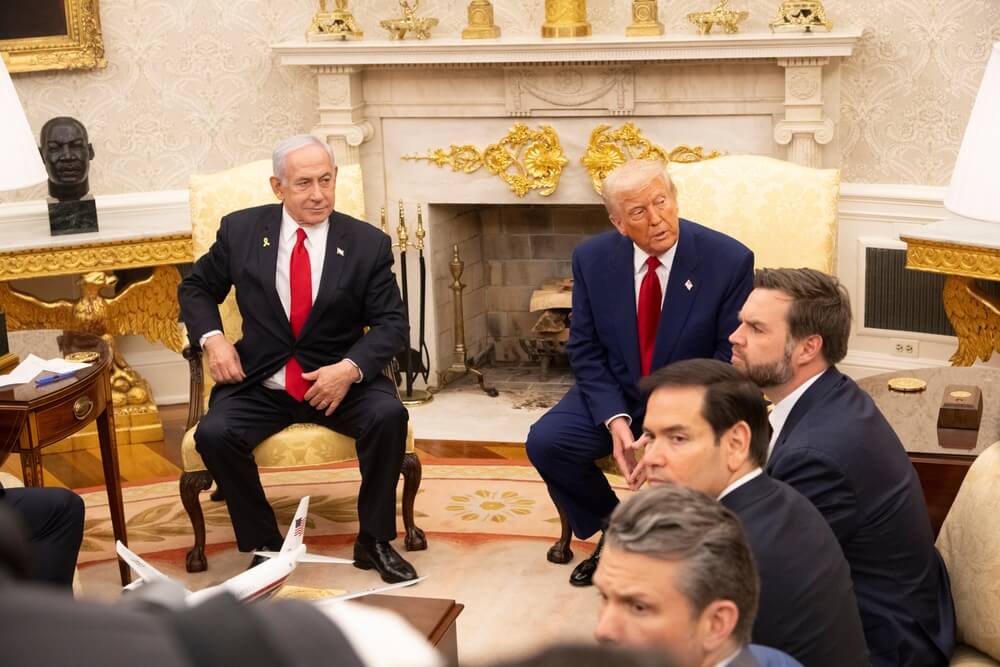 Israel allies itself increasingly with right-wing elements both in the US and Europe and shores up its position by becoming an arms and energy supplier
Its actions to stop this slide all seem to be aimed at the propaganda and political influencing side, without actually doing anything to improve the situation on the ground.
Israel allies itself increasingly with right-wing elements both in the US and Europe and shores up its position by becoming an arms and energy supplier.
By relying so much on the right-wing and the extreme-right side of the political spectrum, it further alienates the often already pro-Palestinian immigrant demographics in both Europe and the US that have shown on occasion, for example, on Gaza, to be able to affect political outcomes.
Even accepting that Israel’s conflicts with the Palestinians and its other neighbours are not as simple to resolve as some of its critics would like to suggest, it has undertaken an extraordinary number of actions in recent years that are beyond the pale.
The EU and future US administrations will need to balance how to stabilise the region while managing its relations with an ever more divergent, erratic and increasingly uncomfortable ally. And also, how to shield their domestic politics from the ructions in the Middle East.
Even if a divorce between Israel and the West is not on the cards yet, the two are increasingly estranged.
