In my early years as an economics professor, I was occasionally asked to present my work to a group of international economists, and several times I was lucky enough to do so at a beautiful site overlooking Lake Geneva.
One economist—quiet, thoughtful, not at all antagonistic—always appeared at those presentations, and even met me for breakfast in New York City.
His name was Scott Bessent, currently Secretary of the United States Treasury under President Donald Trump.
Bessent began his career managing the hedge fund owned by George Soros, and when I was appointed as an adviser to Japanese Prime Minister Abe Shinzō, they came to see me at Yale University.
As Bessent recounted in his book, I (with my Japanese accent) described to him and Soros (with his Hungarian accent) our early plans to reinvigorate Japan’s economy, including through looser monetary policy.
He found those plans “inspiring,” he wrote. Yet, today, he is recommending the opposite.
Trump, Bessent’s current boss, could not have less in common with Soros. But Bessent appears to be moderating, to some extent, Trump’s irrational tariff policies.
Meanwhile, he is recommending a measure that, unlike tariffs, actually could help US industry: higher Japanese interest rates.
Raising interest rates would strengthen the yen
The Japanese yen has sunk to a 40-year low against the US dollar. Raising interest rates would strengthen the yen, increasing the competitiveness of US exports.
The question is whether this would be good for Japan, which benefited from a weak yen throughout its postwar economic recovery.
That was ended by the 1985 Plaza Accord, under which France, West Germany, Japan, and the United Kingdom agreed with the US to intervene in currency markets to weaken the dollar against their respective currencies.
This does not mean that a weaker yen is always better
The stronger yen sharply undercut Japan’s economic dynamism, and, together with population aging and a rigid kaisha (company) system that struggles to adapt to new technologies, contributed to decades of chronic economic malaise.
But this does not mean that a weaker yen is always better. One way to assess whether a currency is over- or undervalued is to compare the actual exchange rate to the purchasing-power-parity rate compiled by the International Monetary Fund.
Yen-per-dollar exchange rate
If the actual yen-per-dollar exchange rate is higher than the PPP rate (which accounts for price levels within each country), then the yen is undervalued. If it is lower, the yen is overvalued.
At the beginning of 2013, when Abenomics was rolled out, the actual dollar exchange rate was ¥83, and the PPP rate was around ¥127, meaning that the yen was more than 50% overvalued.
This generated powerful headwinds for Japanese producers and deflationary pressures for the entire Japanese economy.
In April 2026, the actual dollar exchange rate was around ¥160, while the PPP rate was only about ¥93. The yen was thus some 70% undervalued
Today, the opposite is true: in April 2026, the actual dollar exchange rate was around ¥160, while the PPP rate was only about ¥93.
The yen was thus some 70% undervalued. Foreigners are well aware of this: Tokyo has been experiencing a tourism boom, as visitors seek to take advantage of low prices.
Japan’s circumstances have changed
Were Bessent still a fund manager, he would probably be taking advantage of this situation, borrowing yen at lower interest rates, converting them into higher-yielding US dollars, and investing in riskier assets.
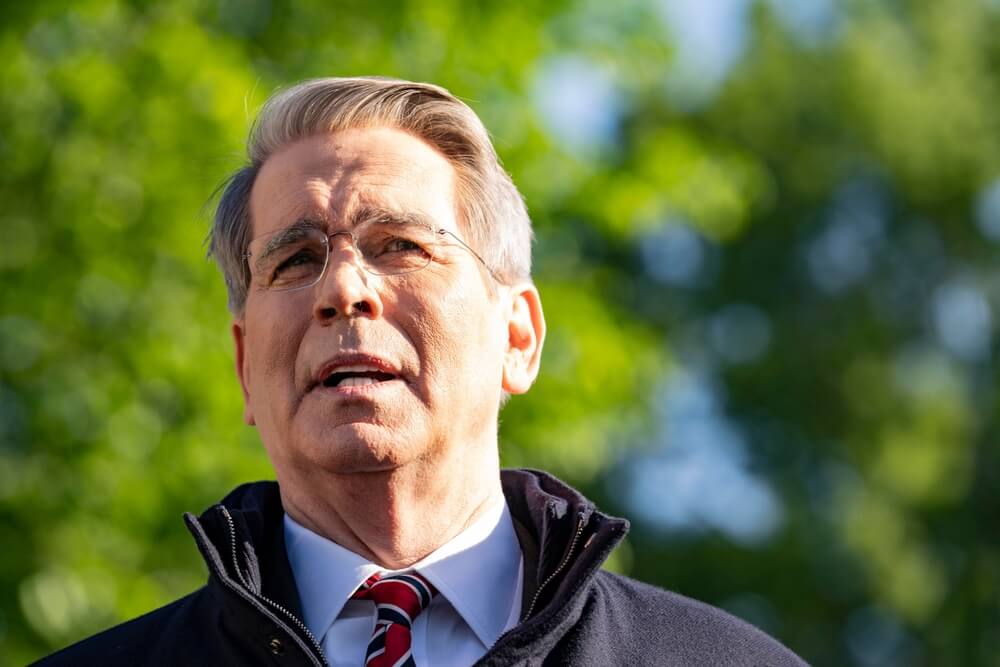 Scott Bessent is rightly encouraging the Bank of Japan to raise rates
The interest-rate differential—which now exceeds two percentage points—would deliver significant profits upon loan repayment.
But instead of engaging in this speculative carry trade, Bessent is rightly encouraging the Bank of Japan to raise rates.
Whether he will show the same integrity at home, defying Trump by recommending higher interest rates to rein in rising inflation, remains to be seen.
As for Japan, the case is clear. When I was Abe’s adviser, I strongly advocated monetary easing. But I would not give the same advice today. Japan’s circumstances have changed, so my recommendation has, too.
Koichi Hamada, Professor Emeritus at Yale University, was a special adviser to former Japanese Prime Minister Abe Shinzō.
