Public broadcasters find themselves currently in the line of fire in the battle over media and democracy. It’s one aspect of the wider struggle over control of information that could well shape many countries’ political futures.
Hungary saw a major overhaul of its public broadcasting this week in a further indication that the new government under Péter Magyar and his Tisza Party is serious about breaking the near monopoly that former PM Viktor Orbán and Fidesz had on the country’s media.
The move echoes steps to restore the independence of the public broadcaster in Poland after the Civic Coalition under Donald Tusk defeated the right-wing PiS, which had gained similar control over public media.
In the Czech Republic, though, the balance threatens to shift to the other side, with the public broadcaster’s independence and funding being targeted by the current right-wing government of Andrej Babiš.
In Slovakia, the nationalist government of Robert Fico has dissolved and replaced the public broadcaster, which has led to the European Commission opening a ‘pre-infringement dialogue’. Slovakia is already facing an infringement procedure over democratic backsliding.
The pressure on public broadcasters is not confined to Eastern and Central Europe. In Italy, Giorgia Meloni’s far-right government has also interfered in the independence and funding of its Rai network, to the extent that the European Commission issued a warning.
The country’s opposition is now calling Rai ‘Telemeloni’, a label fiercely rejected by the broadcaster’s leadership.
The fickle nature of broad government-based financing
In the UK, the BBC is also confronting questions over its funding model, the licence fee, impacting both its independence and viability.
The previous Conservative government planned to abolish the fee, while the far-right Reform UK, which leads in the polls, wishes to drastically cut back the whole BBC, which it accuses of ‘institutional bias’.
The current Labour government has scrapped the Conservative plans and is ostensibly looking at ways to modernise the model and make it more sustainable. Yet, given the level of populist agitation against the broadcaster, it is faced with only unattractive options.
One cautionary tale is the United States under the second Donald Trump administration. Funding for the US public broadcasters PBS and NPR was slashed in 2025, resulting in the closure of the umbrella Corporation for Public Broadcasting (CPB) earlier this year.
There appears to be a global, mostly but not exclusively, right-wing push to either do away with independent state broadcasters or bring them under government control
Funding came from Congress under a law going back to 1967. Yet the administration used its majority in both chambers to push through the cuts, showing the fickle nature of broad government-based financing for public broadcasters.
Both PBS and NPR for the moment survive, but in a much-reduced form. Many local affiliates manage to stay barely afloat through philanthropic and community contributions.
Conversely, in Spain and some Latin-American countries, left-wing governments have similarly attempted to gain more control over their public broadcasters, which has also been condemned by international media watchdogs.
Thus, there appears to be a global, mostly but not exclusively, right-wing push to either do away with independent state broadcasters or bring them under government control.
Challenges to the whole of the media landscape
This coincides with the precipitous decline in ‘legacy media’ news consumption among the public and the shift to online news viewing, along with the perception among many consumers that online news should be free.
Trust in traditional news sources and especially public broadcasters is still relatively high, compared to newer platforms and forms of news distribution.
The Reuters Digital News Report 2026 found in selected countries that by and large views of public service media, such as public broadcasters, were more positive – 37% – than negative – 22%.
In most surveyed countries it’s people on the left that have a more positive view of the public broadcasters, except, unsurprisingly, in Italy, where it was distrusted by the left and supported by the right.
The European Union is stepping in with a mechanism to support public service media and potentially penalise countries such as Slovakia and Italy that could be in breach of the European Media Freedom Act or more broadly are the subject of democracy and rule of law infringement procedures.
Technology, especially AI, tech-money and where these intersect with politics, were flagged as challenges to the whole of the media landscape
A new fund, proposed for the next EU budget period, from 2028 to 2034, called AgoraEU, is to disburse billions to support public service media and independent journalism. It could possibly be topped up by fines levied against tech corporations under the bloc’s Digital Services Act and Digital Markets Act.
At a recent Media and Democracy Summit, organised by Project Syndicate and the Meliore Foundation at the French Ministry of Foreign Affairs in Paris, speakers hailed the EU efforts and the importance of public service media but also noted the model’s falling appeal among younger audiences.
While public broadcasters are seen as an important part of the bulwark against disinformation, which for a large part comes from Russia, they only form one part of the overall media environment that is under pressure.
Technology, especially AI, tech-money and where these intersect with politics, were flagged as challenges to the whole of the media landscape.
Public media organisations suffer from the same decline in audience as other traditional news media, the same unfavourable algorithms, and the increasing invisibility in search results and AI chatbot answers as other media.
Media freedom and democracy
Other issues also abound, such as intimidation of independent journalists with so-called SLAPP lawsuits. One bright point in that respect is that Poland, apart from setting its public broadcaster on a newly independent course, also just passed anti-SLAPP legislation.
Media freedom and democracy were repeatedly equated with each other at the Paris summit, and some speakers made the comparison with the rise of fascism in the 1930s.
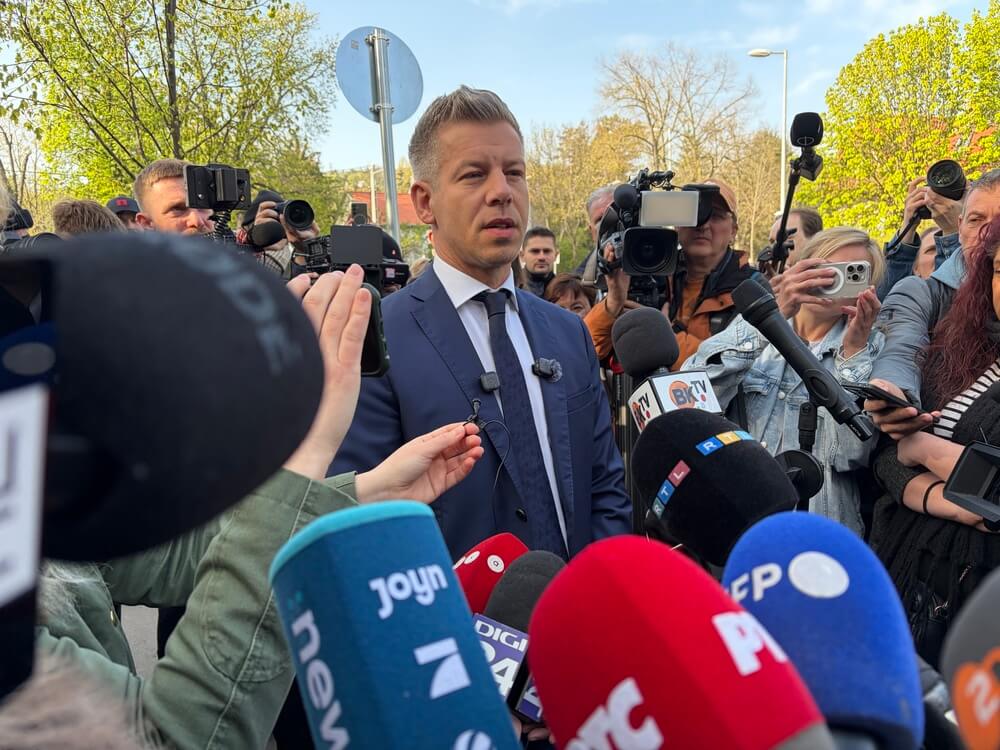 At the Media and Democracy Summit, Hungary was frequently cited as a bright spot - Péter Magyar
For those who think that’s overwrought, the V-Dem Institute in Gothenburg, Sweden, earlier this year published its annual report, noting global democratic decline and an increase of ‘autocratising’ countries.
In fact, the level of democracy for those living in the US and Western Europe is at a 50-year low.
Around the same time, Reporters Without Borders noted in its 2026 Press Freedom Index that this was at the lowest level it has ever been.
It said that, “For the first time in the Index’s 25-year history, more than half the world’s countries now fall into the ‘difficult’ or ‘very serious’ categories for press freedom.”
At the Media and Democracy Summit, Hungary was frequently cited as a bright spot, both by speakers and attending journalists. Independent outlets, even while only a small percentage of the total media landscape, were instrumental in uncovering Orbán’s missteps and excesses.
It was often overlooked that until their work got amplified by a former Fidesz insider, Péter Magyar, their findings gained little traction.
Faced with intimidation, financial squeezes or other government measures, journalists from countries where the media are under pressure concluded their only course of action was to keep carrying on their work to the best of their ability.
It’s notoriously hard, it was also said, to organise journalists to take collective action. Indeed, that’s up to politicians, the judiciary, and ultimately, the public.
