Ask the average American or European if they know who currently leads Iraq, few could give the right answer.
Iraq may remain synonymous with quagmire and fears of how the current Iran war may embroil rich world economic interests, but many people have lost interest in its internal wrangling.
Mohammad Shia Al-Sudani is the current caretaker prime minister of Iraq, and he is treading a very fine line as his country comes under attack by Iran and Iranian-backed militias and US-Israeli counterattacks.
More than 100 people have been killed in Iraq since the Iran war started, including Iraqi security officers, militia members and a French soldier, according to an AFP tally.
Violence is likely to spread further, creating further complications in what President Donald Trump had hoped would be a swift military operation to contain Iran.
With strikes hitting Iraq from all sides, the country could prove to be as much of a headache for Trump as it was for his predecessors since the US-led invasion of Iraq in 2003 as an array of armed groups and separatist Iraqi and Iranian factions jostle for position and influence.
The Iraqi people will continue to pay a high price amid economic freefall, although their pain is unlikely to register much in a world grappling with higher energy costs and increased security risks.
US focus on Iranian-aligned factions
Washington has focused on risks posed by Iranian-aligned factions in the Iraqi Popular Mobilisation Forces, which have launched drones and rockets at Kurdish and US targets, including its embassy in Baghdad. The US and Israel have hit back at commanders of the factions and weapon depots linked to them.
Adding to Al-Sudani’s many challenges is trying to maintain ties with Arab neighbours, who last week issued a strongly worded joint statement condemning attacks by the Iran-aligned groups in Iraq.
Washington even threatened to cut off Iraq’s supply of dollars drawn from sales of Iraqi oil that are deposited at the US Federal Reserve
Baghdad said it would take measures against the Shia factions. But few believe the weak government is likely to be successful, particularly if there is a US land invasion of Iran or other military actions that could provoke Tehran into activating its proxies to escalate their military operations.
Negotiations over a durable Iraqi government have been deadlocked since parliamentary elections last November, with Washington opposed to Nouri Al-Maliki serving a third term as prime minister while Al-Sudani seeks to be formally installed to serve a second term. Whoever prevails in the post will likely depend on how much Tehran is able to sway Iraqi politics post-war.
In January as part of US efforts to curb Tehran’s influence in Baghdad, Washington even threatened to cut off Iraq’s supply of dollars drawn from sales of Iraqi oil that are deposited at the US Federal Reserve.
Power-sharing disputes
Iraqi government formation has also been complicated by wrangling among the two main parties that lead the autonomous Kurdistan Regional Government in northern Iraq.
Under the Iraqi constitution, the federal presidency is reserved for a Kurd who must be appointed before a prime minister, a Shia, and the parliamentary speaker, a Sunni, are put in place.
But the Kurdistan Democratic Party and the Patriotic Union of Kurdistan cannot agree on a candidate for the federal Iraqi presidency as part of their wider dispute over power-sharing.
Adding to Kurdish woes is the attention drawn to them by earlier US and Israeli plans to back Iranian Kurdish forces to join the Iran war on the ground from Iraqi Kurdistan.
Turkey was adamantly opposed to Kurdish forces joining any ground fighting in Iran
Reports say the CIA and Mossad have been arming the Iranian Kurds for years, but the US and Israel were forced to call off a Kurdish ground invasion after their plans were leaked and Tehran bolstered its defences in north-west Iran, according to an Israeli Channel 12 report.
Many Kurds were themselves wary, particularly after Trump and Turkey backed Syrian President Ahmed Al-Sharaa’s offensive earlier this year against Syrian Kurdish forces, which had been key in the fight against the Islamic State.
Furthermore, Turkey was adamantly opposed to Kurdish forces joining any ground fighting in Iran. Turkish foreign ministry and intelligence delegations have warned Iraq’s Kurds that Ankara could launch a military intervention if Kurdish militants fight in Iran, according to an Asharq Al-Awsat report.
High toll on Iraq’s economy
The Iran war is exacting a high toll on Iraq’s economy because oil exports account for more than 90% of revenues. Even before the conflict, Al-Sudani had ordered measures aimed at “rationalising spending” to ease financial pressures and a widening fiscal deficit.
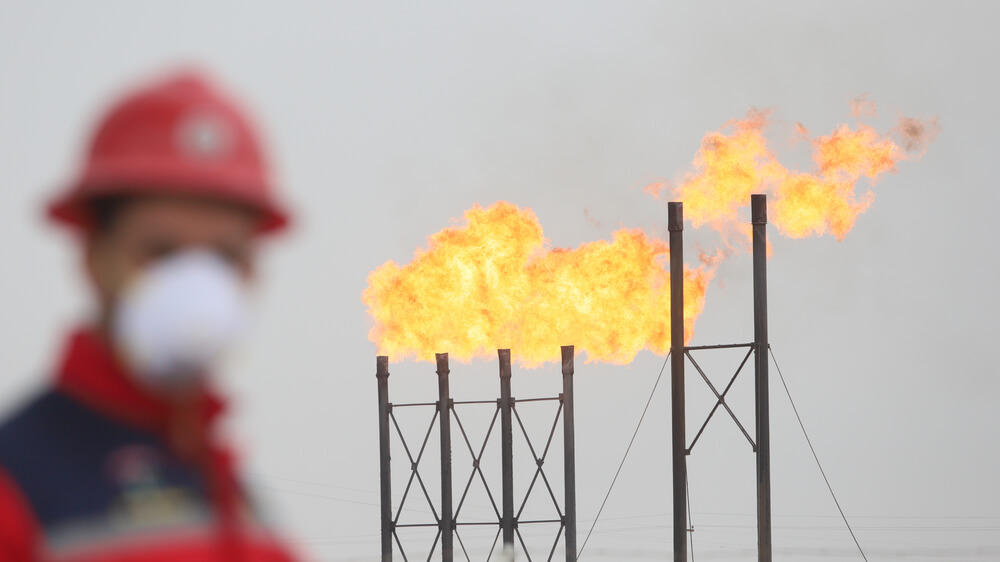 Baghdad was forced to declare force majeure on oilfields operated by foreign oil companies
Now, oil exports have fallen from 3.4 million barrels per day to around 250,000 since the war started, with storage tanks at near-critical levels. Baghdad was forced last month to declare force majeure on oilfields operated by foreign oil companies.
Unlike Gulf countries that can export oil over land or through the Red Sea, Iraq is more dependent on the Strait of Hormuz, through which 90% of its oil exports must pass. It also relies on imports of food and medicines, which have seen sharp rises in price as the Iraqi dinar plummets against the US dollar.
The collapse in oil revenues also threatens a Public Distribution System food safety net for 39 million people, or 84% of the population, says the ACAPS humanitarian analysis non-profit.
One of the many unintended consequences of the 2003 Iraq war was the empowering of Iranian influence in Iraq, and the Iran war is likely to generate many more unknowns, said Foreign Affairs. “And Iraq is one of the places where those aftershocks are most likely to surface—and where they may prove hardest to contain.”
