When we think about the technologies that will shape the next decade, we tend to think of artificial intelligence, quantum computing, advanced semiconductors, robotics and space technology. Cryogenics is an engineering field we rarely hear about, yet it underpins many of these innovations.
Cryogenics focuses on creating, managing, and applying extremely low temperatures. Engineers use cryogenic systems to cool equipment and materials to temperatures far lower than those achievable with traditional refrigeration. Materials can exhibit radically diverse behaviours at high temperatures.
So what is the purpose of cryogenics in technology? In quantum computing, cryogenics creates the conditions necessary for superconducting qubits to function. In medical imaging, cryogenic systems support superconducting magnets in MRI scanners.
Space exploration uses cryogenic technology to support instruments, propulsion systems, and sensors that require extremely low temperatures.
And scientists also use cryogenic conditions to examine materials, preserve biological samples, and develop novel sensing and computing technologies.
The year 2026 gives us plenty of reasons to start paying attention to this topic. IBM has committed more than $10 billion to quantum computing over the next five years. Microsoft continues to develop its topological quantum computing architecture. Google continues to advance superconducting quantum computing while expanding into neutral atom systems.
All three companies rely on increasingly sophisticated approaches to quantum hardware and the supporting infrastructure.
The bottom line is that we are going to hear a lot more about cryogenics.
Cryogenics has become critical infrastructure for the quantum era
The first technology involves dilution refrigerators. These machines create temperatures close to absolute zero. Superconducting quantum processors operate at temperatures around 10 millikelvin, or roughly -273.14 degrees Celsius. Google describes its dilution refrigerators as some of the coldest environments in the universe.
The physical states of quantum computers are very sensitive. Thermal energy can disturb such states and produce noise. By reducing undesirable thermal effects, cooling the system enables superconducting circuits to display the characteristics quantum engineers need.
The refrigerator therefore becomes part of the computer. It changes how we should think about computing infrastructure. With conventional computers, we often separate the processor from the cooling system.
Quantum computing makes the relationship much tighter. The thermal environment directly determines whether the processor can function.
The second technology involves cryocoolers. They deliver cooling at cryogenic temperatures.
A major barrier in cryogenic engineering is scaling quantum systems. As qubit counts rise, so do connections, control electronics, and heat loads. While keeping temperatures incredibly constant, engineers must eliminate that heat. It produces a challenging engineering formula.
Cryogenic environments can reduce thermal noise and allow sensors to detect extremely weak signals
More computing power creates more thermal complexity. The industry therefore needs cryogenic systems with higher cooling capacity, lower energy consumption, smaller footprints, and better scalability.
The third technology is cryogenic electronics, such as cryo-CMOS. This year, IBM exhibited a large-scale cryogenic CMOS control device as part of its efforts to create scalable superconducting quantum computing.
By positioning control electronics inside the cryogenic environment, this approach aims to reduce the physical footprint and wiring complexity needed to operate a large number of qubits.
We need to improve the infrastructure surrounding the qubits for quantum computing. By placing more control electronics close to the processor, we can reduce wiring, latency, and system complexity. Conventional electronics do not automatically function well at very low temperatures.
The fourth technology involves superconducting magnets. These magnets generate extremely strong magnetic fields while superconducting materials carry electrical current with very low resistance.
MRI systems provide one of the most established commercial applications. Particle accelerators and fusion research also depend heavily on superconducting magnet technology.
The fifth technology involves cryogenic sensing and detectors. Scientists use cryogenic detectors in astronomy, space science, particle physics, quantum sensing, and other fields that require extraordinary sensitivity.
Cryogenic environments can reduce thermal noise and allow sensors to detect extremely weak signals. This could become increasingly important as technology moves towards more sensitive measurements. And measurement drives discovery.
IBM, Microsoft and Google are turning cryogenic engineering into a strategic technology
IBM gives us one of the clearest examples of how cryogenics connects directly to a broader computing strategy. As mentioned earlier, IBM announced in June 2026 that it would invest more than $10 billion in quantum computing over five years.
The programme includes research and development, manufacturing, capital expenditure, partnerships, and acquisitions. IBM wants to deliver a large-scale, fault-tolerant quantum computer by 2029.
IBM then announced its agreement to acquire HRL Laboratories in July. HRL brings expertise in silicon-spin qubits, quantum sensing, materials, cryogenics, control electronics, qubit interconnects, and packaging.
IBM is treating quantum computing as a systems engineering problem. The quantum computer of the future will need processors, cryogenic systems, control electronics, interconnects, packaging, software, error correction, networking, and classical computing infrastructure.
While continuing its superconducting work, Google expanded its quantum research into neutral-atom computing
Microsoft follows a different technical path. The company continues to develop topological quantum computing through its Majorana 2 processor. Microsoft says Majorana 2 delivers substantially improved qubit reliability and supports its ambition to develop a scalable quantum computer by 2029.
Microsoft also frames quantum computing as a full-stack architecture that connects hardware, software, AI, cloud infrastructure, and networking. This approach highlights that different quantum architectures may require different thermal architectures.
The final example comes from Google. Google has kept investing in superconducting quantum hardware, and its Willow quantum processor runs in a cryogenic environment. While continuing its superconducting work, Google expanded its quantum research into neutral-atom computing in March 2026.
Google's earlier research describes dilution refrigeration as essential for maintaining superconducting qubits at around 10 millikelvin. The company also brought Atlantic Quantum into Google Quantum AI in 2025.
Atlantic Quantum developed highly integrated quantum hardware that combines qubits and superconducting control electronics within the cold stage.
The cryogenic economy could become much bigger than quantum computing
If we talk about cryogenics only through the lens of quantum computing, we miss a much bigger opportunity.
Cryogenic technology already supports healthcare, scientific research, space exploration, industrial gases, superconducting systems, and advanced sensing.
Quantum computing could accelerate investment and innovation across the entire cryogenic ecosystem. But the requirements are becoming more demanding. Quantum systems need lower temperatures, higher cooling efficiency, reduced vibration, improved thermal management, denser interconnects, and smaller footprints.
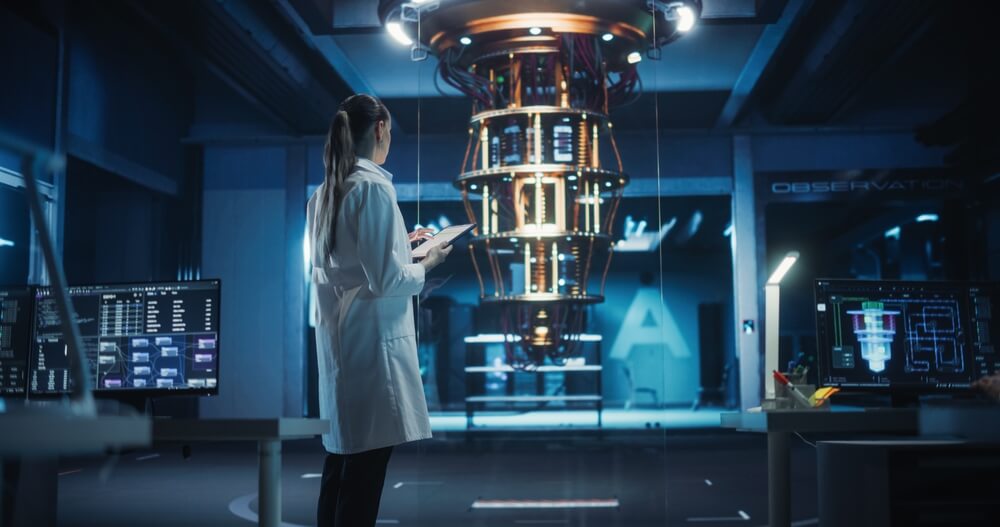 Future quantum data centres may require entirely new approaches to cryogenic infrastructure
Future quantum data centres may require entirely new approaches to cryogenic infrastructure.
Europe's quantum industry roadmap highlights this challenge. As quantum chip counts increase, cryogenic systems need greater cooling power while maintaining efficiency.
The roadmap also identifies compact, modular systems; superconducting cabling; new cryogenic materials; and cryogenic infrastructure for quantum cloud services as key areas for development.
Can you see the emerging industrial opportunity? We will need companies building cryocoolers and developing dilution refrigerators. We will need specialists in cryogenic electronics. We will need superconducting materials, thermal management expertise, better sensors and control systems, and engineers who understand the relationship between cryogenic physics and large-scale computing.
Although cryogenics may function at temperatures near absolute zero, the expansion journey has already started, and the opportunity most definitely has not.
Over the next few years there will be more announcements about quantum computing, cryogenic systems, superconducting materials, advanced sensors, and thermal management.
We are entering an era in which colder can mean smarter. The companies solving the engineering challenges at the edge of absolute zero could help unlock some of the biggest technological advances of the next decade.
And if quantum computing delivers on its promise, cryogenics won't remain a specialist engineering discipline operating behind the scenes. It could become a foundation of the next computing era.
