The Olympic Games have always been about more than sports, with the medal count serving as a measure of national vitality.
The 2026 Winter Games in Milan and Cortina are no different. The Americans, like everyone else, want confirmation of their pre-eminence.
So important is that outcome that even US Vice President JD Vance briefly acknowledged the value of non-white immigration to the United States, when he complained that Eileen Gu, the US-born medal-winning skier for China, should be competing under the American flag.
But the medal table is just one scoreboard. Beyond the ice rink and the slopes is a much larger and more consequential contest for excellence, namely in scientific leadership, technological supremacy, and geopolitical influence.
Here, too, China is most portrayed as America’s nemesis, with the future of each at stake.
And here, too, there is a question about what role immigrants – like Gu’s Chinese mother – should play.
Although immigrants bring talent and ambition, they also might compete for jobs or disseminate US-acquired knowledge abroad.
Owing to these concerns, the US has tightened its immigration policies in recent years, even restricting highly skilled professionals.
Such measures reflect a fundamental misunderstanding of how countries compete for global pre-eminence – and the Olympics reveal why.
Consider figure skating, one of the most visible winter sports. For decades, the US has crowded the podium with the children of immigrants: Michelle Kwan (silver, 1998; bronze, 2002), Sasha Cohen (silver, 2006), Mirai Nagasu (bronze, 2018, team), Nathan Chen (gold, 2022), and, this winter, Ilia Malinin (gold, 2026, team) and Alysa Liu (gold, 2026).
The same is true in other sports. For example, the speed skater Apolo Ohno (gold, 2002, 2006; eight medals total) has a Japanese-born father, and the snowboarder Chloe Kim (gold, 2018; gold, 2022; silver, 2026) is the daughter of South Korean immigrants.
The list grows longer still if one includes champions descended from earlier waves of migration, such as Polish-American Tara Lipinski (gold, 1998) and Japanese-American Kristi Yamaguchi (gold, 1992).
Time and again, America’s strength on ice and snow has been built by families whose journeys began elsewhere.
Talent flows both ways
The analogy to science is hard to miss. Roughly 1.2 million international students study in the US each year – accounting for about 6% of total higher-education enrollment – and they are concentrated in STEM and quantitative fields.
For example, foreign nationals account for 82% of full-time graduate students in petroleum engineering, 74% in electrical engineering, 72% in computer and information sciences, 71% in industrial and manufacturing engineering, 70% in statistics, 67% in economics, 61% in civil engineering, 58% in mechanical engineering and agricultural economics, 56% in mathematics, 54% in chemical engineering, 53% in metallurgical and materials engineering, 52% in materials sciences, and 50% in pharmaceutical sciences.
Immigrants and their children also make up a disproportionate share of America’s engineers, founders, and patent holders.
Some see this as a source of American strength, whereas critics warn of leakage.
The benefits of attracting foreign talent outweigh the costs
In fact, talent flows both ways. Among Olympians, for example, the figure skater Deanna Stellato-Dudek was born and trained in the US but now competes for Canada.
More controversially, China reportedly allocated substantial state funding to recruit US-trained athletes such as Gu (who has now won five Olympic medals for her sponsor) and Zhu Yi before the 2022 Beijing Games.
It is not surprising that such moves fuel anxiety in the US. But a sense of perspective is in order.
The US won 25 medals at the Beijing Olympics in 2022, compared to China’s 15, and this gap will be even wider in 2026. Evidently, the benefits of attracting foreign talent outweigh the costs.
The world’s leading source of Nobel laureates
The same lesson holds in science, where the US has been the world’s leading source of Nobel laureates.
American institutions have captured about 40% of science Nobels since 1945, and over half of economics Nobels since 1969.
America’s prize-winning edge has been deeply intertwined with immigration. Roughly 40% of US-affiliated Nobel laureates in physics, chemistry, and physiology or medicine have been foreign-born.
Many of the private-sector architects of America’s most important strategic technologies were born abroad
Many of the private-sector architects of America’s most important strategic technologies were also born abroad. Sergey Brin, born in the Soviet Union, co-founded Google.
Elon Musk, born in South Africa, built Tesla and SpaceX. Jensen Huang, born in Taiwan, co-founded Nvidia. Eric Yuan, born in China, founded Zoom.
This is not new. Immigrants have fueled America’s rise on the global stage since before World War II. Albert Einstein fled to the US in the 1930s. John von Neumann, born in Hungary, designed the architecture that underlies modern computing.
Wernher von Braun, born in Germany and once an engineer for the Nazis, later became the chief architect of the Saturn V rocket that carried Americans to the moon.
Engines of national strength
The US has repeatedly turned foreign-born talent – even from rival powers – into engines of national strength.
To see why isolation is harmful, ask a simple question: What if America had closed its doors to these brilliant minds?
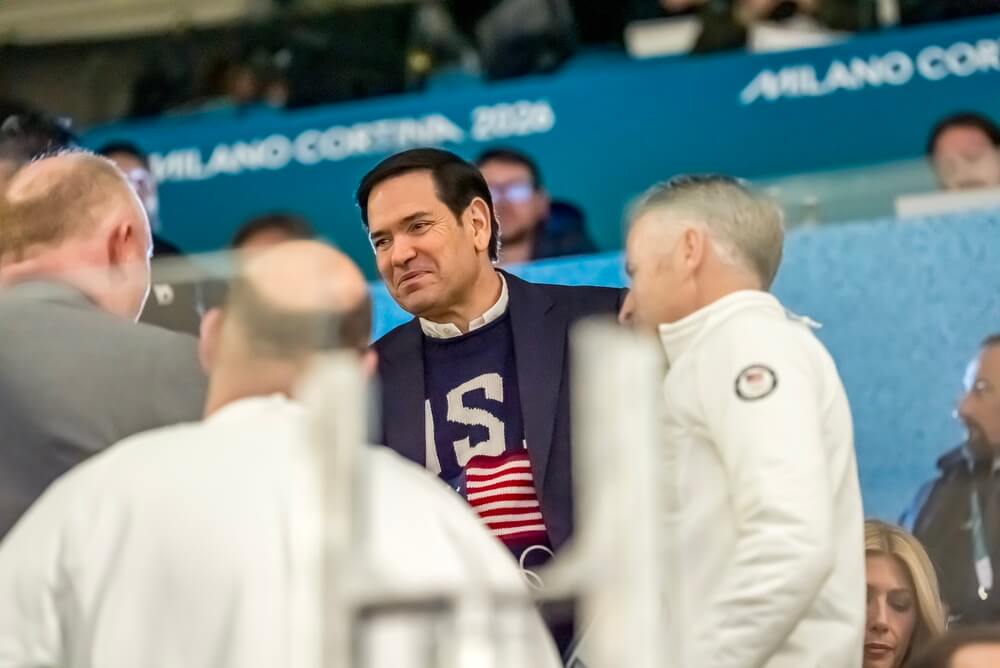 International rivalry – whether on the ice rink or in the laboratory – is a competition for talent and it cannot be achieved by hiding from the world - Marco Rubio
Would they have stopped thinking, inventing, and striving? Of course not, just as Ohno and Kwan would not have stopped skating.
If America turns talent away, talent will not vanish; it will relocate, and another country will claim the medals and the breakthroughs.
In the past year, the number of international graduate students studying in the US declined by 12%.
If this trend continues, it will undermine America’s scientific competitiveness in the long run. International rivalry – whether on the ice rink or in the laboratory – is a competition for talent and it cannot be achieved by hiding from the world.
It requires creating the most compelling environment for talent to gather, develop, and remain.
If the US wants to win the race for science, it must pair the best from abroad with the best at home, and offer not just opportunity but also a country where the best want to be.
Nancy Qian, Professor of Economics at Northwestern University, is Co-Director of Northwestern University’s Global Poverty Research Lab, Founding Director of China Econ Lab, and a visiting professor at the Einaudi Institute for Economics and Finance.
