Argentina is a country where almost half of the working-age population does not exist in formal terms. They do not pay contributions, do not receive severance pay, and do not have access to any legal protection mechanisms for employees.
Almost nine million people work in the grey economy, outside the system that has claimed to protect them for decades. This figure – nine million workers without legal status, contributions, or any protection – reveals the central weakness of the unions’ argument.
The system that claims to protect workers for decades has failed to include in its protection almost half of those on whose behalf it speaks.
President Javier Milei won the 2023 election on a wave of rejection of the political class that had plunged Argentina into economic collapse.
The February reform of labour legislation did not match the rhetoric that accompanied his rule, either in scope or content. It was targeted, legislatively precise, and in many respects more moderate than both his supporters and opponents expected.
The Argentina Senate voted on the reform on 12 February by 42 votes to 30, after a debate lasting more than thirteen hours. At the same time, there was chaos in front of Congress.
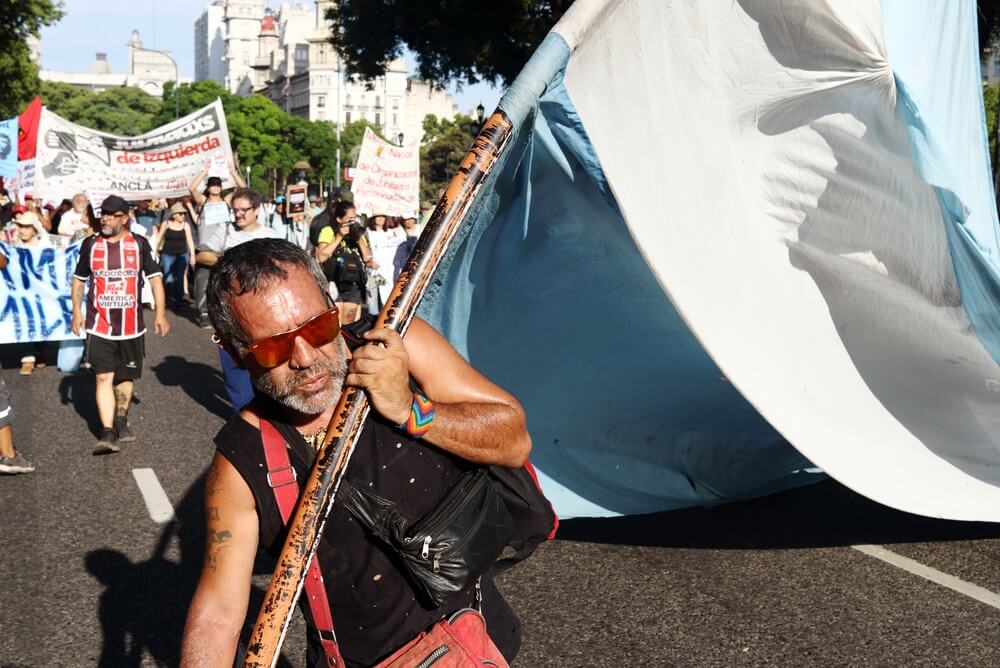
The police used water cannons and tear gas; 71 demonstrators were arrested, and another 70 were temporarily detained. The CGT (General Confederation of Labour, Argentina’s largest union headquarters) mobilised workers in protests described as “unprecedented in intensity.”
On 20 February, Argentina's lower house voted 135 in favour and 115 against the reform, while Buenos Aires was virtually paralysed by a general strike that halted flights, buses, taxis, and trains.
Due to subsequent amendments, in which the government removed a controversial article to ensure passage, the amended text returns to the Senate for final approval, scheduled for 27 February, the day before the president’s annual address to Congress.
Milei was in Washington at the time of the vote. On platform X he wrote, "Historic. Argentina will be great again."
Direct negotiations and the limits of union power
Argentina's labour laws have essentially remained unchanged since the 1970s. It was created during a period of mass industrial production, closed national economies, and almost full formal employment – conditions that would no longer exist in Argentina in 2026.
Today, with almost half of the workforce employed without any legal framework, this regulation primarily serves to protect the smaller, formal segments of the labour market while also maintaining trade union power, which no longer rests on the organisation of workers but on the monopoly over collective bargaining.
The right to strike has not been abolished, but it has been limited in a way that puts unions in a more difficult negotiating position
The reform introduces a so-called "hours bank" system, replacing paid overtime. Workers may work up to twelve hours a day (instead of the previous eight), but rather than receiving monetary compensation, the excess hours are transferred to a fund from which the employer unilaterally determines when and how the worker will take days off.
The reform reduces severance pay and introduces the possibility of direct negotiations between companies and employees, bypassing sectoral union contracts that previously automatically covered all workers in the sector, regardless of union membership.
The right to strike has not been abolished, but it has been limited in a way that puts unions in a more difficult negotiating position.
Article 44, which provided for a drastic reduction in sick pay resulting from an off-the-job accident, was removed from the final text as a direct concession to the centrists whose votes were necessary to pass the reform.
The structural reality behind the reform
La Libertad Avanza (Freedom Advances, Milei's party) holds about a third of the seats in both houses of parliament.
A landslide victory in the October 2025 election showed centrists that Milei's electoral base was stable and growing, which was reason enough not to vote against legislation coming from a president with such a mandate.
The unions' argument that the reform threatens workers' rights is valid for employees already in the formal system. However, it ignores the structural reality that provides context for the reform.
Argentina has the same number of formal company employees as it did ten years ago, despite the population having grown by three million in the meantime.
"The reality is that he’s being surgical, this isn’t the chainsaw. This reform is moderate, but it’s a start" - José Anchorena
According to data from the third quarter of 2025, 43.2% of the workforce is employed in the grey economy, without any legal status. Among young people, it exceeds 63 per cent.
The Fate tyre factory, the only one of its kind in Argentina, announced the closure of its plant and nine hundred layoffs in recent days, which the unions cite as a direct consequence of Milei's policies, while the government interprets it as a consequence of the rigidity that for decades has forced companies to grow exclusively outside the formal system.
José Anchorena, a former labour undersecretary in the government of Mauricio Macri and one of the analysts most familiar with the mechanisms of the Argentine labour market, evaluated the reform as follows: "The reality is that he’s being surgical, this isn’t the chainsaw. This reform is moderate, but it’s a start."
The reform’s actual targets
Examining the reform's actual targets is necessary to understand why the February protests were so intense. These are not provisions on overtime or the amount of severance pay.
Argentina's model of collective bargaining dates back to 1946 and was introduced under Juan Perón.
In this system, the union representing a sector negotiates contracts that automatically apply to all workers in that branch, regardless of whether they are union members.
This mechanism gives unions control over the working conditions of employees who are not their members and from whom they do not receive membership fees, representing an extremely privileged position unique among developed economies.
The CGT is not just a trade union headquarters in the traditional sense; it is the political infrastructure of Peronism
The reform, by introducing direct negotiations between companies and employees, does not formally abolish that monopoly but limits it functionally.
The CGT is not just a trade union headquarters in the traditional sense; it is the political infrastructure of Peronism. It has financed parties, launched election campaigns, and controlled mass mobilisation on the streets for eight decades. No president since 1946 has seriously questioned that position.
The February laws do so, at least partially and in one legislative step. It is precisely in this dimension that the explanation for the intensity of the reaction lies.
Formal employment or fewer rights
Union headquarters have announced lawsuits before the Constitutional Court, claiming that key provisions are unconstitutional.
The Argentine Constitution guarantees the right to collective bargaining but nowhere stipulates that contracts concluded by the union must automatically apply to all workers in the sector.
 Will companies that now operate in the grey economy, faced with more flexible formal employment rules, begin to register workers
That distinction is crucial, and the court battle will be fought over it. Lawyers are divided over the prospects for success. A real possibility exists that a portion of the reform might face judicial suspension prior to its implementation.
The final vote in the Senate is scheduled for 27 February, the day before the annual presidential address to parliament. The order is not random.
The government wants the law passed before the speech because it would give Milei a concrete legislative result to present to parliament and the public.
If the vote does not pass, it will not be a technical problem but a political signal that the centrist MPs who supported the reform are beginning to distance themselves from the government.
The central economic question of this reform is simple: will companies that now operate in the grey economy, faced with more flexible formal employment rules, begin to register workers, or will the reform only reduce the rights of those who already had a job in the formal system, while those nine million invisible workers remain where they are?
The answer to that question will be provided by employment data up to the end of 2026, and that data will be the only relevant judgement on whether the reform is working.
What can already be stated is that Milei is implementing legislative measures that no Argentine president since the return of democracy in 1983 has even attempted, and he is doing so using constitutional instruments and parliamentary procedures, not executive orders.
How long that approach can be sustained depends on two variables over which the government has no control: the courts and economic data, which will show over the course of the year whether the labour market is reacting as theories and laws predict.
