German companies invested approximately €5.6 billion in China in the first half of 2026, about one-third more than in the same period last year.
Over the same period, their direct investment in the United States fell by almost two-thirds, to around €4.3 billion. The analysis was carried out by the German Economic Institute in Cologne, based on Bundesbank statistics.
The amount invested in China is not a record and roughly corresponds to the average for half-year periods from 2020 to 2025, but it comes at a time when official Berlin is urging business to reduce its dependence on the Chinese market, technology and raw materials.
The increase in investment follows the rapid weakening of German exports to China, which fell by more than 12 per cent in the first six months of this year to less than €37 billion.
China slipped from second place among Germany’s export markets in 2021 to ninth.
Imports from China increased by 8.9 per cent to €91.8 billion, and Germany’s trade deficit with China reached approximately €55 billion, compared with around €40 billion a year earlier.
Large German groups can no longer rely on producing goods at home to sell in China, so they are shifting operations locally to protect their market position.
More German capital is staying in China
Direct investment statistics, beyond the construction of new factories, include the purchase of equity stakes, profits retained by companies in Chinese subsidiaries and loans between related firms.
From January to November 2025, more than €7 billion was invested in China, 55.5 per cent more than the approximately €4.5 billion invested in 2024.
Growth in the first half of 2026 has continued along this path, although the volume of investment remains far below the peaks recorded at the beginning of the decade.
Manufacturing in China allows companies to avoid part of the customs costs, shorten delivery times to Chinese customers and adapt goods more easily to their requirements
Manufacturing in China allows companies to avoid part of the customs costs, shorten delivery times to Chinese customers and adapt goods more easily to their requirements.
The cost of such adaptation is increasingly evident in Germany. When a car, machine or industrial piece of equipment is no longer exported from a German factory, domestic suppliers receive fewer orders, and part of the development, procurement and manufacturing work moves to China.
The profits of the Chinese subsidiary may accrue to the German group and its shareholders, but the wages, tax revenues and most of the industrial know-how associated with that facility are generated where the product is made.
China develops products for the world market
Volkswagen's plan illustrates how much the role of its Chinese subsidiaries has expanded. The company has stated that it intends to use technologies and cars developed in China in the markets of South-East Asia, South America, Africa and the Middle East.
Chinese subsidiaries are thus taking over part of the work that was previously mainly carried out by centres in Germany and are developing products intended for sale outside the country in which they were created. Lower labour costs are only part of the calculation.
Chinese manufacturers of electric vehicles, batteries and digital systems have shortened development times and imposed a pace that German companies can hardly keep up with if they rely solely on domestic centres.
A survey conducted in September by the German Chambers of Commerce and Industry, among around 1,300 companies, shows how widespread the pressure is.
Two-thirds of the companies surveyed face stronger Chinese competition, and in industry this share reaches 83 per cent
Two-thirds of the companies surveyed face stronger Chinese competition, and in industry this share reaches 83 per cent. Despite this, 88 per cent do not plan to withdraw from sectors where Chinese companies are advancing.
German companies are trying to respond by developing products more quickly, reducing costs and entering new markets, while almost a third are considering closer cooperation with Chinese partners.
For the management of large groups, withdrawing from China would not eliminate Chinese competition, because they are already competing with these companies in Europe and other markets.
Berlin and companies measure risk differently
During his visit to Beijing in February, Chancellor Friedrich Merz warned that Germany must not rely on a single country for supply chains, technologies and raw materials.
In recent years the German government has been particularly sensitive to China’s restrictions on exports of rare minerals and basic chips, as any disruption in supplies would quickly hit the automotive, machinery and electrical industries.
Merz, however, took representatives of about 30 German companies to China and spoke of the need for a strategic partnership.
The two messages are not incompatible, but they show how difficult it is to translate the political demand for reduced dependence into decisions that companies will accept.
For Berlin, risk reduction means more suppliers outside China, additional production capacity in Europe and less dependence on Chinese raw materials and technology
For Berlin, risk reduction means more suppliers outside China, additional production capacity in Europe and less dependence on Chinese raw materials and technology.
Large companies often interpret the same goal differently. They are building businesses in China that can continue to operate if tariffs, export bans or transport disruptions make the connection with Germany difficult.
Local production reduces exposure to border issues, but at the same time increases the amount of capital that cannot be moved quickly, as well as dependence on Chinese regulations, suppliers and political decisions.
The state is trying to secure an exit from China in the event of a serious crisis, while companies are making sure that their Chinese operations can survive even if relations with Europe deteriorate.
America is no longer a straightforward alternative
The drop in German direct investment in the United States to around €4.3 billion further complicates Berlin’s calculations.
This is the lowest half-year amount since 2023 and almost 80 per cent less than in the first half of 2024. The data do not indicate that German companies have withdrawn from America or opted for China instead.
Volkswagen has stressed that it makes investment decisions in the two markets independently.
For the German economy, the weakening of export-oriented production is far more significant than whether more money was invested in China or the US in a single half-year
However, the decline coincides with the uncertainty created by tariffs imposed during the Donald Trump administration, so the United States no longer offers a straightforward and predictable destination for German capital relocating from China.
In these conditions, the largest industrial groups are building separate systems for the three major markets.
Products intended for China are increasingly being developed and manufactured in China, the US market requires its own factories and suppliers, while the European Union is trying to keep production and employment within its territory.
This division protects companies from tariffs and disruptions to cross-border trade, but reduces Germany’s role as a global supplier.
For the German economy, the weakening of export-oriented production, which has sustained well-paid industrial jobs for decades, is far more significant than whether more money was invested in China or the US in a single half-year.
Europe prepares tougher trade protection
German companies are increasingly calling for a tougher European policy towards China. In a survey by the German Chambers of Commerce and Industry, 55 per cent of companies supported stronger EU measures against unfair competition, even at the risk of higher costs and Chinese retaliation.
Two-thirds favoured a harmonised European approach and 60 per cent wanted to reduce dependence in sensitive areas of production.
The business sector is not asking for a break in relations with China, but for protection of the European market while continuing to operate there.
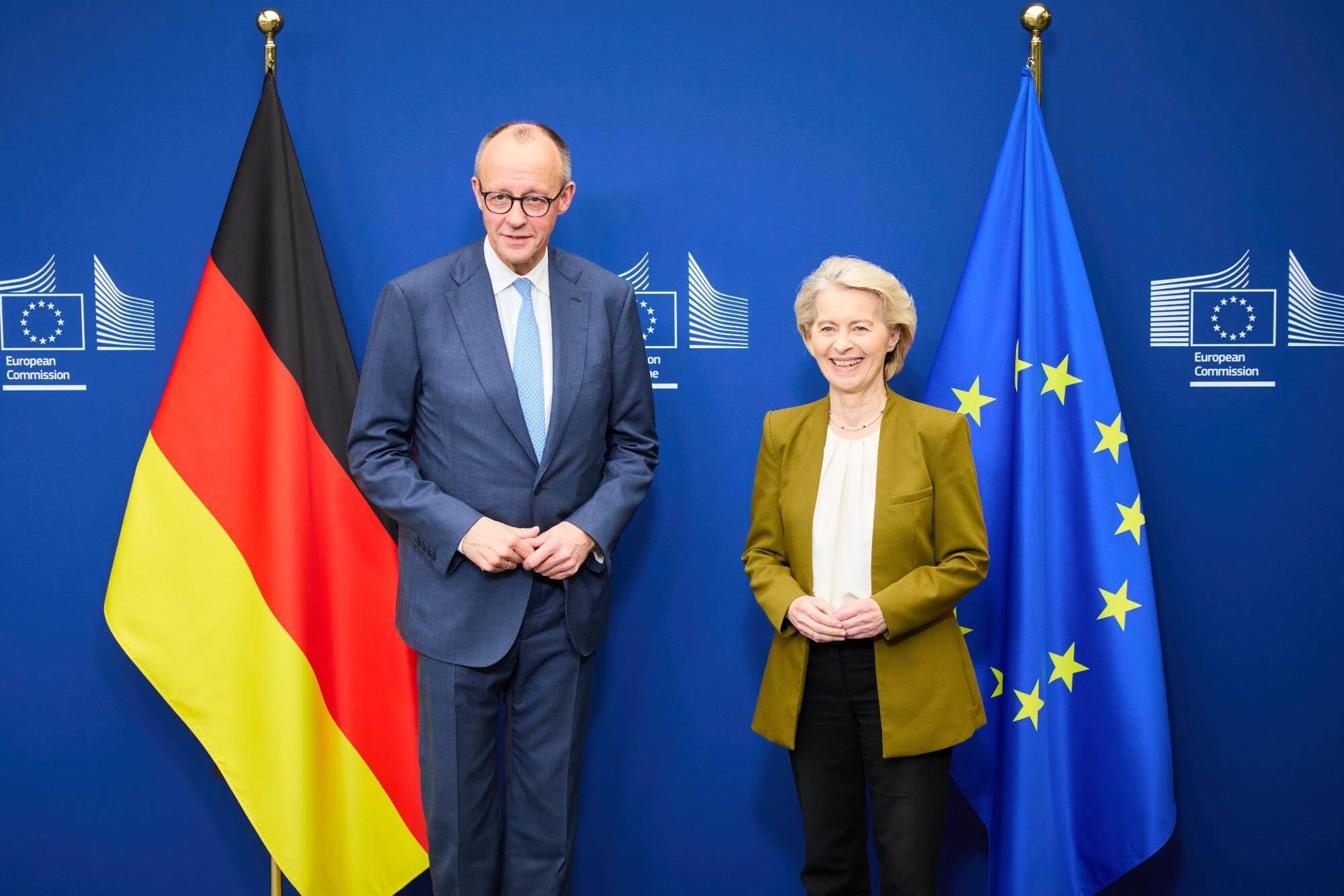 By the end of 2027, German companies are likely to be more deeply rooted in China, while Germany and the European Union impose more barriers to Chinese goods entering their markets
Berlin and Brussels will find it increasingly difficult to ignore this demand as Chinese manufacturers expand their sales in Europe and German exports in the opposite direction continue to fall.
The European Commission has given Beijing until the beginning of October to present initial steps to reduce the trade imbalance.
China’s trade surplus with the European Union reached €360.6 billion in 2025, an increase of 15 per cent, and in the first half of this year it grew by a further 9 per cent.
If the Chinese side does not offer sufficient concessions, support in Brussels will increase for new trade investigations, tariffs and restrictions on products entering the European market with extensive Chinese state backing.
Germany will support such measures more cautiously than France and some other member states, as its companies have more capital exposed in China, but current trade data leave less room for delay.
Berlin is unlikely to require companies to leave China, but over the next year it will tighten conditions for state support, encourage the sourcing of critical raw materials and components from a wider range of countries and accept stronger protections for European manufacturing.
Over the same period, large German groups will continue to make their Chinese subsidiaries more independent, as this is the fastest way to preserve access to a market where domestic competitors are becoming stronger.
By the end of 2027, German companies are likely to be more deeply rooted in China, while Germany and the European Union impose more barriers to Chinese goods entering their markets.
This development will not sever business ties but will further weaken the model in which German factories produced and China bought.
Investments totalling €5.6 billion show that companies have already adapted to the changed relationship, while Berlin is still looking for ways to preserve domestic industry without closing the Chinese market to German firms.
