In January 2026, Mykhailo Fedorov, then 35, became Ukraine's new defence minister. He had spent the previous several years running the Ministry of Digital Transformation, where he built a reputation as a moderniser who used digital tools to cut bureaucracy and improve transparency.
Even in that earlier role, he was already deeply involved in defence matters, notably through programmes like “Army of Drones,” which supplied the military with drones and specialised IT systems.
His move to the Defence Ministry coincided with a sharp increase in Ukrainian drone strikes on the rear of Russian forces operating inside Ukraine, made possible by a new generation of drones.
The military calls this “battlefield interdiction” and it corresponds to strikes on enemy supply lines and support infrastructure rather than on front-line troops themselves.
What is more, he began to “overhaul a wide range of internal processes”, notably linked to procurement.
That momentum was short-lived. In mid-July 2026, Fedorov lost his post in a cabinet reshuffle and was replaced as defence minister by Yevhen Khmara.
It soon became clear that the main reason for his removal was a string of clashes with traditionalists within the army's General Staff, most notably with General Oleksandr Syrskyi.
Syrskyi had commanded Ukraine's Ground Forces before taking over as head of the armed forces (known by the Ukrainian acronym ZSU) in February 2024, succeeding General Valerii Zaluzhnyi.
After several days of public criticism and protests, President Volodymyr Zelensky dismissed Syrskyi as well and replaced him with Mykhailo Drapatyi, a widely respected officer.
To understand what is really at stake, it helps to look back at the more than three decades long ZSU history.
Three decades in the making
When Ukraine became independent in 1991, it inherited from the Soviet Union a massive military force that it neither needed nor could afford to maintain.
Over the next two decades, the ZSU shrank dramatically, suffering from chronic underfunding amid the broader economic collapse that followed the Soviet Union's demise.
As a result, the military could barely train its troops, let alone feed or house them properly.
Russia's 2014 seizure of Crimea and the war that followed in the Donbas caught the ZSU almost entirely unprepared
These conditions fostered nepotism and corruption within a force that had also inherited the Soviet military's rigid, top-down command culture. Ukrainians describe this mix of corruption, rigidity and nepotism as “Sovietism”.
Russia's 2014 seizure of Crimea and the war that followed in the Donbas caught the ZSU almost entirely unprepared.
Ukrainian civil society stepped in to fill the gaps. Volunteers formed fighting units, and solidarity networks raised money, food and medical supplies for the troops.
Working with relatively junior officers, some civilian groups even developed IT tools to modernise the army's outdated command-and-control equipment.
A wake-up call
The setbacks of 2014-2015 also served as a wake-up call. Defence budgets rose sharply and the ZSU underwent years of reform.
Training exercises increased dramatically, and Army doctrine shifted towards giving unit commanders far more autonomy. Those reforms paid off in 2022.
That year, the ZSU defeated Russia's initial invasion plan despite serious setbacks in the south, then held the line in the Donbas before launching several successful counter-offensives.
That momentum lasted until the failed summer 2023 counter-offensive tipped the war into a grinding stalemate.
The pre-war reforms never fully eradicated the old “Soviet” practices
Over this period, the relationship between civil society and the ZSU became almost symbiotic.
A new generation of talented commanders also rose quickly through the ranks, helping Ukraine stay a step ahead of Russia in innovation.
Even so, these pre-war reforms never fully eradicated the old “Soviet” practices, and those habits came back with a vengeance once the full-scale war began.
They were evident in a cumbersome, over-centralised command system, which was only reformed starting in early 2025 with the introduction of a corps structure, and in a chaotic mobilisation and training process.
They also persisted in nepotism that kept incompetent commanders in place for far too long, and in a series of corruption scandals tied to military procurement.
The ZSU's inner workings
General Syrskyi came to personify these problems. Critics both within and outside the army blamed him for stalling reforms intended to fix the ZSU's command structure, for micromanaging operations, and for favouring loyal unit commanders while depriving others of manpower and supplies.
They also accused him of repeatedly refusing to allow units to withdraw even as they faced encirclement, invariably at the cost of unnecessary casualties, and, more recently, of using elite assault regiments almost as a personal guard to launch extremely costly, and sometimes operationally questionable, counter-attacks.
Whilst it is worth noting that Syrskyi’s job was never an enviable one, the criticism levelled at him has been remarkably consistent for years.
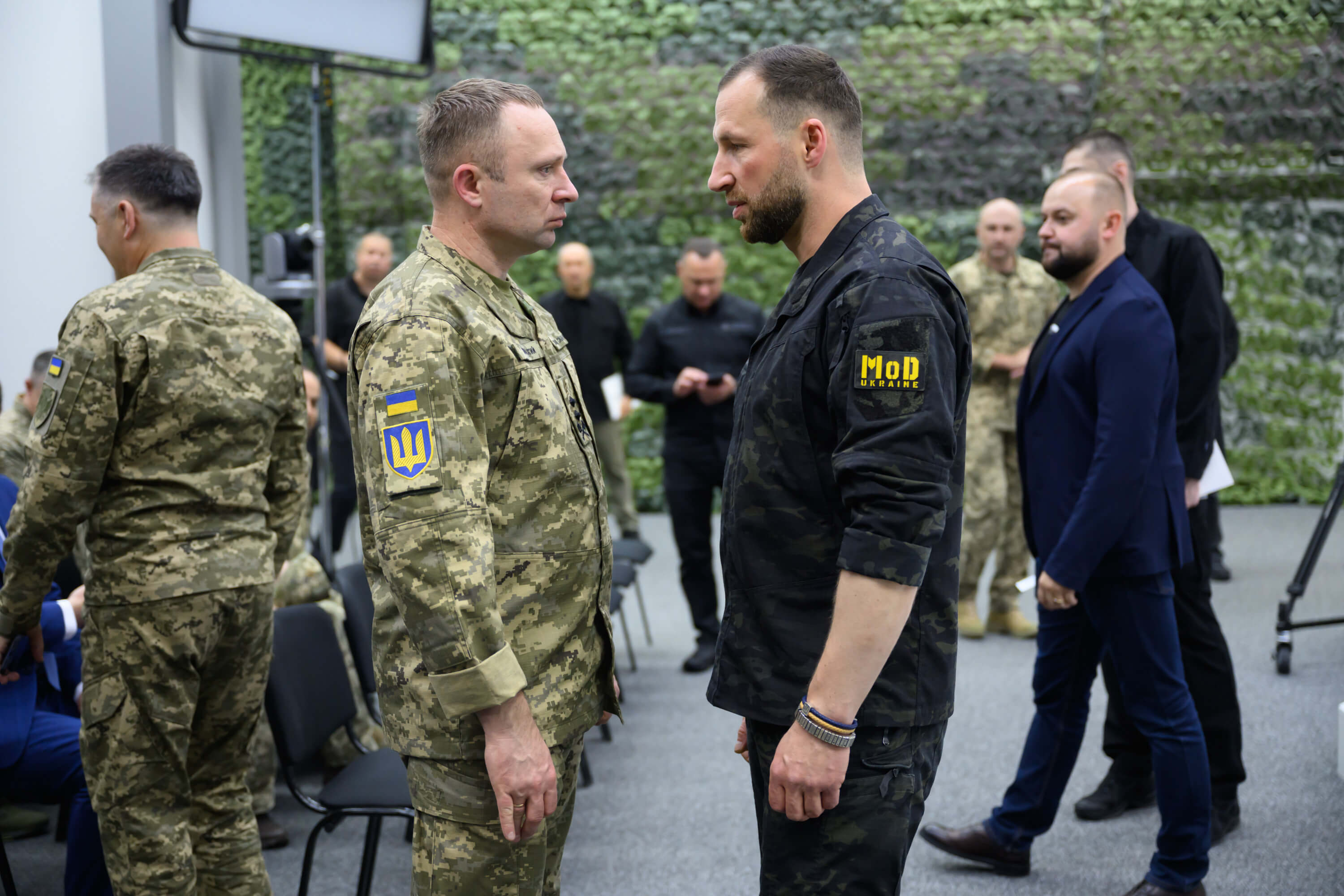 Mykhailo Drapatyi and Yevhen Khmara know the ZSU's inner workings intimately and have had years to think through how to fix its flaws
Drapatyi, his successor, belongs to the generation of battle-hardened commanders forged on the front lines since 2014.
He built his reputation by stabilising desperate situations, notably around Kharkiv and Pokrovsk.
He is also known as a reformer who champions the use of all kinds of drones, along with better command-and-control systems, as a way to offset Ukraine's chronic manpower shortage.
The new defence minister, Yevhen Khmara, has a similar profile. He is a former officer in Ukraine's elite Alpha special forces unit and is seen as both pragmatic and tech-savvy.
Both men know the ZSU's inner workings intimately and have had years to think through how to fix its flaws.
Break with the “Soviet” system
Drapatyi and Khmara wasted little time. On 26 July, Drapatyi ordered a halt to new recruits joining two assault regiments that had enjoyed exclusive recruitment privileges under Syrskyi.
The move followed allegations of serious misconduct, including orders to fire on retreating Ukrainian soldiers, which led to dozens of non-combat deaths.
By early August, the new command had begun to move moved against senior officers closely associated with Syrskyi
By early August, the new command had also begun to move moved against senior officers closely associated with Syrskyi.
Whether this amounts to a genuine break with the “Soviet” system, however, will depend less on personnel changes than on whether these translate into lasting structural improvement.
The clearest metric to watch in the months ahead is whether Ukraine's chronically troubled procurement and logistics system and its mobilisation and training pipeline for new recruits show marked and durable improvements.
Adrien Fontanellaz is a military historian and analyst specialising in contemporary warfare. He is a member of the scientific committee of the Centre d’Histoire et de Prospective Militaires (Pully, Switzerland).
