The European Parliament backed a three-year postponement of certain obligations to measure and report methane emissions during the production and import of oil, gas and coal.
On the same day, Donald Trump declared the import of wind turbines and their parts a threat to US national security and ordered negotiations with trading partners.
Both decisions introduce new uncertainty for companies that sell energy or energy equipment on the other side of the Atlantic.
The two decisions are not linked by a single negotiated agreement, but they illustrate how different the scope is for the two parties to set conditions on access to their markets.
The Commission and Parliament are proposing to delay the European rule following public pressure from major oil and gas exporters, including the United States.
Washington is keeping open the possibility of new restrictions on wind turbines, and certain turbine parts already face US tariffs on steel, aluminium and copper.
The Turnberry Agreement, through which the EU and the US sought to govern mutual trade last year, will be reviewed in December.
The European Commission is due to submit a report on US tariffs on European steel and aluminium products, including wind turbine parts, by 1 December.
If those tariffs remain above 15 per cent at the end of the year, the EU may retaliate by withdrawing benefits for American steel and aluminium.
Turnberry and the difference in bargaining power
In July 2025, a political agreement was reached in Turnberry, Scotland, and a joint statement issued in August set out rules to ease the trade dispute.
The European Union abolished tariffs on American industrial products, and the US imposed a tariff ceiling of 15 per cent on most goods from the EU, with some exceptions.
The European provisions have been in force since 1 July this year. The deal also includes energy co-operation and the EU’s intention to buy 750 billion dollars’ worth of American energy products by the end of 2028, although actual purchases will depend on companies’ contracts.
European buyers are seeking alternatives to the remaining Russian supplies while avoiding a dispute with their largest supplier of liquefied natural gas
The growing importance of gas in these relations is evident from the latest Eurostat data. In the second quarter of 2026, the US accounted for 63.2 per cent of European imports of liquefied natural gas, and Russia for 17.3 per cent.
The ban on imports of Russian liquefied natural gas under long-term contracts will take effect on 1 January 2027, the same day that the implementation of key methane obligations for imported fuels is due to begin.
European buyers are seeking alternatives to the remaining Russian supplies while avoiding a dispute with their largest supplier of liquefied natural gas.
How exporters secured a delay
US Energy Secretary Chris Wright and ministers from Qatar, Nigeria and Algeria warned European institutions in a joint letter in June that from January 2027 almost all oil imports and a significant share of gas imports would fail to comply with European rules.
They called for deadlines to be suspended and for no penalties to be imposed during the transitional period. In July, the Commission recommended that member states refrain from penalising importers for non-compliance between 2027 and 2029, and in October it proposed postponing certain obligations by one year. Parliament went further, backing a three-year delay.
The exporters’ demands carried greater weight because of market conditions. In July, the Commission stated that conflict in the Middle East was forcing the EU to compete for oil and gas amid tighter supply and rising prices.
It justified the October proposal by pointing to high energy prices and pressure on gas and oil supplies ahead of winter. Brussels is also responding to the risk that stricter rules could further curb the volume of fuel European importers are able to purchase.
The 2024 regulation requires verification of how much methane escapes into the atmosphere during the extraction and transport of oil, gas and coal. Methane is the primary component of natural gas, so any leak represents lost fuel that could otherwise be sold.
The postponement covers several obligations with differing deadlines. For contracts signed or renewed from 4 August 2024, Parliament proposes giving importers until 31 May 2031 to prove that fuel originates from operations where emissions are monitored, reported and verified under rules as rigorous as those of the EU.
France is among the leading suppliers of wind turbines and components to the US market
Industry figures warn that several supplier countries face a shortage of independent auditors, harmonised measurement standards and certificates recognised by European authorities.
At the same time, the delay erodes the competitive edge of producers that have already invested in monitoring and reducing emissions.
The International Energy Agency estimates that by tackling leaks and unnecessary flaring, exporters supplying the EU, Britain, Japan and South Korea could deliver more than 25 billion cubic metres of additional gas to buyers.
According to the same report, around 320 billion cubic metres of gas were certified in 2024, mostly from North American fields, although certification standards vary widely.
US exporters face another challenge: gas from large numbers of wells is blended in pipelines before reaching export terminals, where it is chilled and liquefied for shipment to Europe.
Consequently, exporters cannot identify which specific wells supplied a given cargo, nor calculate the exact volume of methane emitted during production.
The three-year delay is not yet certain. Parliament has adopted only its negotiating stance, and the final wording must still be agreed with member states in the Council of the EU. Member state ambassadors failed to agree a common position on 21 October, so talks are scheduled to resume on 28 October.
By July, 17 of the 27 member states had called for changes to the import rules. French President Emmanuel Macron requested a one-year pause in September. At the same time, France is among the leading suppliers of wind turbines and components to the US market, so the new American measures would affect it directly.
Security as a reason for trade restrictions
On 22 October, Donald Trump signed an executive order declaring the import of wind turbines and their components a threat to US national security.
He cited three principal grounds: foreign equipment could be used by hackers to breach systems that manage electricity generation, turbines interfere with radar systems, and the US is overly reliant on foreign manufacturers.
Commerce Secretary Howard Lutnick and US Trade Representative Jamieson Greer have been instructed to negotiate with foreign trading partners and report back to the president within 180 days. The decision does not impose new tariffs on wind turbines, but keeps existing levies in place.
In August 2025, the Department of Commerce included wind turbines and their components among the 407 product categories subject to US tariffs on steel and aluminium.
The order goes beyond the technical risks posed by imported equipment. Trump administration portrays wind power as an unreliable energy source because the wind does not blow continuously.
It also claims that wind farms place an unnecessary strain on the American power grid and divert capital from fossil fuel and nuclear power stations, which generate uninterrupted baseload electricity.
European manufacturers now find themselves negotiating with an administration that questions the viability of wind energy itself. Neither scaling up domestic manufacturing in the US nor offering cybersecurity guarantees would address that underlying concern.
In December 2025, Trump administration halted the construction of five offshore wind farms, citing classified military assessments of radar interference
There is some technical basis for the security risks highlighted by the administration. Under certain conditions, wind turbines can disrupt radar systems, and grid-connected infrastructure can present an attack surface for hackers if network defences are weak.
However, the US Department of Energy maintains that radar interference can be mitigated through site selection, turbine positioning and technical adjustments.
The executive order does not explain why restricting imports of specific components would resolve these issues, which are typically addressed through software audits, robust access controls and careful site planning.
The Trump administration has already faced similar arguments in federal courts. In December 2025, it halted the construction of five offshore wind farms, citing classified military assessments of radar interference.
Among those affected were projects led by Denmark’s Ørsted and Norway’s Equinor. On 12 January 2026, Federal District Judge Royce Lamberth granted an injunction allowing construction to resume on the Revolution Wind project, which was nearly 90 per cent complete at the time.
The court ruled that the government had failed to show why the national security risk could not be mitigated with less disruptive measures instead of shutting down the development entirely. The same national security argument about radar systems is now being used to justify import restrictions.
The Chinese problem and European manufacturers
In 2024, the United States imported about $1.8 billion worth of wind turbines and related parts. According to an analysis by the American Action Forum, a Washington-based economic policy research centre, Mexico, France, India, Denmark and Germany were the leading exporters.
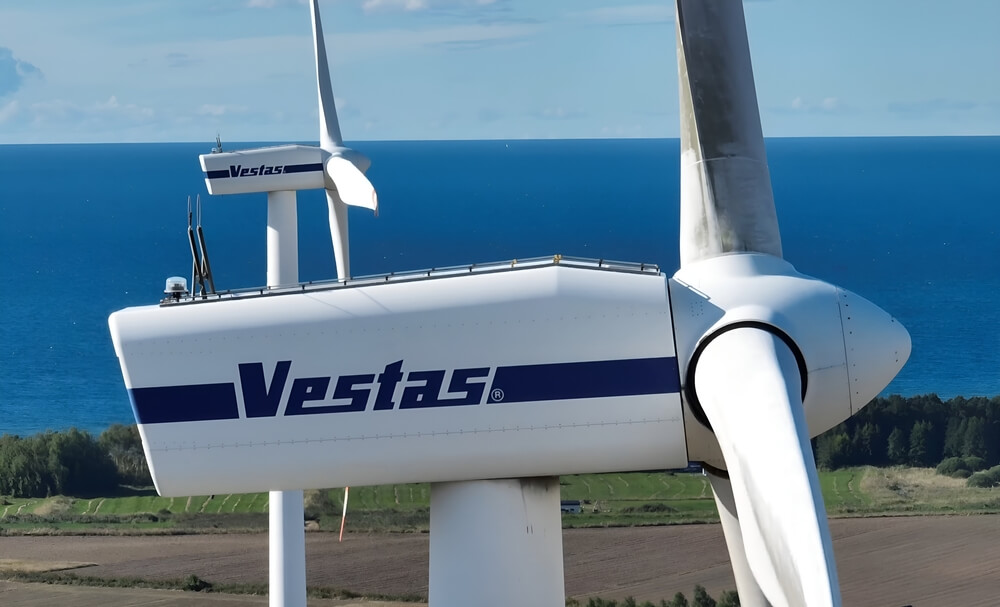 Denmark’s Vestas supplied 40 per cent of all new onshore wind turbines installed in the US in 2024
Only about 5.6 per cent of those imports came from China. According to energy market consultancy Wood Mackenzie, Denmark’s Vestas supplied 40 per cent of all new onshore wind turbines installed in the US in 2024, while US firm GE Vernova accounted for 56 per cent.
Vestas also operates manufacturing plants in the US state of Colorado, meaning that import restrictions could directly affect American workers.
According to Eurostat, the European Union exported wind turbines worth €3.1 billion in 2025. Imports of assembled wind turbines into the EU were significantly lower, at around €700 million, although China accounted for 59.6 per cent of that total, up from 41.3 per cent the previous year.
Europe is itself seeking to mitigate security risks associated with Chinese equipment. In January, the European Commission proposed regulations that would allow suppliers deemed a security risk to be excluded from the electricity grid and other critical infrastructure.
New US restrictions would hit European manufacturers particularly hard, given that they are the primary alternative to Chinese equipment for both Europe and the United States.
December check
Europe has a means to respond. Under the regulation through which the EU implemented the Turnberry agreement, the European Commission has until 1 December to submit a report assessing the level of tariffs the US levies on European steel and aluminium products. Washington then has until the end of the year to reduce them.
If those tariffs remain above 15 per cent on 31 December, the Commission may reintroduce tariffs on US iron, steel, aluminium and derived products, although it is under no legal obligation to do so.
The same regulation allows Brussels to withdraw other trade concessions for US goods if Washington breaches the agreement or deliberately targets European businesses. The emerging restrictions on European wind turbines could represent precisely such a breach.
Although Trump’s executive order requires a report on negotiations within 180 days, fresh measures targeting European equipment could arrive much sooner
Brussels has so far chosen not to jeopardise gas supplies and to protect the broader trade deal with Washington. The EU appears set to delay its methane rules by more than a year, going beyond the Commission’s original proposal, and to adopt a cautious stance on US tariffs.
Although Donald Trump’s executive order requires a report on negotiations within 180 days, fresh measures targeting European equipment could arrive much sooner.
How Brussels responds after 31 December will reveal its willingness to pursue a more intense trade dispute to protect its domestic industry, at a time when nearly two-thirds of the liquefied gas Europe imports by ship comes from the United States.
