On 1 May, Donald Trump increased tariffs on European cars and trucks from 15% to 25%. In Brussels, this move was presented as further proof of his unpredictability.
However, the main problem for the European Union is not Trump's negotiating method. The problem is simpler and more politically embarrassing: nine months after the signing of the Turnberry agreement, the EU has still not managed to ratify the deal it initiated and presented as stabilising transatlantic trade.
The second trilogue between the European Parliament, the Council and the Commission, concluded during the night of 6–7 May, again failed to reach a compromise.
A new round of negotiations is scheduled for 19 May. For Washington, this is enough to claim that the European side is not fulfilling the obligations it has accepted.
That is the crux of the problem. Trump uses a political style often described in Europe as aggressive and transactional, but at the same time the EU has left him procedural space to turn that style into a negotiating advantage.
What was actually agreed at Turnberry
The July 2025 agreement was not intended to establish a new transatlantic economic partnership, but rather to prevent further deterioration in trade relations between the US and the EU.
The European Union agreed to reduce certain tariffs and expand access to the European market for US industrial, agricultural, and marine products, while Washington, in turn, limited tariffs on most European exports to 15%, including cars.
For European industry, the automotive sector was crucial. In 2024, the United States imported about 750,000 European vehicles, worth almost 39 billion euros.
The majority of these exports came from Germany, Italy, and the Central European production chain linked to German companies.
The problem did not arise when Trump raised tariffs. It began much earlier, when it became clear that the EU was unable to implement the agreement it had negotiated quickly enough to have a practical effect.
Trilogues are slow even when there is full political agreement, which was lacking from the outset in this case
The European system is not designed for situations in which the other party imposes external deadlines and uses time as a tool of pressure. Trilogues are slow even when there is full political agreement, which was lacking from the outset in this case.
Parliament has already delayed the procedure twice. The first delay was due to Trump's threats to countries that did not support the American position on Greenland. The second delay followed the February 2026 decision of the US Supreme Court, which challenged part of the legal basis for the previous tariffs.
After the US Supreme Court decision, the effective tariff on European exports temporarily fell from 15% to 10%, as the Trump administration lost part of the legal basis for the previous tariff regime.
Brussels then insisted on returning to the originally agreed 15%, not because the higher tariff was more favourable for Europe, but because the EU wanted a stable and formally agreed framework rather than a temporary regime that could be changed at any time.
This gap enabled Washington to use the argument of "non-fulfilment of obligations" with much greater political weight than would have been possible if the European procedure had been completed on time.
The real problem is not tariffs, but internal divisions within the EU
Behind the procedural deadlock lie deep differences among key EU members.
Berlin and Rome want the agreement ratified as soon as possible, even if this requires certain political concessions to Washington.
Their main reason is industrial, directly linked to the automotive sector, which is most exposed to the consequences of higher US tariffs.
German manufacturers are already experiencing serious consequences. In 2025, Volkswagen incurred multibillion-euro losses due to additional US tariffs while trying to maintain competitiveness in the US market. BMW reported a significant drop in profits in the first quarter of 2026, citing US tariffs as one of the main reasons.
The situation is even more difficult for Porsche and Audi, which lack significant production capacity in the US and therefore cannot mitigate the impact of higher tariffs through local production.
Germany seeks a quick agreement, while France wants a deal that can withstand Trump’s next move
For Berlin, this is no longer a matter of trade tactics or political prestige; it is about protecting industry, which remains one of the key pillars of the German economy.
France and Spain view the problem differently. Their focus is not the current tariff level, but the political reliability of the US administration. Parliament therefore insists on an automatic response mechanism in the event of new unilateral American actions.
Such a request is not unrealistic. Since July 2025, Washington has changed the operational terms of the agreement several times through political or legal instruments.
Paris assesses that ratification without a safeguard mechanism would effectively mean accepting a model in which the US can periodically use tariffs as an instrument of political pressure without a serious European response.
This is now the main conflict within the EU. Germany seeks a quick agreement, while France wants a deal that can withstand Trump’s next move. These two positions are currently incompatible.
Why has the automotive sector become a central target?
Trump did not choose cars by accident. The European automotive industry is the most concentrated point of economic pressure on the EU. At the same time, it creates political divisions within the Union itself.
Germany remains the most exposed, but the problem extends far beyond the German economy.
The entire Central European production chain is connected to the German automotive industry: the Czech Republic, Slovakia, Hungary, Poland and Romania are directly dependent on the export of components and subcontracting capacities.
The pressure is directed not only at Brussels, but also at Berlin, and through Berlin at the rest of the European industrial chain
This alters the internal dynamics of the EU. Countries that formally support a tougher European position also have a strong interest in stabilising the trade dispute as soon as possible.
Washington understands this very well. The pressure is directed not only at Brussels, but also at Berlin, and through Berlin at the rest of the European industrial chain.
This is precisely why the increase in tariffs on cars has a much greater political effect than a traditional trade dispute. It intensifies internal disagreements within the EU and accelerates the conflict between economic pragmatism and political autonomy.
Why the European response is limited
The European Commission has the means to respond. Lists of possible countermeasures already exist and include digital services, software, and certain US industrial exports.
However, technical capacity to respond is not the same as political willingness to escalate.
The EU currently lacks a unified assessment of how far to proceed in the economic conflict with an administration that remains NATO's key security partner.
Any serious countermeasure carries the risk of a broader political confrontation with Washington
This issue becomes even more serious at a time when the US is conducting parallel operations in the Persian Gulf and remains the central guarantor of the European security architecture.
For this reason, the trade conflict is no longer viewed in isolation in Brussels. Any countermeasure carries the risk of a broader political confrontation with Washington.
This restricts the European Commission's room for manoeuvre far more than is publicly acknowledged.
Europe, therefore, formally possesses instruments of economic retaliation. What it lacks is political consensus on the willingness to use them against the United States.
The EU is entering a phase of political relaxation
The most realistic scenario is not a complete collapse of the Turnberry Agreement; it is much more likely that the European side will gradually yield politically under increasing economic pressure.
If Trump activates the 25% tariffs before the trilogue on 19 May, the EU will almost certainly respond in a limited and symbolic manner. Harsh rhetoric from Brussels will not be accompanied by a proportional economic escalation.
At the same time, pressure from industrial centres within the EU will rapidly increase on Parliament to accept the compromise text.
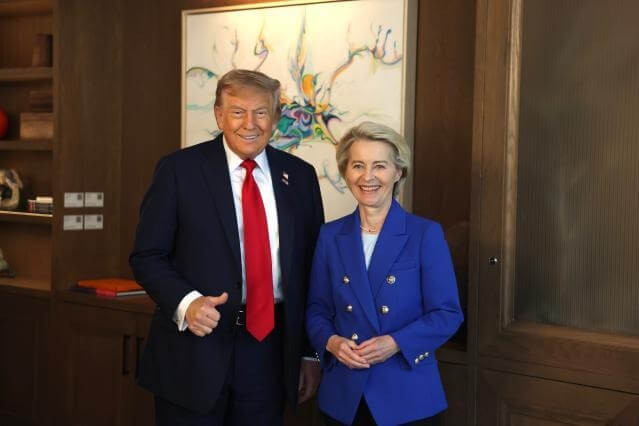 The Turnberry Agreement is likely to survive in some form. However, the damage to Europe's negotiating position has already been done
In that case, the most likely outcome would be an agreement with a weakened protection mechanism that France would formally present as European protection, although its practical value would be limited.
The second scenario involves Trump maintaining the threat as active leverage without immediately imposing new tariffs.
This would allow Washington to continue negotiations from a position of constant pressure, while the EU would attempt to procedurally close the trilogue without triggering an open trade escalation.
However, even in that case, the same structural problem remains: the European institutional system shows a very limited ability to react quickly when the other side uses time as a bargaining tool.
It is a much broader political message than the trade dispute itself.
The Turnberry Agreement is likely to survive in some form. However, the damage to Europe's negotiating position has already been done.
Washington now has a precedent it can use in future: the argument that a political deal with the EU does not automatically produce an operational result.
For an administration that regards international agreements solely in terms of pressure and concessions, European procedural slowness is not a minor issue.
It is a negotiating weakness that Washington will exploit whenever it believes it can obtain an additional concession from the EU.
