A Turkish court annulled the 2023 congress of the Republican People's Party, suspended the leadership of Özgür Özel, and reinstated Kemal Kılıçdaroğlu, Erdoğan's opponent in the 2023 presidential election, as CHP leader.
Özel refused to recognise the decision and leave the party headquarters in Ankara. The crisis ended with police intervention and the takeover of the CHP headquarters.
The political significance of this decision extends far beyond the internal conflict within the largest opposition party. In the previous year, for the first time in a long period, the CHP demonstrated that Erdoğan's AKP could lose political control over key urban centres.
The 2024 local elections confirmed that the opposition is no longer merely a protest bloc without the capacity to threaten the government.
Istanbul and Ankara remained under CHP control, and the election results showed that Erdoğan's party no longer enjoys the political dominance it has regarded for years as almost the natural state of Turkish politics.
Therefore, the current judicial intervention is not merely a matter of party procedures. It is directly linked to the government's attempt to return the opposition to a state of internal conflict, organisational exhaustion, and political uncertainty.
İmamoğlu remains a central problem for Erdoğan
The main problem for Erdoğan is not Özgür Özel; it is Ekrem İmamoğlu.
The mayor of Istanbul is the only opposition politician who, according to credible research, can directly threaten Erdoğan in the presidential elections. This is why pressure on the CHP has become increasingly open and aggressive in recent months.
The trials against İmamoğlu, investigations into opposition mayors, and the current intervention in the CHP leadership are all part of the same political strategy.
CHP is a much more serious threat today than it was two or three years ago
The aim is not to ban the opposition, but to weaken it before the next major election cycle.
Istanbul is central to this strategy. Erdoğan’s political career began in the city, and he understands its symbolic and operational significance very well. The loss of Istanbul in 2019 was a serious political setback for the AKP.
The confirmation of that defeat in the 2024 local elections demonstrated that the opposition is no longer limited to traditional secular strongholds but can mobilise a much broader urban bloc of voters dissatisfied with the economic situation and the government’s long-term dominance.
This is why the CHP is a much more serious threat today than it was two or three years ago.
The courts enter into a political conflict
In recent years, Turkish politics has operated less through traditional competition between government and opposition, and more through a model in which the institutional apparatus actively participates in political conflict.
Courts, regulatory bodies, and administrative mechanisms are no longer merely the framework within which political struggle occurs; increasingly, they determine its boundaries and direction.
The CHP case is now the most direct example of such a process. The court decision affects not only one opposition politician, but also directly changes the leadership of the largest opposition party in the country.
The government is now trying to return the opposition to a state of procedural disputes, internal conflicts, and a struggle for legitimacy
For Erdoğan, such a strategy is politically rational. After the local elections, it became clear that the opposition is no longer weak enough to be ignored. Under Özel, the CHP began to act more organised, aggressive, and effective than in the period following the 2023 presidential elections.
This is why the government is now trying to return the opposition to a state of procedural disputes, internal conflicts, and a struggle for legitimacy.
This is currently the most favourable scenario for the presidential system. An opposition that uses energy on internal conflicts is much less dangerous than one that succeeds in mobilising voters around a single political objective.
Kılıçdaroğlu's return raises the issue of legitimacy
Kemal Kılıçdaroğlu remains an important figure in the Turkish opposition. For years, he held the CHP together under very difficult political circumstances and managed to unite a broad opposition bloc against Erdoğan in 2023.
However, after the defeat in the presidential elections, he lost political momentum and the support of much of the party membership.
That is why his return by court decision does not appear as a political renewal of the CHP, but rather as an attempt to restore the party to an older and politically safer configuration for those in power.
This is where a serious problem arises for the party itself. Even if Kılıçdaroğlu formally takes control of the party infrastructure, it is very difficult to expect him to regain the political authority he lost after 2023.
An attempt to destabilise the opposition could produce exactly the opposite effect
Özel is trying to build resistance on this point. His calculation is simple: the court can change the administrative control of the party, but it is much more difficult to change the political mood within the CHP base.
That is why he insists on a new congress and rapid confirmation of legitimacy through delegates and local committees.
If he succeeds in presenting the crisis as a politically motivated intervention by the state in the opposition, the CHP could emerge from this conflict more politically unified than before.
This is a serious risk for Erdoğan, as an attempt to destabilise the opposition could produce exactly the opposite effect.
Economic stability and political pressure: increasingly difficult to reconcile
The market reaction indicates that investors are monitoring developments closely. The court decision was followed by a fall in Turkish shares and increased nervousness among investors.
This is not due to the market’s political proximity to the CHP, but to the perception that political uncertainty is deepening within the state’s institutional system.
The Turkish economy has operated for years under the pressure of high inflation, a fragile lira, and the need for a constant inflow of foreign capital.
Erdoğan is attempting to pursue two parallel policies, which are increasingly difficult to harmonise
In this environment, political conflicts involving the courts, the police, and the largest opposition party increase the perception of systemic risk.
Erdoğan is attempting to pursue two parallel policies, which are increasingly difficult to harmonise.
On one hand, he seeks to maintain firm political control over the system. On the other, he is trying to convince markets and international partners that Türkiye remains a stable and predictable country for investment.
These two goals do not always align when political conflict begins to affect the core of the institutional system.
The West has little scope for exerting pressure
Reactions from Western countries are likely to remain limited to diplomatic criticism and warnings about the state of democracy.
This is not due to ignorance of the situation, but to strategic dependence on Türkiye. Ankara remains important for NATO, the Black Sea, the war in Ukraine, migration policy, Syria, and the security of the Eastern Mediterranean.
Erdoğan understands well how much this geopolitical position increases his room for manoeuvre.
Shifts in public mood usually occur gradually, but once they become widely accepted, they are very difficult to reverse politically
In recent years, he has shown that he relies on the West’s view that a functional Türkiye is more important than a serious conflict with Ankara over domestic politics.
But this is precisely where a long-term problem arises for the Turkish government. The more the institutional apparatus enters into open conflict with the opposition, the more the impression grows that the political system no longer functions as a fair electoral contest.
Such shifts in public mood usually occur gradually, but once they become widely accepted, they are very difficult to reverse politically.
Erdoğan buys time, but not political peace
Erdoğan’s calculation is clear at present. The longer the CHP remains embroiled in the battle for control of the party, the less space the opposition has to address the economy, inflation, and falling living standards – issues where the government seriously lost political initiative in the major cities last year for the first time.
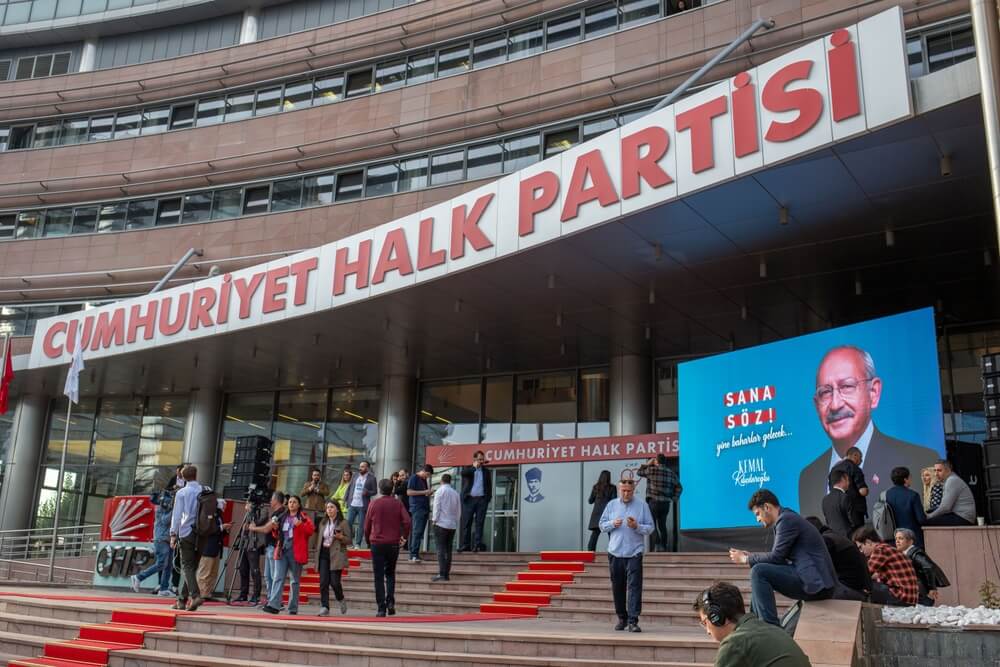 The longer the CHP remains embroiled in the battle for control of the party, the less space the opposition has to address the economy, inflation, and falling living standards
But this is where the greatest risk for the system itself arises. The local elections of 2024 showed that part of the urban electorate no longer votes only against the opposition or for stability, but against the long-term concentration of political power.
In such a climate, judicial intervention in the largest opposition party can slow the opponent in the short term, but it can hardly restore the political dominance the AKP enjoyed in previous years.
Therefore, the next period will probably be determined less by who formally controls the CHP, and more by whether the opposition manages to present this crisis as evidence that political competition in Türkiye is no longer primarily resolved through elections.
If it succeeds, Erdoğan’s government could enter the presidential cycle for the first time in a long while with a more serious problem than the opposition itself: the growing impression that the system no longer has enough confidence in its own political strength.
