Luckily for the rest of the world, the Ebola disease outbreak that has claimed almost 4,000 lives in the Democratic Republic of Congo is not a global pandemic and has remained confined to the region.
The US last week rejected a UN declaration pledging international collaboration and solidarity in response to pandemics.
Health experts are highly concerned about how the world may respond to the next pandemic, which they fear may be worse than Covid.
It only ended as a global public health emergency three years ago but has been pushed to the back of many people’s minds.
Washington’s response to the UN declaration and absence from the World Health Organisation (WHO), which is negotiating a treaty on global pandemic preparedness, means the world is failing to unite to prevent and get ready for the next health emergency.
“Agreeing to collaborate to prevent, prepare for and respond to pandemics should not be controversial,” said Helen Clark, a former prime minister of New Zealand and a co-chair of the Independent Panel for Pandemic Preparedness and Response, which was established by the WHO in 2020 to evaluate the global response to Covid and provide evidence-based recommendations for preventing future pandemics.
In the meantime, the number of confirmed Ebola cases has passed 8,000 for the first time in an outbreak since the current one began in the DRC in mid-May, Congolese authorities announced on 28 September. There have been 3,901 deaths, representing a fatality rate of 48.4%.
In two past outbreaks of Bundibugyo virus that causes Ebola diseases, reported in Uganda in 2007 and in the DRC in 2012, the case fatality rates were 30% and 50% respectively, says WHO.
The regional 2014-2016 West Africa Ebola outbreak killed more than 11,000 people, primarily in Guinea, Liberia and Sierra Leone.
An elaborate hoax
“We know that for Ebola disease, early access to care can significantly improve chances of survival,” said Janet Diaz of WHO’s Health Emergencies Programme. “Yet in this outbreak, many people are still dying at home or in their communities because they are unable to reach health facilities on time.”
Last weekend, a senior DRC politician was beaten to death after he defended the government’s containment measures against Ebola on a radio show.
It was unclear who carried out the attack against Marie-Celestin Karondwa, the acting president of the Union for Democracy and Social Progress (UDPS) party’s federal executive committee in Butembo, a new hotspot for the outbreak.
Many Congolese are sceptical about the disease, some even think it is an elaborate hoax
Many Congolese are sceptical about the disease, some even think it is an elaborate hoax, and several health workers and health facilities have been attacked.
The UDPS said Karondwa was “an innocent victim for having defended the party’s position on the existence of the Ebola virus disease… and the threat it poses to the population.”
The outbreak is “far from over” and officials are struggling to control the spread of “many outbreaks in many places” across the DRC, says WHO chief Tedros Adhanom Ghebreyesus. “The area is so vast that it’s hard to speak of a single epidemic,” he said.
Disease control is also severely hampered by ongoing war in eastern DRC as groups battle for control of territory and mineral wealth.
The Rwanda-backed March 23 Movement (M23) rebel group controls large parts of North and South Kivu provinces, including major hubs like Goma and Bukavu captured in early 2025. More than seven million people are displaced in the DRC.
Retreat from multilateralism
Washington’s main response to the Ebola outbreak was a travel ban imposed in May for people coming from the DRC, Uganda or South Sudan.
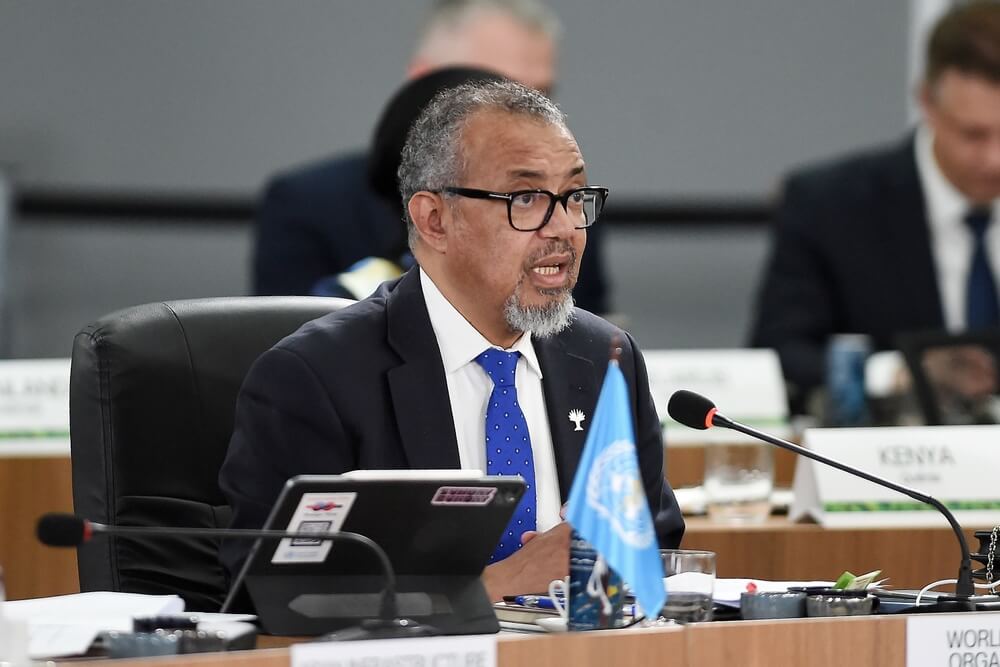 On 17 May, WHO declared the outbreak a public health emergency of international concern, the highest level of global alert issued by the body - Tedros Adhanom Ghebreyesus
On 17 May, WHO declared the outbreak a public health emergency of international concern, the highest level of global alert issued by the body, meaning there is a public health risk to other countries that are legally required to respond.
The US pulled out of the WHO soon after President Donald Trump took office last year as part of Washington’s retreat from multilateralism.
The US was even the lone vote against a global commitment to reduce traffic accidents, saying road safety was being used “as a backdoor vehicle to enforce global climate pacts,” the New York Times pointed out.
In the attempt to pass by consensus a UN declaration on pandemic preparedness, the US opposed “the inclusion of divisive ideologies that lack definitional consensus”, thought to refer to issues of equity and universal access to sexual and reproductive healthcare services.
Bilateral health agreements
The EU was also opposed to references to intellectual property, such as whether the transfer of technology between countries should be voluntary or mandated. Such divisions have also left the WHO pandemic treaty in limbo.
The treaty was adopted by the WHO in May 2025, but key details have yet to be finalised, including whether countries should be obligated to share data on new pathogens, even though, during Covid, China’s early sharing of the virus’s genome helped lead to rapid vaccine development. But the subsequent vaccines were unevenly distributed across the world.
Treaty negotiations will continue until May next year
“Countries in the global south want ironclad guarantees that if they share a sample or a data today, tomorrow they will get the drugs or vaccines and diagnostics that are developed with them,” Suerie Moon, co-director of the global health centre at the Geneva Graduate Institute, told NPR.
Treaty negotiations will continue until May next year. Health officials worry that a series of bilateral health agreements between the US and 35 mostly African countries, which include sharing pathogen data in exchange for aid, will undermine any global pandemic treaty.
There are still lots of questions about how these health agreements will replace slashed foreign aid and help the 35 countries to achieve their health needs, says analysis by the Think Global Health non-profit.
In the meantime, keep your fingers crossed that a global pandemic does not break out any time soon.
