On 22 June, the US Treasury Department announced a general licence allowing Iran to freely sell oil, petroleum products, and petrochemical products to all buyers worldwide, including, for the first time in two decades, the United States.
The licence covers extraction, transportation, shipping, insurance, and financial transactions in US dollars, and is valid until midnight on 21 August.
US Secretary of the Treasury Scott Bessent explained in one sentence: Iran has committed to free transit through the Strait of Hormuz and to the return of International Atomic Energy Agency inspectors to the country.
Iran denied both conditions by the end of the same day.
Iranian Foreign Ministry spokesman Esmail Baghaei stated that Iran had not met with IAEA Director Rafael Grossi and that there was no schedule for inspections of nuclear facilities.
The Speaker of the Iranian Parliament and head of the negotiating team, Mohammad Baqer Ghalibaf, announced on the return flight from Geneva that the management of the Strait of Hormuz will never be the same as before the war and that the strait will be administered by the Islamic Republic of Iran.
He described the agreement reached in Bürgenstock as evidence of US failure. The next day, Trump accused Iran of making false statements but added that there was no urgency for inspections.
What the Islamabad Memorandum actually envisages
The agreement is officially called the Islamabad Memorandum of Understanding, where the key negotiations took place.
Trump physically signed it on 17 June at the Palace of Versailles during dinner with Macron after the G7 summit; Iranian President Pezeshkian signed simultaneously in Tehran, and Pakistani Prime Minister Sharif in Islamabad. Vance and Ghalibaf signed the text electronically on 14 and 15 June.
The fifth point of the memorandum, concerning Hormuz, explicitly states that free passage for commercial ships is provided without charge for only sixty days.
The same point obliges Iran to define the future administration and services in the strait with Oman and other coastal states of the Persian Gulf in accordance with international law and the sovereign rights of the coastal states.
Ghalibaf's statement about Iranian administration of Hormuz is not a diplomatic improvisation; it is a continuation of the text signed by both parties.
Iran's ballistic missile arsenal was not mentioned in the memorandum, nor was the network of proxies in Lebanon, Yemen, or Iraq
The tenth point of the memorandum requires the US Treasury Department to immediately issue concessions for the export of Iranian oil upon signing.
The 22 June licence was not conditional on new Iranian commitments in Switzerland; it implemented the obligation that had existed since 17 June.
Bessent presented the US decision as a consequence of the new Iranian commitments made in Bürgenstock, although Washington's commitment to facilitate the export of Iranian oil appears in the memorandum a few days earlier and is not related to the subsequent negotiations in Switzerland.
The sixth point obliges the US, together with regional partners, to provide at least 300 billion dollars for the reconstruction of Iran, with a payment mechanism to be defined within sixty days.
Iran's ballistic missile arsenal was not mentioned in the memorandum, nor was the network of proxies in Lebanon, Yemen, or Iraq.
Pezeshkian confirmed in Islamabad on 23 June that the missiles are not included in the MoU and never will be.
The nuclear clause exists, but the verification mechanism does not
The memorandum includes a nuclear clause: Iran affirms that it will not pursue nuclear weapons, using wording almost identical to that of the 2015 JCPOA – an agreement that Trump deemed insufficient when he withdrew from it in 2018.
The memorandum also sets out a minimum methodology for the on-site dilution of highly enriched uranium, under IAEA supervision. The precise terms, schedule, and scope of inspections are left to the final agreement.
Any serious negotiation regarding Iran's nuclear programme must begin by addressing the current location of the enriched uranium and determining the actual stockpiles following hostilities and attacks on nuclear facilities.
In June 2025, following the Israel-US attacks on Iran's nuclear facilities, the IAEA withdrew all inspectors. According to the IAEA's February report to the Board of Governors (GOV/2026/8), the agency cannot confirm the current size, composition, or location of Iran's enriched uranium stockpile.
US negotiators want to establish the location and condition of nearly half a tonne of highly enriched uranium
According to the most recent estimate before the attack, Iran had 440.9 kilograms of uranium enriched to 60% U-235, which, by IAEA standards, is sufficient for about nine to ten nuclear weapons if further enriched to 90%.
Iranian Foreign Minister Abbas Araghchi claimed in March that the enriched uranium was beneath the rubble of the attacked facilities.
However, neither the IAEA nor any other international institution can confirm that claim or determine the actual location of the material.
Iranian Foreign Ministry spokesman Esmail Baghaei stated on 23 June that Iran continues to comply with its obligations under the Nuclear Non-Proliferation Treaty, but war-damaged nuclear facilities remain closed to international inspectors.
US negotiators want to establish the location and condition of nearly half a tonne of highly enriched uranium.
Without an answer to that question, any future agreement may have political value, but it can hardly have serious nuclear content or verification significance. This topic was hardly even raised at Bürgenstock.
When the administration replaces free passage
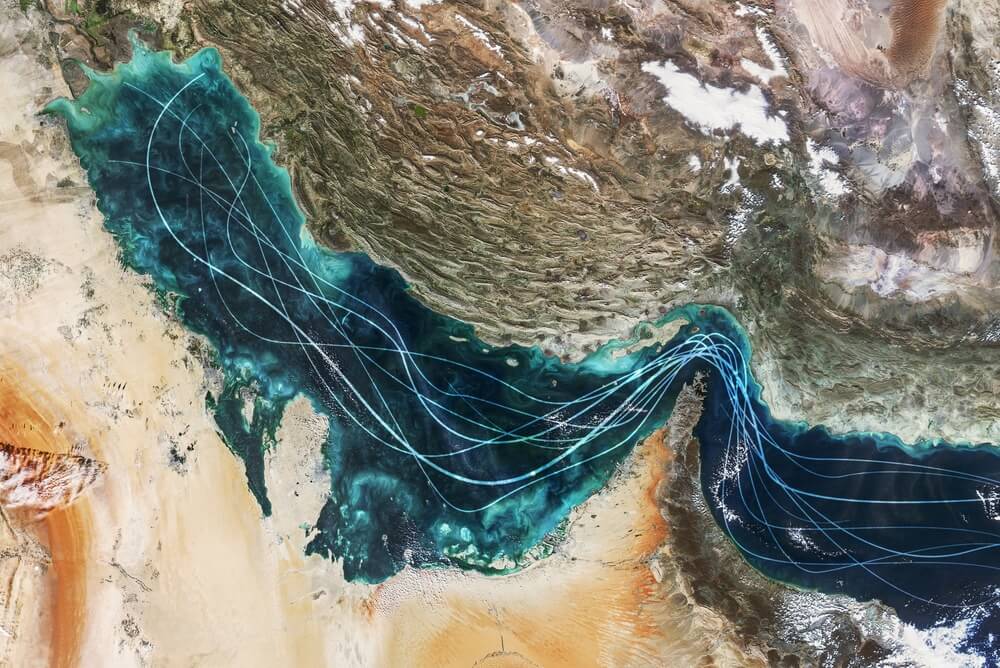
Iranian Parliament Speaker Mohammad Bagher Ghalibaf did not mention closing the Strait of Hormuz.
His message referred to the future management of the strait and the role Iran will play in determining navigation rules after the expiry of the sixty-day regime provided for in the memorandum.
Before the war, the Strait of Hormuz operated under the UN Convention on the Law of the Sea as an international strait with full right of transit passage for all ships, without prior notification, Iranian consent, or compensation.
The Islamabad Memorandum set a time limit within that framework: free passage lasts for sixty days, and future administration is defined by Iran and Oman, together with other coastal states.
On 23 June, Iran and Oman issued a joint statement announcing that they are considering charges for ship passage and forming a joint working group on future arrangements, emphasising the sovereign rights of coastal states in the strait.
The energy shock caused by the closure of the Strait of Hormuz was among the largest disruptions in the oil market in recent decades.
Some tankers still use routes determined by Iranian authorities or switch off their transponders during transit
According to the International Energy Agency, global oil production during the most critical period of the crisis decreased by more than ten million barrels per day, while OPEC+ production fell by almost nine and a half million barrels per day.
The consequences were quickly reflected in energy prices. Brent oil reached 144 dollars per barrel, nearly double the pre-war price of about 72 dollars. The International Energy Agency described this crisis as the largest oil supply disruption in modern market history.
Changes were also evident in the strait itself. The number of ships passing through Hormuz each day fell from approximately 130 to single digits during the worst period of the crisis.
According to Kpler, some tankers still use routes determined by Iranian authorities or switch off their transponders during transit.
Managing the strait involves not only security responsibilities but also the authority to determine navigation rules, routes, costs, and the conditions under which energy products from the Persian Gulf enter the world market.
For Saudi Arabia, the UAE, Kuwait, and Qatar, whose entire oil exports pass through this route, the agreement that leaves the future of the strait to Iran-Oman negotiations results in a structurally worse strategic position than before the war. None of these actors were at the negotiating table in Islamabad or Bürgenstock.
21 August is not a deadline for peace
On 22 June, the markets reacted rationally in the short term. Brent crude fell by 3.3% to $77.90 per barrel, and WTI to $73.86. Last week, Iran delivered more than thirty million barrels to Asian customers. Kuwait lifted its force majeure notice, and Abu Dhabi’s oil company, ADNOC, resumed deliveries.
The EIA estimates that fully reopening the Strait of Hormuz would allow the return of tens of millions of barrels of oil whose transport was delayed during the crisis.
The mere possibility of normalising traffic through the strait was enough to ease fears of further market disruption and reduce pressure on energy prices.
For the Trump administration, this is particularly important at a time when energy costs remain one of the most sensitive economic issues before the November elections.
However, 21 August is not the deadline for a final agreement; it is the date the US sanctions licence expires.
 In Tehran, the outcome is presented as proof that Iran has secured economic concessions without giving up its nuclear programme, missile arsenal, or regional influence
Until then, Iran can sell significant amounts of oil, increase foreign exchange earnings, and mitigate some economic consequences of the war and sanctions.
The United States will then once again face the question of how to renew pressure without jeopardising the stabilisation of the energy market it sought to achieve with this agreement.
The memorandum commits the US to lifting all categories of sanctions, including UN Security Council resolutions, according to a schedule to be determined by the final agreement.
Part of this relief requires congressional approval, and US lawmakers are reportedly very dissatisfied with what has been achieved.
The Trump administration is trying to achieve two increasingly difficult goals. One is to lower energy prices and stabilise the market. The other is to present the Islamabad Memorandum as an agreement fundamentally different from the JCPOA, which Trump abandoned in 2018.
Ghalibaf said on the flight from Geneva that if Iran had chosen a military response, it would have faced a protracted war and great destruction, whereas negotiations in just a few days led to the lifting of restrictions on oil exports and the start of sanctions relief.
In Tehran, the outcome is now presented as proof that Iran has secured economic concessions without giving up its nuclear programme, missile arsenal, or regional influence.
This is precisely why Iranian officials speak much more about reconstruction, oil exports, and the future regime of the Strait of Hormuz than about inspections, enriched uranium, or the return of the IAEA.
From Tehran’s perspective, the most significant outcome of the negotiations so far is not the nuclear agreement, but the return of Iranian oil to the market and the start of economic normalisation.
The real question is therefore not what will happen on 21 August when the US licence expires, but what will happen when Washington tries to obtain what it did not achieve in Bürgenstock.
If by then there is no access to nuclear facilities, the fate of Iran’s stockpiles of enriched uranium remains unknown, and the future regime of navigation through Hormuz continues to be the subject of regional negotiations in which the United States has no decisive role, then it will become clear that the most significant US concession in this conflict was made before any verifiable nuclear concession was secured.
