At the end of World War II, the US Navy was by far the world’s largest. As late as 1975, the United States remained a major shipbuilding power, although its preeminence had already begun to diminish.
By the end of the 20th century, however, American shipbuilding was in steep decline, despite government efforts to revive it.
As American shipbuilding declined, China surged ahead. In 2015, its naval fleet roughly matched that of the US.
Five years later, it had 350 warships, while the US Navy had 293, down from 583 in 1987.
The country now accounts for more than 50% of global shipbuilding by tonnage (commercial and military), with South Korea and Japan producing much of the rest.
Chinese shipyards produced 1,700 ships in 2025, compared with just five ships built in the US.
And the outlook is hardly encouraging. China aims to expand its naval fleet to 435 ships by 2030, compared with the US Navy’s plan to add 58 by 2031, including 15 “Trump-class” battleships.
While the Chinese target is widely viewed as realistic, the American plan is thought to be “far-fetched.”
Efforts to rebuild American shipbuilding
This widening gap has spurred bipartisan efforts to rebuild American shipbuilding.
The SHIPS for America Act of 2025 provides industry subsidies and other measures aimed at boosting domestic production, including a Maritime Security Trust Fund of up to $20 billion.
In February, the Trump administration followed it with the Maritime Action Plan, an effort to rebuild the maritime industrial base by securing investment pledges from allies like South Korea.
The US Navy is struggling to keep its existing fleet ready for service
But shipbuilding capacity is only part of the story. The US Navy is also struggling to keep its existing fleet ready for service, with high costs and chronic delays contributing to a 20-year maintenance backlog; some ships are being decommissioned early.
Fleet readiness fell to 68% in 2025, well below the Navy’s 80% target, pushing deployments beyond the Navy’s six-month goal.
Deteriorating conditions on the USS Abraham Lincoln, the USS Gerald Ford’s 326-day deployment earlier this year, and the recent power outage aboard the USS Benfold are all evidence of that strain.
Uncompetitive shipbuilding
While the current shipbuilding push may strengthen the industry, it does little to address the underlying causes of its decline.
Chief among them is Section 27 of the 1920 Merchant Marine Act, better known as the Jones Act, which requires cargo shipped between American ports to travel on US-registered, American-built vessels owned and crewed by Americans. Repairs performed abroad are subject to a 50% tax.
By protecting American shipbuilders from foreign competition, the Jones Act has made domestic shipbuilding and shipping extremely uncompetitive.
Ships cost 4–5 times as much to build in the US as in major shipbuilding countries and 3 times as much to operate as foreign-flagged vessels, largely because of higher labor and material costs.
The results should surprise no one. As of 2025, only 92 ships were Jones Act-eligible to carry goods from one American port to another, with their average age exceeding what is considered safe.
Cargo traffic along the Atlantic and Pacific coasts has fallen by half since 1960
With shipping so expensive that moving goods by rail, road, and barge is often cheaper, cargo traffic along the Atlantic and Pacific coasts has fallen by half since 1960.
America’s shipping shortage is now so severe that the Trump administration issued a Jones Act waiver for energy and fertilizer shipments in March, then extended it by another 90 days in early August.
More jet fuel has been shipped from the Gulf Coast to the West Coast since the waiver was granted than in the previous 36 years combined.
Tariffs on imported parts and components
Unlike their US counterparts, major shipyards abroad build both commercial and military vessels, which share many inputs, from steel hulls and engines to propellers.
Their workers can gain experience building simpler commercial vessels before moving to more complex military ships.
And because government procurement fluctuates with budgets and changing defense needs, shipyards that can shift workers between commercial and military production have a competitive advantage.
Despite the Navy’s preference for electromagnetic catapults, Trump has ordered a return to steam-powered systems
Tariffs on imported parts and components are another driver of rising US shipbuilding costs.
The US Navy is operating within a fixed budget of $292 billion for fiscal year 2026, including $47.4 billion for shipbuilding, which means that those higher costs must ultimately be paid for through additional taxes or through reductions in fleet size and capability.
Then there are Trump’s expensive whims and bizarre fixations. Despite the Navy’s preference for electromagnetic catapults, which are cheaper, require fewer sailors, and can launch and recover aircraft more quickly, Trump has ordered a return to steam-powered systems.
He has also directed the Navy to explore moving the command tower on aircraft carriers to a location he finds more aesthetically pleasing.
These changes will cost billions of dollars and add nothing to the Navy’s combat capabilities.
Trump’s ‘golden fleet’
Trump’s “golden fleet” of “Trump-class” nuclear-powered warships promises to be vastly more expensive.
Designing the ships could take more than a decade, and the Congressional Budget Office estimates the program’s cost at $275 billion, with the first ship alone costing $23.4 billion.
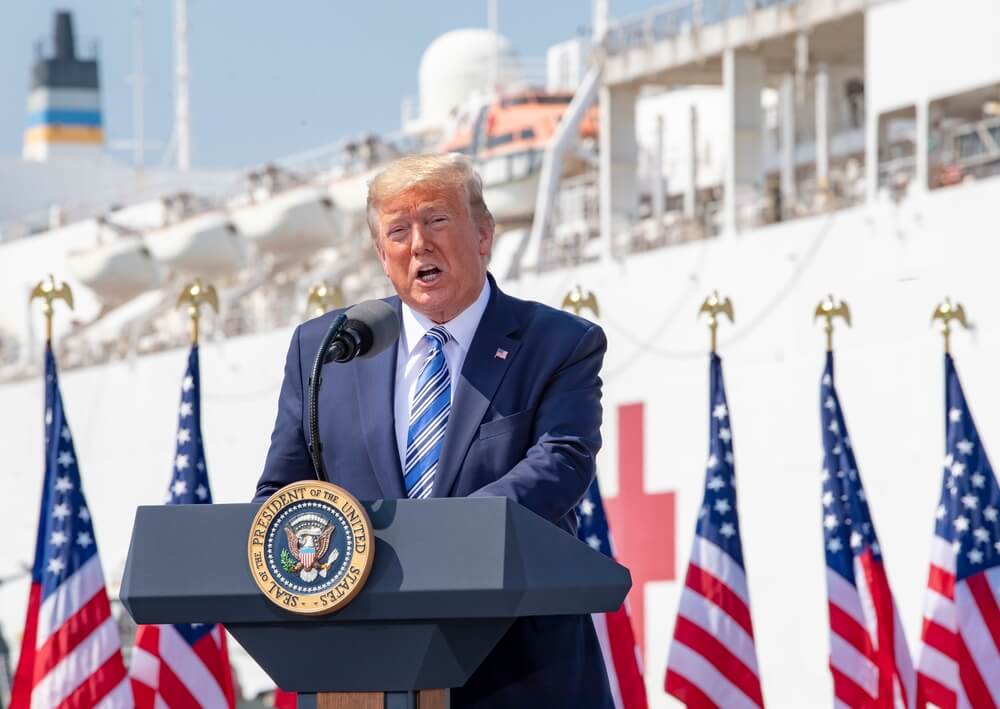 To reduce the exorbitant cost of its naval vessels, the US will have to turn to foreign competitors
Even if the plan proves infeasible, as many analysts expect, pursuing it would still drain the Navy’s budget.
To reduce the exorbitant cost of its naval vessels, the US will have to turn to foreign competitors.
But that alone will not revive American commercial shipbuilding, which cannot recover without repeal of the Jones Act.
Until then, it makes far more sense to procure ships and components from allied shipbuilding powers while continuing to subsidize domestic production where strategically necessary.
Using part of the Navy’s budget to buy ships from foreign allies would enable the US to acquire several times as many vessels at a fraction of the cost of building them at home.
Anne O. Krueger, a former World Bank chief economist and former first deputy managing director of the International Monetary Fund, is Senior Research Professor of International Economics at the Johns Hopkins University School of Advanced International Studies and Senior Fellow at the Center for International Development at Stanford University.
