Latin America almost certainly pays the world’s highest economic price for organized crime.
According to the Inter-American Development Bank (IDB), crime costs Latin America and the Caribbean an average of 3.44% of GDP annually, equivalent to 78% of all public education spending across the region.
But there are significant discrepancies across LAC. Brazil, Colombia, and Mexico stand out both for the scale of the problem and how organized crime operates.
To begin, one caveat is essential. This analysis covers only economic costs—lost investment, productivity, and growth.
It does not attempt to calculate the human toll of lives lost, communities displaced, and families torn apart, not because they are not important, but because any attempt to quantify these losses would be inadequate and trivializing.
The numbers below reflect only a fraction of the true damage.
Colombia’s organized-crime groups
For more than 40 years, Colombia has been dragged down by crime networks built around a single illicit commodity: cocaine. Colombia’s cocaine “industry” amounts to a quasi-export sector, and business is booming.
One study estimates that in 2024 alone, cocaine trafficking generated roughly $16.5 billion for criminal organizations—some 4.4% of GDP, and more than the country earns from oil exports.
Add the broader costs of crime and violence—estimated by the IDB and Fedesarrollo at 3.6% of GDP in 2022—and the drag on growth becomes stronger.
Colombia has long endured armed conflict involving far-right paramilitary groups, far-left guerrilla organizations, and crime syndicates, in which the narcotics industry plays a key role.
The government fought the Revolutionary Armed Forces of Colombia (FARC) for more than a half-century, before reaching a peace agreement in 2016.
Eliminating armed conflict could have added as much as 4.4 percentage points to average annual economic growth between 1988 and 2009
One study estimated that eliminating armed conflict could have added as much as 4.4 percentage points to average annual economic growth between 1988 and 2009.
The 2016 agreement with FARC did not deliver this peace dividend. The criminal economy the accord was meant to dismantle has continued to thrive, with coca cultivation hitting a record 230,000 hectares in 2023.
When coca cultivation surges in a given area, homicides follow closely behind, along with forced displacement and attacks by armed groups.
The damage compounds at the firm level: research on Colombian companies found that kidnappings targeting individual businesses make managers pull back on investment for years afterward, as fear becomes a tax on doing business.
Meanwhile, Colombia’s organized-crime groups have diversified into extortion and illegal mining—the main impediments to growth in Mexico and Brazil, respectively.
Mexican cartels
In Mexico, criminal organizations charge mostly small and medium-size businesses an illegal tax—euphemistically called derecho de piso (“floor rights”)—simply to operate.
With every link in the distribution chain subject to such tolls, prices become gradually inflated: limes that leave the farm at 13 pesos ($0.76) per kilo can have a price tag of 85 pesos by the time they reach consumers.
Whereas Colombia’s cocaine income at least brings foreign currency into the economy, Mexico’s extortion amounts to pure loss.
Estimates suggest that extortion costs the country around 2% of GDP annually.
Crime is subtracting 1–2 percentage points from Mexico’s annual GDP growth
Similarly, the OECD’s chief Mexico economist estimates that crime is subtracting 1–2 percentage points from Mexico’s annual GDP growth.
This helps to explain why growth has remained stubbornly weak, despite broadly sound macroeconomic fundamentals.
The costs are compounded by US President Donald Trump’s administration, which is now treating Mexican cartels as a trade and security issue.
Tariff threats, sanctions, and the implicit threat of unilateral military action increase uncertainty and undermine investor confidence.
Sophisticated financial actor
In Brazil, organized crime is increasingly operating as a sophisticated financial actor, rather than a territorial predator.
Criminal organizations like the Primeiro Comando da Capital (PCC) and Comando Vermelho (CV) have diversified well beyond drug trafficking into fuel distribution, mining, real estate, and investment funds.
The recent Operação Carbono Oculto uncovered a scheme involving the use of more than 1,000 gas stations and shell companies to launder illicit proceeds through the formal financial system.
Notably, homicides in Brazil fell by roughly one-fifth in 2013–23, but the economic cost of organized crime kept rising—a sign of the professionalization and financialization of criminal groups.
In 2025, the Igarapé Institute put the total value of organized crime at 10.24% of GDP—roughly R$1.3 trillion ($250 billion).
If Brazil brought its crime rate down to the global average, the IMF estimates that its GDP could grow 0.5 percentage points faster annually
If Brazil brought its crime rate down to the global average, the International Monetary Fund estimates that its GDP could grow 0.5 percentage points faster annually.
The prevalence of organized crime is becoming a major political issue in all three countries.
In Colombia, Abelardo de la Espriella just won one of the closest presidential elections in the country’s recent history on a promise to dismantle the criminal economy. He has a mandate to do so, but it is very thin.
In Brazil, Luiz Inácio Lula da Silva has spent his latest presidency largely avoiding the public security issue, even as Rio de Janeiro police conducted a large-scale operation against the CV and the US designated the PCC and CV as terrorist organizations.
Now, Flávio Bolsonaro, Lula’s challenger in the October election, is seeking to capitalize on this weakness, positioning himself as the law-and-order candidate.
While Lula has now signed a R$11 billion anti-organized-crime package of his own—and still leads in most polls—this is ground on which he would rather not be fighting.
A bleak picture
The stakes are highest for Mexican President Claudia Sheinbaum. Mounting evidence that organized crime has not merely infiltrated her governing coalition, but helped to finance it, has dented her reputation ahead of the 2027 midterm elections.
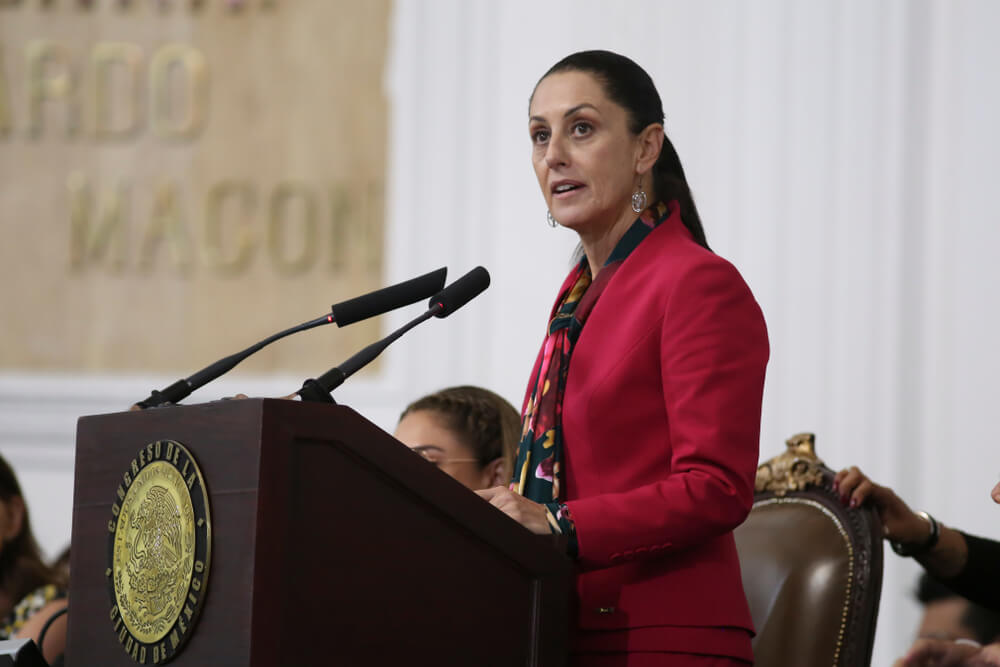 The stakes are highest for Mexican President Claudia Sheinbaum
It has also invited increased scrutiny from the US, which indicted ten Mexican officials on cartel-conspiracy charges in April.
The government has responded with a constitutional amendment allowing elections to be annulled on grounds of “foreign interference,” providing further fuel to critics.
More recently, former President Andrés Manuel López Obrador’s son (Andy) had his US visa cancelled, signaling a significant increase in US pressure reaching the inner circle.
Even excluding lives lost, communities displaced, and families ravaged, the economic costs of organized crime produce a bleak picture, shaving 0.5–2 percentage points off annual GDP growth in the countries most affected.
Over two decades, this leaves these economies roughly 15–30% smaller than they could have been otherwise. That, too, represents a hefty human toll.
Guillermo Ortiz, a former finance minister of Mexico and governor of Banco de Mexico, is Treasurer of the G-30.
