Colombia is holding parliamentary elections today, which, in terms of political significance, far exceed the usual renewal of legislative power.
More than 41 million voters will decide the composition of Congress – 103 Senate and 183 House seats – while three political primaries are held simultaneously, in which the largest political blocs select their presidential candidates for the 31 May elections.
This election is shaped by the broader regional context, which has changed dramatically in the past two months.
The US Operation Absolute Resolve in Caracas led to the fall of Nicolás Maduro’s regime and raised the issue of political and security stabilisation in Venezuela.
Yesterday, the Doral Charter was signed in Miami, a document through which the Donald Trump administration is seeking to assemble a group of Latin American countries willing to pursue closer political and security cooperation with Washington.
In this environment, Colombia, as Venezuela’s immediate neighbour and the closest US partner in the region, has gained significantly more political weight than it had just a few months ago.
Colombia’s geography determines its political importance at this moment. It shares a long border with Venezuela, through which both migration flows and the main routes of illegal trade pass.
At the same time, it is the most stable country in the immediate vicinity and the most important security partner of the United States in the northern part of South America.
Therefore, the political direction that emerges from these elections will have consequences far beyond Colombia itself.
That is exactly why today's vote in Bogotá is being watched closely both in Washington and across the region.
The new balance of power in Colombian politics will determine how willing the country is to participate in Venezuela's stabilisation and in the security arrangements the United States is seeking to establish in that part of the continent.
Domestic political conflict
An additional political dispute arose over the government's handling of the budget crisis.
Congress passed the 2026 budget in September 2025 but in December rejected the Appropriation Act that would have provided the government with the additional $4.2 billion needed to implement it.
Today's vote is also a referendum on Petro's political model
Petro responded by declaring an economic emergency, claiming the right to introduce taxes by decree, bypassing parliament.
The Constitutional Court suspended that decree in January 2026 – six out of nine judges voted for the suspension.
That is why today's elections carry additional political weight. That is why today's vote is also a referendum on Petro's political model.
The political arena: elections that determine the president
Although a new composition of Congress is being elected today, the political significance of these elections far exceeds the parliamentary framework.
The result will largely indicate the balance of power ahead of the presidential elections scheduled for 31 May.
Public opinion surveys published in recent months by the agencies Invamer, Guarumo, and AtlasIntel show a clear polarisation in Colombian politics. The electorate is increasingly divided between left and right political options, leaving less room for centrist candidates.
The most important candidate of the left-wing Historic Pact coalition is Senator Iván Cepeda, a close political ally of President Gustavo Petro. According to most surveys, his support currently ranges between 29 and 31 per cent.
However, Cepeda's campaign cannot be separated from the legacy of the current government. It is precisely the policy of Gustavo Petro's government that now represents his greatest political weakness.
Petro's government has faced serious political and economic problems in recent years. Proposed reforms of the healthcare system and labour legislation did not pass Congress.
Iván Cepeda is leading a campaign that is closely associated with the legacy of the current government
At the same time, investigations were launched against the president's son due to suspicions of illegal campaign financing. In addition, public finances are under pressure: estimates suggest that the fiscal deficit could reach between 7.5 and 8 per cent of GDP in 2026.
During 2025, Petro resorted three times to extraordinary economic measures to introduce tax changes by decree. The opposition claims that this circumvents the regular parliamentary procedure and that the executive branch is expanding its powers at the expense of Congress.
Under these circumstances, Iván Cepeda is leading a campaign that is closely associated with the legacy of the current government. His political space is limited.
If he relies too much on Petro's policies, he risks losing some voters who are dissatisfied with the government's performance. If he distances himself from them, he weakens the support of the coalition that nominated him.
His long-standing role in negotiations with guerilla organisations carries additional political weight. Urban and more liberal circles perceive this as support for peace agreements. In more conservative parts of the country, there remains strong suspicion towards any politician closely involved in those negotiations.
The opposite side of the political spectrum
On the opposite side of the political spectrum is a candidate who, until a few months ago, was almost outside the political mainstream.
Cartagena lawyer Abelardo de la Espriella quickly gained political visibility and became one of the main representatives of the right.
According to surveys published at the beginning of the year by AtlasIntel, his support has approached the 30 per cent mark.
De la Espriella built his political profile through open conflict with the government of Gustavo Petro. He particularly distinguished himself with legal initiatives against presidential decrees, which he submitted to the Constitutional Court, claiming that the executive thereby bypasses parliamentary procedure.
In the campaign, he presents clear political messages. He promises a tougher fight against drug cartels and armed groups, including wider use of the military against their logistics networks.
At the same time, he seeks a change in energy policy and the return of investment in the oil and gas sector, which the Petro government tried to limit. The third element of his platform is closer security cooperation with the United States.
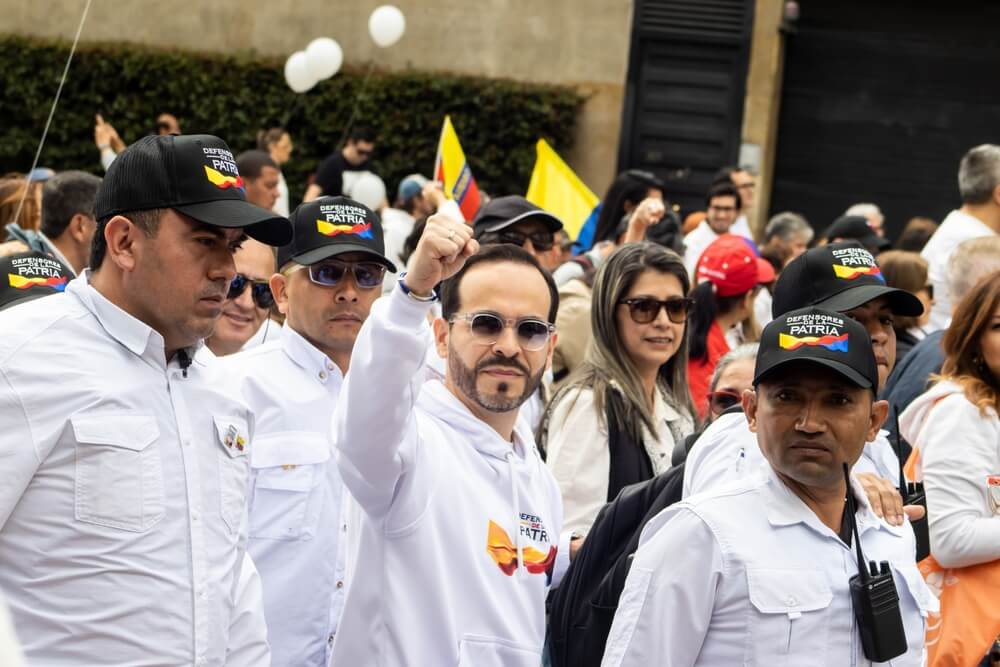 Abelardo de la Espriella promises a tougher fight against drug cartels and armed groups
This political direction fits into the broader strategy that Washington has been trying to shape in the region in recent months.
Such a political programme also carries serious risks. Stronger use of the military against cartels may lead to a short-term reduction in their operational freedom, but Colombia's experience shows that such operations often trigger new waves of violence.
On the other hand, a return to strong investment in oil and gas could stabilise public finances in the short term, but it would further tie the Colombian economy to a sector with limited reserves and an increasingly uncertain future.
Between these two political options lies a weak centre. The most prominent representative of this political area is the former Mayor of Medellín, Sergio Fajardo. According to most surveys, his support currently hovers between 10 and 14 per cent.
Fajardo's campaign focuses on issues such as education, institutional reforms, and the fight against corruption. However, in a political atmosphere dominated by sharp division between left and right, such an agenda rarely comes to the fore.
Fiscal reality
The state of public finances and the investment climate significantly influence the political debate in Colombia today. In recent years, there has been a marked decline in foreign investment.
In 2025, it was about 14 per cent lower than the previous year, and compared to 2022, it had almost halved. At the same time, the country's foreign debt reached approximately 118 billion dollars, while the fiscal rules that previously limited the budget deficit were temporarily suspended until 2027.
One of the most controversial issues has become the government's energy policy. President Petro's administration introduced a moratorium on new oil and gas exploration, justifying it with an energy transition plan.
However, this decision caused concern in the industry and among investors. Natural gas production has already begun to decline, and Colombia had to increase its imports of this energy for the first time in decades to meet domestic demand.
The political debate in the country is increasingly between two approaches that offer short-term solutions
Iván Cepeda defends the continuation of the energy transition initiated by President Petro's government. The issue with this policy is that no clear plan has been presented on how to finance the transition from oil and gas to other energy sources, nor how to compensate for the loss of budget revenues that the sector provides in the meantime.
Abelardo de la Espriella advocates the opposite approach. He proposes renewing concessions for oil and gas exploration and opening the sector to new investments, explaining that Colombia cannot stabilise its public finances without these revenues.
However, neither of these two policies addresses the underlying problem. The Colombian economy has been heavily dependent on energy exports for decades, and the available reserves are not unlimited. Estimates suggest that the depletion of some key deposits could occur as early as the next decade.
This is why the political debate in the country is increasingly between two approaches that offer short-term solutions but do not provide a clear answer to the long-term energy model for the Colombian economy.
Security pressure
The security situation remains one of the key factors in Colombia's political life. In recent months, it has become more complicated due to changes in the region.
The American intervention in Venezuela disrupted the logistics networks used by certain guerrilla and criminal groups in that territory. As a result, the struggle for control over new drug smuggling routes has intensified.
Colombia remains the world's largest producer of cocaine. According to estimates by international agencies, annual production exceeds 1,800 tonnes, the highest level recorded so far.
The Comunes party is running for the first time without previously guaranteed seats in Congress
At the same time, the legacy of the peace agreement signed in 2016 with the FARC is being tested on the political scene.
The Comunes party, which emerged from that process, is running for the first time without previously guaranteed seats in Congress. Most research indicates that it could fall below the electoral threshold required for parliamentary status.
If that happens, it will be an important political signal. After decades of guerrilla organisations having a strong influence on the country's political processes, their institutional importance could be seriously reduced for the first time.
Broader regional framework
The elections in Colombia are taking place during a period of profound change in the northern part of South America.
The fall of the regime in Caracas has raised a series of issues that are only now entering the phase of resolution. Venezuela's oil industry faces a long process of rebuilding after years of collapse.
At the same time, millions of Venezuelans who have left the country in the last decade continue to exert strong migratory pressure on neighbouring countries, primarily Colombia.
In addition, the border between the two countries remains an area through which, for decades, trade in drugs, weapons and other forms of the illegal economy has taken place.
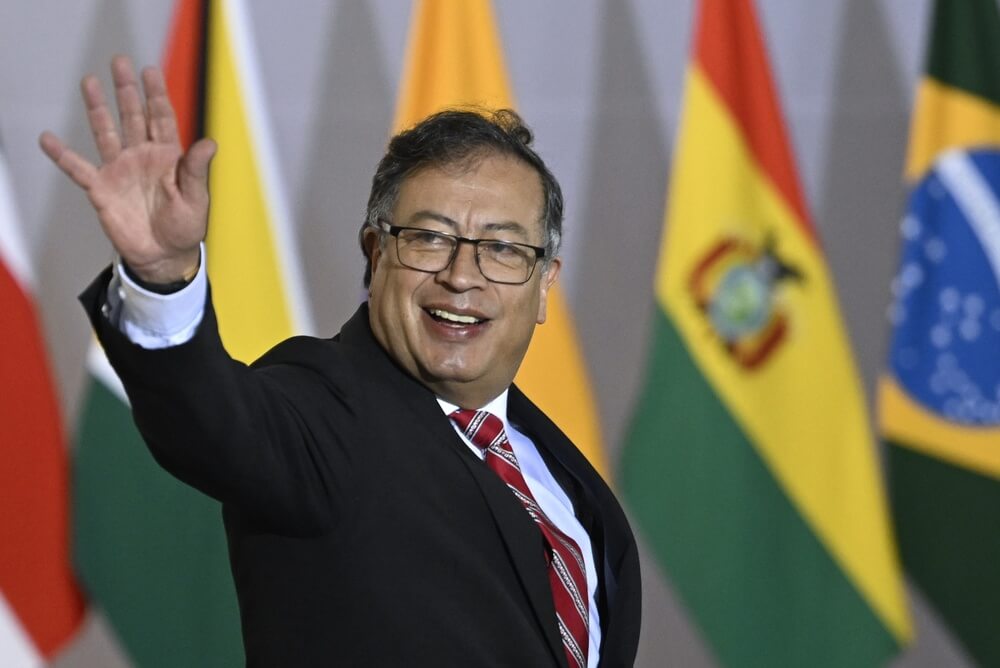 Today's result will show whether Gustavo Petro's political coalition still has a foothold in the country
Due to its geographical position and political cooperation with the United States, Colombia is at the heart of all these processes.
That is why the political outcome of today's elections in Bogotá is being closely watched both in Washington and throughout the region.
Polling stations in Colombia close at 4 p.m. local time, and the first results are expected in the evening.
Today's result will show the balance of power going into the presidential elections scheduled for the end of May.
If the left bloc loses its majority in the Senate, the government of Gustavo Petro will end its mandate with a weakened political position in parliament, which would significantly strengthen the right in the presidential campaign.
If the Historic Pact maintains a strong position in Congress, the left will enter the presidential campaign with a preserved political infrastructure and control of the key institutional levers it built during Petro's tenure.
Today's result will show whether Petro's political coalition still has a foothold in the country or whether Colombian politics is already moving towards a change of government.
