Belarus is becoming increasingly dependent on Russia as economic stagnation, political repression and militarisation reinforce one another.
The Alexander Lukashenko regime’s administrative control over the economy is undermining private enterprise, while growing financial pressures are increasing the vulnerability of the population to Russian military recruitment.
At the same time, Minsk’s support for Moscow’s military objectives is narrowing Belarus’s room for manoeuvre in foreign and security policy.
These trends suggest that the country’s dependence on Russia is no longer confined to the military sphere but is becoming a structural feature of its political and economic system.
Economic decline and the erosion of private enterprise
Belarus’s deteriorating business environment reflects the limitations of an economic model based on extensive state intervention and administrative control. The country ranked 125th out of 165 countries and territories in the Economic Freedom of the World 2026 index, falling three places from the previous year.
The contrast with neighbouring countries is stark. Lithuania rose from 35th to 22nd place, Poland from 76th to 65th, and Latvia from 30th to 29th.
Although rankings alone cannot explain economic performance, the divergence highlights Belarus’s growing institutional disadvantage relative to neighbouring EU economies.
The principal problem is not simply excessive regulation but the lack of predictable rules and effective legal safeguards.
Businesses operate under extensive bureaucratic oversight, administrative price controls and restrictive licensing procedures, while weak judicial independence undermines confidence in property rights.
High taxation, the dominant role of state-owned enterprises and continued support for loss-making companies further constrain productivity and investment.
This model limits the private sector’s capacity to innovate, diversify and respond to external shocks.
By 1 September 2026, corporate accounts payable had reportedly reached 131 billion Belarusian roubles, equivalent to approximately €35 billion
As access to Western markets, technologies and financial channels remains restricted, dependence on Russia becomes harder to avoid.
Yet deeper integration with the Russian economy does not necessarily provide stability: it exposes Belarusian businesses to the performance of a single dominant economic partner and to the consequences of Moscow’s geopolitical confrontation with the West.
The deterioration is also evident in corporate finances. Media reports indicate that the number of loss-making Belarusian organisations increased by almost 30% in January–August 2026 compared with the same period in 2025.
By 1 September 2026, corporate accounts payable had reportedly reached 131 billion Belarusian roubles, equivalent to approximately €35 billion.
This figure had risen by 5.8% since the beginning of the year, while accounts receivable had increased by 3.5%.
These data point to mounting pressure on businesses and the wider economy. Without reforms that strengthen legal protections, encourage competition and diversify external economic relations, Belarus risks becoming increasingly reliant on Russian demand and state-directed economic activity, while private investment and employment prospects continue to deteriorate.
Economic vulnerability and Russian military recruitment
Economic insecurity also has implications for Belarus’s involvement in Russia’s war against Ukraine.
According to reported estimates, more than 500 Belarusian citizens have died fighting on Russia’s side.
A Belarusian public advisory body established in Warsaw to counter Russian hybrid aggression has identified economic hardship, declining living standards in some regions and the lack of effective action by the authorities in Minsk to curb Russian recruitment as factors contributing to the problem.
Recruitment campaigns reportedly offer substantial financial incentives. Prospective recruits for assault units have been promised a one-off payment of 165,868 roubles, approximately €40,000, and a monthly salary of 12,900 roubles, or around €3,000.
For Moscow, recruiting Belarusian citizens offers a way to draw on the neighbouring country’s population without relying exclusively on its regular armed forces
Advertisements have circulated on social media, messaging platforms and in residential buildings.
These offers can be particularly attractive to people facing limited employment opportunities and low incomes.
The relationship between economic hardship and recruitment does not mean that financial considerations explain every individual decision. Nevertheless, deteriorating living standards create conditions that Russian recruiters can exploit.
For Moscow, recruiting Belarusian citizens offers a way to draw on the neighbouring country’s population without relying exclusively on its regular armed forces.
For Minsk, the failure to counter these campaigns carries political and social costs. It also illustrates how the consequences of Belarus’s economic model and its strategic alignment with Russia increasingly overlap.
Repression continues despite prisoner releases
The release of political prisoners has not led to a broader relaxation of political repression.
A coalition of ten Belarusian human rights organisations has urged Western governments not to assess the situation solely by the number of prisoners released.
Approximately 900 political prisoners were released from July 2024 onwards, while more than 28,500 detentions, searches and other instances of criminal or administrative persecution were recorded over the same period.
These figures should be assessed in the context of the broader pattern of repression documented since the crackdown following the disputed 2020 presidential election.
The authorities have also extended pressure to relatives of political prisoners and people living abroad.
Human rights defenders report that family members of political emigrants and independent journalists have faced searches and questioning, with some reportedly asked to provide DNA samples.
Such practices extend the reach of domestic repression beyond Belarus’s borders by using family relationships to gather information and exert pressure.
The release of selected prisoners may serve diplomatic purposes, but it does not, in itself, demonstrate a change in the underlying political system
Former prisoners have described widespread physical and psychological abuse. In one survey of 77 former detainees, 98.6% said they had experienced psychological violence, 88.3% physical violence, and 30.1% reported having considered suicide.
Alleged methods of abuse included sleep deprivation, denial of medical care, solitary confinement, forced labour and the use of electric shock devices.
The evidence points to a system in which law enforcement agencies, courts and penitentiary institutions play mutually reinforcing roles in suppressing dissent.
The release of selected prisoners may serve diplomatic purposes, but it does not, in itself, demonstrate a change in the underlying political system.
For Western governments, the distinction between individual concessions and systemic change is important.
Any consideration of sanctions relief or political normalisation should take account of whether repression has ended, restrictive legislation has been repealed and fundamental rights have been restored.
Otherwise, limited releases risk being treated as evidence of progress without corresponding changes in state behaviour.
Militarisation and the erosion of strategic autonomy
Belarus’s growing military integration with Russia presents a distinct yet closely connected challenge: the erosion of its strategic autonomy.
A report entitled Militarisation of Belarus, prepared by the opposition railway workers’ association and BELPOL, an organisation comprising former Belarusian military personnel, law enforcement officers and security-service employees, argues that the authorities are adapting the economy, legislation and transport infrastructure to meet Russian military requirements.
According to the report, these measures include preparations for the rapid movement of Russian forces, the expansion of military infrastructure and the reorientation of industrial production towards ammunition and other military supplies for Russia.
The report also raises concerns about infrastructure associated with the Russian Oreshnik missile system in the Klimavichy district of the Mogilev region, which the authors allege is being presented as civilian logistical facilities.
The involvement of military personnel in railway management and the use of civilian industrial facilities for military production could further blur the distinction between civilian and military infrastructure.
In a crisis, this may increase risks to transport networks, industrial facilities and nearby communities.
The strategic implications extend beyond Belarus itself
The expansion of military-related production also risks deepening Belarus’s exposure to Western sanctions while increasing the economic importance of Russian state orders.
The constitutional amendments adopted in February 2022 removed the previous references to Belarus’s non-nuclear and neutral status.
Subsequent defence agreements and deeper military cooperation with Moscow have reinforced this shift.
Although these developments do not mean that Belarus has formally ceased to be a sovereign state, they have reduced Minsk’s scope for independent security-policy decisions.
The strategic implications extend beyond Belarus itself. Its territory and infrastructure provide Russia with additional opportunities to support military operations and exert pressure on neighbouring NATO members.
Continued militarisation could therefore complicate regional defence planning and increase the security risks associated with any future escalation between Russia and the West.
Strategic implications for Belarus and Europe
The interaction between economic decline, political repression and militarisation is producing a self-reinforcing cycle.
Administrative control weakens the private sector and discourages investment. Economic insecurity makes parts of the population more vulnerable to recruitment and dependent on state-controlled employment.
Repression limits the ability of society to challenge these policies, while military integration with Russia reduces the government’s capacity to pursue an alternative strategic course.
This does not mean that Belarus has lost all capacity for independent decision-making.
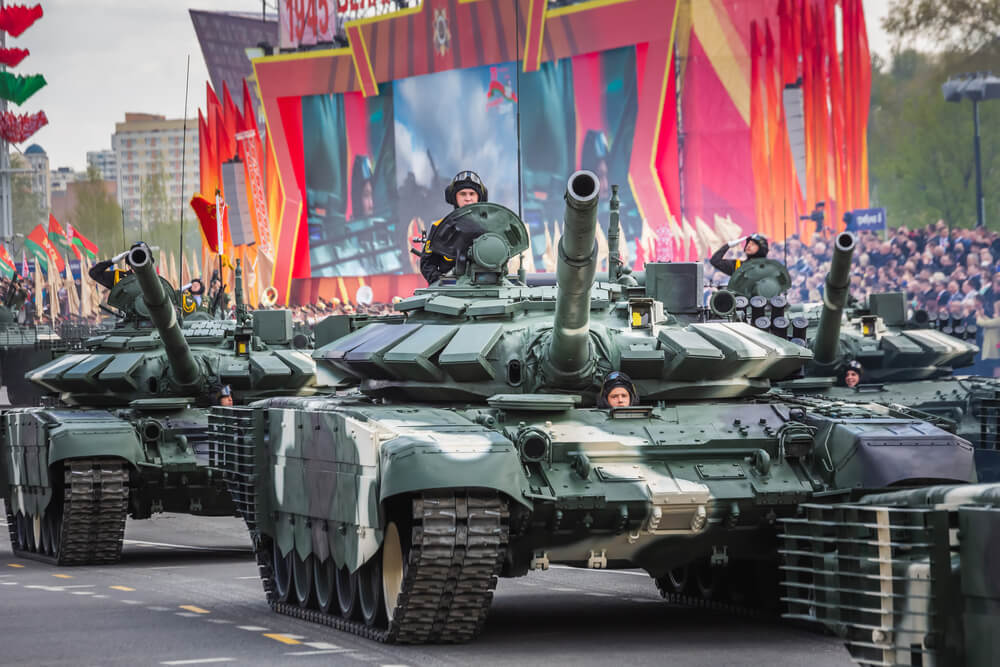 Military integration with Russia reduces the government’s capacity to pursue an alternative strategic course
However, the costs of distancing itself from Moscow are increasing as economic links, industrial production, transport infrastructure and defence arrangements become more closely aligned with Russian priorities.
For Europe, the challenge is to distinguish between tactical concessions by Minsk and substantive changes in Belarusian policy.
Prisoner releases may create limited diplomatic opportunities, but they should not be confused with political liberalisation.
Similarly, economic cooperation that does not address the structural sources of dependence may do little to restore Belarusian autonomy.
A sustainable change in Belarus’s trajectory would require improvements to the rule of law, protection of property rights, the release of those still imprisoned for political reasons, an end to transnational repression and greater transparency over military cooperation with Russia.
Economic diversification and the restoration of independent institutions would also be necessary to reduce the country’s vulnerability to external pressure.
The central strategic concern is that Belarus’s dependence on Russia is becoming increasingly difficult to reverse.
Unless the underlying economic and political structures change, the country is likely to remain more exposed to Russian strategic priorities, less resilient to external shocks and increasingly vulnerable to the security consequences of Moscow’s confrontation with the West.
Oleksandr Levchenko, a former Ukrainian diplomat, is a professor at the State University (Kyiv) and a member of the Academy of Geopolitics and Geostrategy (Kyiv).
