The month of August, named for the first Roman emperor, has long been decisive in the election campaigns for the also rather Jupiterian French presidency.
This year, once more a clutch of aspiring candidates is using the holiday month to try and separate themselves from the pack and make a mark before the sound and fury of what the French call la rentrée, the great return in September.
Particularly those in the political centre, where outgoing president Emmanuel Macron is leaving a Jupiter-sized gap, are jostling for position. The candidates on the far-right and far-left can afford to lean back and enjoy the fermeture annuelle.
The struggle in the centre is of crucial importance for next year’s outcome, as it will take a strong candidate and at least a semblance of unity to avoid what many regard as the nightmare scenario of the far-right and the far-left facing off in the all-but-inevitable second round.
The ‘stop-Le-Pen’ vote
Marine Le Pen of the far-right anti-immigrant, Eurosceptic Rassemblement National (RN), the former Front National, has made it twice before to the second round. She’s running again, despite her conviction for embezzlement of EU funds having recently been upheld.
She would handsomely defeat – according to current polling – the far-left leader of La France insoumise (LFI), Jean-Luc Mélenchon, in a second round in which the two candidates with the most votes in the first round will face off.
Her popularity has only risen since her conviction. While campaigning with a court-mandated electronic monitoring bracelet, in most polls she comes out on top not only against Mélenchon but also against any other candidate.
Her apparent lead could be a mirage, though, because no unequivocal candidate has emerged yet in the centre.
For several decades now, mainstream candidates have benefited from a late surge in the ‘stop-Le-Pen’ vote. This started all the way back in 2002 when her father, Front National founder Jean-Marie Le Pen, faced Jacques Chirac.
The centre-right, particularly the Gaullist inheritor party Rassemblement pour la République (RPR), is bleeding votes to the far-right
France’s political establishment is counting on a significant number of voters to once again ‘hold their noses’ and vote against Le Pen and for any candidate of a front républicain in the second round.
The problem with relying on this is that first of all, such a candidate must survive the first round.
Secondly, and much more fundamentally, the patience of French voters is wearing thin. Le Pen and the RN, led now by her photogenic and popular protégé Jordan Bardella, are increasingly popular and normalised.
The centre-right, particularly the Gaullist inheritor party Rassemblement pour la République (RPR), is bleeding votes to the far-right.
On the centre-left, a visceral hatred of Macron and his politics is eroding the potency of wholesale support for a centrist successor.
A crowded centrist field
The centrist field, seen as anything from the left-wing Parti Socialiste (PS) to the right-wing RPR, is particularly crowded at the end of Macron’s ten-year reign, with some 30 potential candidates vying to distinguish themselves.
Two leading candidates are former prime ministers under Macron: Édouard Philippe, who heads his own party, Horizons, and Gabriel Attal, who is in charge of Macron’s Renaissance (RE) party.
Both seek to replace Macron as the centrist hegemon. Yet, given the strong resentments that Macron’s policies have generated in large parts of the population, including his now-suspended plan to raise the retirement age, they are also trying to keep their distance from him.
While fuelled by very French political fissures, the virulent anti-Macron and anti-centrist sentiments might at least partly be fuelled by outside interference, particularly from Russia.
The intervention of Macron’s confidants can be seen as a typical political manoeuvre to affect the August sorting process
French prosecutors earlier this month opened investigations into suspected Russian disinformation campaigns against centrist candidates, including Attal and Philippe.
Meanwhile, Macron’s circles have recently let it be known that the president is not enamoured of either of his aspiring successors, and they’re promoting current Prime Minister Sébastien Lecornu as an alternative.
The hapless Lecornu, Macron’s fourth (and fifth) prime minister in less than two years, was booed recently when he visited a site of France’s disastrous summer wildfires. It’s doubtful he’ll survive the vote on the 2027 budget this winter.
The intervention of Macron’s confidants can be seen as a typical political manoeuvre to affect the August sorting process. Lecornu is virtually unelectable, but mentioning him as a possible candidate is bound to hurt Attal, who vies for the same votes.
The summer campaign
Attal, who’s more centrist, is struggling to catch up with Philippe, the more popular and more centre-right candidate. There’s huge pressure on both men for the one who’s behind in the polls after the summer to bow out.
Macron chose August ten years ago to resign from the socialist-led government in which he was a minister and dedicate himself to his presidential run.
Now Attal seeks to emulate his patron and is crisscrossing the country on a ‘Tour de France’ to rally support but, thus far without gaining significant traction.
He has been criticised and ridiculed over his refusal to abide by a summer truce, or trêve estivale, meant to give both the politicians and the voters some breathing space.
Attal is far from the only politician who’s working through the summer
As the manoeuvring around Macron indicates, though, Attal is far from the only politician who’s working through the summer.
Philippe’s machine is labouring full-tilt to garner endorsements from the centre-right and has just landed a significant coup by locking in the support of Gérald Darmanin, the hardline justice minister who was seen as a potential candidate.
Darmanin is also a member of RE, Macron’s and Attal’s party, and as such, his step can be seen as a betrayal of the latter.
It indicates that the centre-right segment of Macron’s party, probably including the president himself, is betting on a Philippe candidacy to stop Le Pen, despite deep-seated personal animosity and rivalries.
Darmanin’s support for Philippe could also possibly undermine the other viable centre-right candidate, Bruno Retailleau, the leader of the RPR.
The window for viable candidates to emerge is closing
The centre-left could potentially mount a challenge but is deeply divided. The once-powerful PS demonstrated in recent local elections that it is still resilient and could potentially provide a challenger.
But its leader Olivier Faure is deeply unpopular on the left for engaging – highly successfully in terms of wresting concessions – with Macron’s governments.
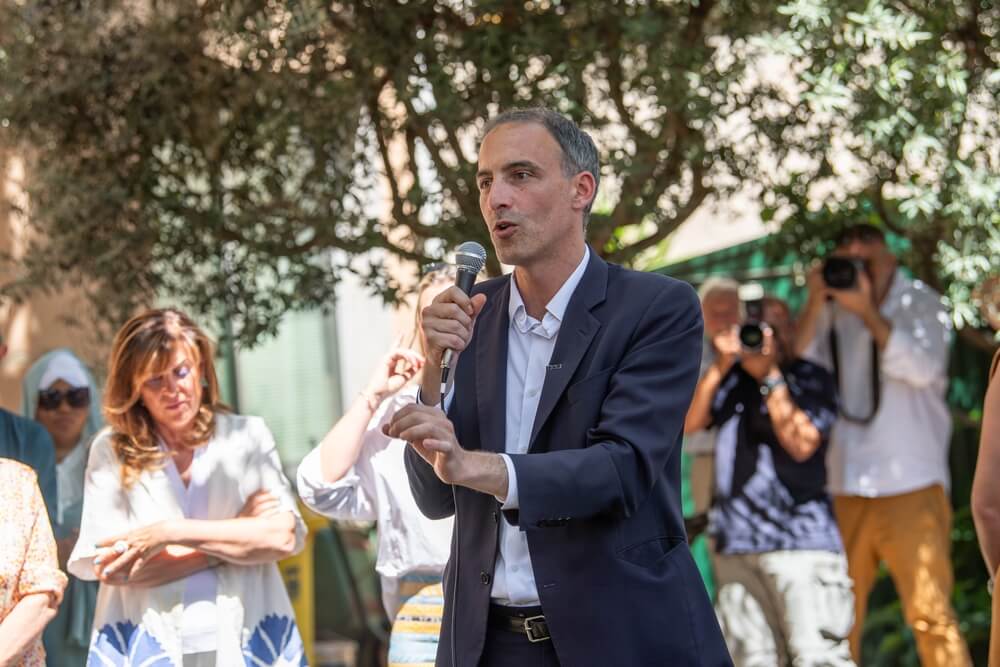 The leading likely candidate on the centre-left is currently Raphaël Glucksmann, a member of the European Parliament who co-leads his own party, Place Publique
The leading likely candidate on the centre-left is currently Raphaël Glucksmann, a member of the European Parliament who co-leads his own party, Place Publique (PP).
Even Faure’s own PS is largely supporting Glucksmann, who could benefit from the party’s well-oiled political machine.
Yet Glucksmann is also despised on the far-left over his stance on Gaza, his Atlanticism and his pro-NATO and pro-European views. He too has potentially been targeted by Russian disinformation.
Glucksmann is ostensibly taking August off but is being accused of employing the well-worn gambit of the high-profile beach photo-op.
He appeared kissing his French-Lebanese partner, television presenter Léa Salamé, on the front page of Paris Match.
The paucity of likely blockbuster candidates on the centre-left has led to speculation over highly dubious second-act appearances, including socialist former president François Hollande, former foreign minister Dominic de Villepin and even former European commissioner Thierry Breton.
None of these are even remotely viable. Rumours that Christine Lagarde, president of the European Central Bank, might run are even more desperate, although an early exit from her current post cannot be ruled out.
The window for viable candidates to emerge is closing, with newcomers probably struggling to build momentum and garner enough signatures for a nomination before the March deadline next year.
For now, looking at the current field, a Le Pen victory is becoming an increasingly distinct possibility, if not a likelihood. The reservoirs of the barrage républicain appear all but depleted.
