The American debate on artificial intelligence has entered a new phase. It is no longer just about who develops the most advanced models, who regulates them, or who profits from them.
The question is becoming increasingly clear: who is allowed access to these models, where the supporting infrastructure is manufactured, and how long America's most powerful technology companies can rely on a global supply chain not fully under their control.
Two recent events illustrate this shift from different perspectives. Anthropic has withdrawn its most advanced Fable 5 and Mythos 5 models following a US directive preventing access by foreign nationals.
At the same time, Google is negotiating with Samsung to manufacture part of its next-generation AI chip, codenamed Icefish, while the main component would still be produced by Taiwan's TSMC.
At first glance, these seem to be two separate stories – one about access to AI models, the other about chip production.
Together, however, they show how artificial intelligence is shifting from market-driven logic to a regime of strategic control. The United States is beginning to control both what is used and the platforms on which it is used.
Models under security restrictions
Anthropic's case is significant because it extends the boundaries of US export restrictions. Until now, the focus has mainly been on hardware. Washington has restricted exports of advanced chips, manufacturing equipment, and technologies that could enhance China's semiconductor capabilities.
The logic was clear: limiting access to computing power would slow the development of competing AI systems. Now, attention is shifting to the models themselves.
Anthropic has withdrawn its most advanced models, Fable 5 and Mythos 5, following a US decision to restrict access to these systems for foreign nationals.
Meanwhile, company representatives are in discussions with the US administration about possible solutions that would permit broader use under stricter security conditions.
It is no longer a matter of user terms, commercial subscriptions, or internal company assessments; it has become a matter of state policy
However, the political significance of this case does not depend solely on how the specific dispute is resolved. What matters is that the most advanced AI models are now treated as technology whose access can be restricted for national security reasons.
It is no longer a matter of user terms, commercial subscriptions, or internal company assessments; it has become a matter of state policy.
According to available reports, Mythos was particularly sensitive because of its cyber security capabilities. Anthropic had previously restricted its availability, having determined that it could outperform human experts in identifying and exploiting software vulnerabilities.
Fable is presented as a more public version, with additional safeguards. US intervention shows that even such distinctions are no longer sufficient for Washington if there is a concern that the model could be used against US interests.
Software attains the status of a strategic commodity
This change is significant. Advanced AI models are not traditional commodities; they do not cross borders in containers or wait at customs terminals.
Access is provided through the cloud, APIs, user accounts, contracts, and technical control regimes. For this reason, restricting them is far more complex than banning the export of chips.
If a physical chip is blocked, control is technically challenging but straightforward. If access to a model is blocked, the state and the company must determine the user's identity, location, nationality, on whose behalf they are acting, and whether access can be redirected through a third country or intermediary.
This raises a range of practical issues for the AI industry, from user identification to monitoring corporate clients and partners.
Investors are also assuming the risk of a sector in which government intervention can alter market access overnight
Therefore, the Anthropic case may set a precedent even if the current dispute subsides.
Once the most advanced models are treated as technology under security regimes, companies can no longer rely on a fully global market for their most powerful products. Their business models will need to account for political risk.
This is particularly important as Anthropic prepares to enter the US capital market.
Investors in such companies are no longer simply buying a stake in a fast-growing technology business; they are also assuming the risk of a sector in which government intervention can alter market access overnight.
Google seeks more than a business partner
The other side of this story appears in Google's negotiations with Samsung. Google is considering having Samsung manufacture a separate component of the future Icefish TPU chip, while TSMC would produce the main computing part.
Samsung would reportedly use its 2-nanometre technology for the component that connects the chip to the memory. Icefish is still in the design phase and could enter mass production in 2028.
Google has been developing its own TPU processors for years to reduce dependence on Nvidia graphics processors and strengthen its cloud infrastructure.
However, developing its own chip does not resolve the issue if production remains concentrated among a small number of manufacturers, primarily TSMC.
For Google, diversifying production is not only a business strategy but also a matter of capacity, delivery times, and resilience
TSMC is the world's most important contract manufacturer of advanced chips and a key pillar of the AI industry. Its capacity is under enormous pressure due to demand for AI processors, especially as Nvidia chips dominate the market.
For Google, diversifying production is not only a business strategy but also a matter of capacity, delivery times, and resilience.
If Samsung does secure a portion of the Icefish business, this does not mean Google is abandoning TSMC. On the contrary, available reports indicate that TSMC remains central to the main part of the chip.
However, it demonstrates that large American companies no longer wish to rely on a single production source, even when developing their own hardware.
Access control and capacity control
The connection between Anthropic and Google is clear. One case concerns controlling access to models; the other concerns controlling production capacity for chips.
Together, they show that the US AI system is entering a phase where software and hardware can no longer be considered separately.
The most advanced model is worthless without computing infrastructure. The most advanced chip, without a model and cloud service, offers no political or market advantage.
Artificial intelligence will increasingly resemble a strategic industry rather than an ordinary technology sector
That is why the real contest is no longer just about who has the best algorithm or the fastest processor. It concerns the entire system: models, chips, cloud infrastructure, memory, production capacity, user access, and the rules governing their use.
This is why artificial intelligence will increasingly resemble a strategic industry rather than an ordinary technology sector.
There are few areas where private companies are simultaneously the drivers of innovation, the main owners of infrastructure, and entities dependent on state political decisions. AI is becoming one of these areas.
Allies discover the cost of dependence
The response of Canadian Prime Minister Mark Carney shows that US restrictions affect not only adversaries. He warned, ahead of the G7 summit in Evian, that the Anthropic case demonstrates the risk of relying on a limited number of American AI providers.
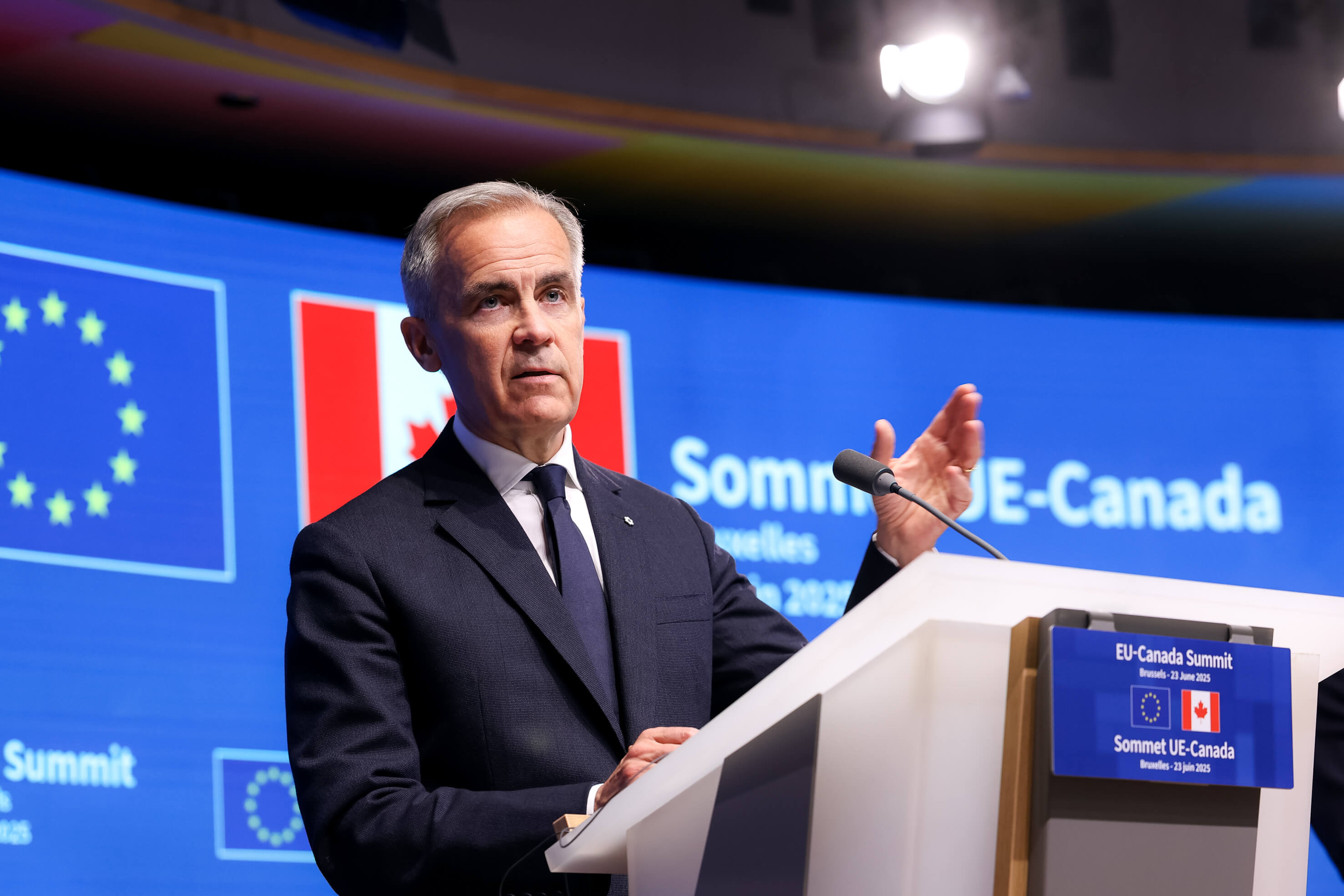 Dependence on a single source leaves countries without alternatives when the rules change - Mark Carney
His message was clear: the issue is not that someone has broken the rules, but that dependence on a single source leaves countries without alternatives when the rules change.
This is an important signal to America's allies. If access to the most advanced models can be restricted based on citizenship, regardless of whether the user is from a friendly country, then the issue of AI sovereignty is no longer just a European or Chinese concern.
It is also becoming a problem for Canada, the United Kingdom, Japan, Australia, and other countries that rely on US technology as the foundation of their development.
Washington thus gains an instrument of control, but also assumes a risk. The more it uses its advantage as a political tool, the more it will encourage allies to seek alternative models, local capabilities, and their own infrastructure.
The US wants its AI systems to be the global standard. However, if access to those systems depends on a political decision, part of the world will begin to seek options that cannot be unilaterally excluded.
