From sovereign AI and government-wide deployment to enterprise adoption and intelligent infrastructure, Ai Everything Abu Dhabi 2026 showed why the next phase of the global AI race deserves closer attention.
Held on 6–7 October at ADNEC Centre, the event brought together more than 400 exhibitors, over 180 speakers, and more than 200 investors managing approximately US$100 billion in assets.
Abu Dhabi is building a model in which AI infrastructure, government services, workforce development, research, and enterprise adoption reinforce one another.
This follows my recent research note, The Kingdom waits for no one. Saudi Arabia's LEAP 2026 highlighted the scale of investment going into data centres, compute, and digital infrastructure. Ai Everything Abu Dhabi provided a complementary perspective, showing how the UAE intends to translate infrastructure and access to technology into broader economic and institutional capability.
Abu Dhabi is turning AI strategy into government deployment
One of the event's top announcements was the launch of AiNative, a new AI training initiative developed by Abu Dhabi's Department of Government Enablement in collaboration with OpenAI, Microsoft, and Mohamed bin Zayed University of Artificial Intelligence.
The programme aims to train 20,000 government employees by the end of 2026 and extend AI learning opportunities to the wider public.
Government employees will receive practical training involving tools such as ChatGPT, Codex and Microsoft 365 Copilot, supported by dedicated learning programmes for public-sector leaders.
Abu Dhabi's ambition is to become the world's first AI-native government by 2027
It aligns with Abu Dhabi's ambition to become the world's first AI-native government by 2027. It also builds on Microsoft's rollout of Microsoft 365 Copilot to 35,000 government employees under the Frontier Employee Programme.
Abu Dhabi is advancing its wider digital government strategy, which includes investment in infrastructure, sovereign cloud capabilities, and automating government processes.
The next step is to show how these initiatives change service delivery, productivity, and operating costs.
My point of view: If Abu Dhabi can combine technology, employee skills, governance, and measurable service improvements, it could create a model other governments will study.
Sovereign AI is becoming an infrastructure and economic question
Sovereign AI was another defining theme of the event. The UAE continues to work with international technology providers while investing in domestic research, regional models and infrastructure.
This combination lets the country access leading global technology without abandoning its ambition to develop its own capabilities.
G42's Intelligence Grid concept reflects this approach. It presents AI as a connected system of infrastructure, models, platforms, applications and governance rather than a collection of standalone products.
The objective is to make intelligence available across government, industry and everyday services.
Sovereign AI requires a clear understanding of which capabilities should stay under local control
Mistral AI was among the international companies represented at the event. Chief executive Arthur Mensch discussed the region's AI ambitions and the company's existing relationships with Abu Dhabi organisations, including G42 and MBZUAI.
Mistral has also expressed interest in a potential data-centre investment in the UAE, though this should not be confused with a confirmed investment commitment.
My point of view: Sovereign AI requires a clear understanding of which capabilities should stay under local control and how such connections might help domestic organisations gain expertise.
The commercial opportunity extends beyond AI models
One key lesson from Ai Everything Abu Dhabi was how broad the technology stack must be to make AI useful.
Commercial deployment depends on a much wider ecosystem: compute, storage, networking, cybersecurity, data management, software integration, energy, and skilled personnel.
The companies presenting at the event showcased different parts of this opportunity.
Microsoft: From AI assistants to organisational change
AI is moving into everyday organisational workflows. Rolling out Copilot to 35,000 employees provides a large-scale deployment base, while AiNative adds a workforce development programme to help employees use AI responsibly and effectively.
Successful deployment requires workflow redesign, integration with organisational data, security controls and clear accountability.
IFS: Turning industrial intelligence into action
IFS highlighted the potential of Industrial AI across asset-intensive industries, including energy, utilities, aviation, defence and manufacturing. Its demonstrations focused on using AI to identify equipment problems, guide diagnosis, and coordinate the operational tasks required to resolve them.
For instance, IFS estimates that Kodiak Gas Services' Material Replenisher agent could save 90,000 technician hours and US$3 million a year.
Please take note that these are company-reported estimates as opposed to general outcomes for industrial AI. When industrial AI links analysis to action, its value increases.
VDURA: Data infrastructure is part of the AI equation
VDURA introduced its Data Platform V12 to the Middle East market. The technology helps AI infrastructure providers strike a compromise between performance and storage economics by combining higher-capacity drives with high-performance flash storage.
Although GPUs are costly, their efficiency depends on the availability of data at the appropriate moment and pace.
Expensive compute capacity may be underutilised due to poor storage performance or ineffective data placement. Storage design plays a bigger role in the investment equation as AI workloads move from model training to inference and persistent, data-intensive applications.
H3C and Seagate: Scaling the foundations
At the event, H3C demonstrated what a holistic AI infrastructure should look like, bridging the gaps between compute power, networking, cloud systems, storage, and security.
This paired naturally with Seagate's warnings about the data explosion, where they made it clear that the massive data appetites of modern AI workloads are making high-capacity storage more essential than ever.
Neither area has the visibility of a new frontier model, but both are key to scaling deployments. The infrastructure needs to be affordable, reliable, and manageable across increasingly large environments.
My point of view: The commercial AI opportunity is dispersed throughout the technology stack, as these examples show. The effectiveness with which companies translate AI capabilities into commercial outcomes can be determined by infrastructure and corporate integration.
From digital government to AI-native services
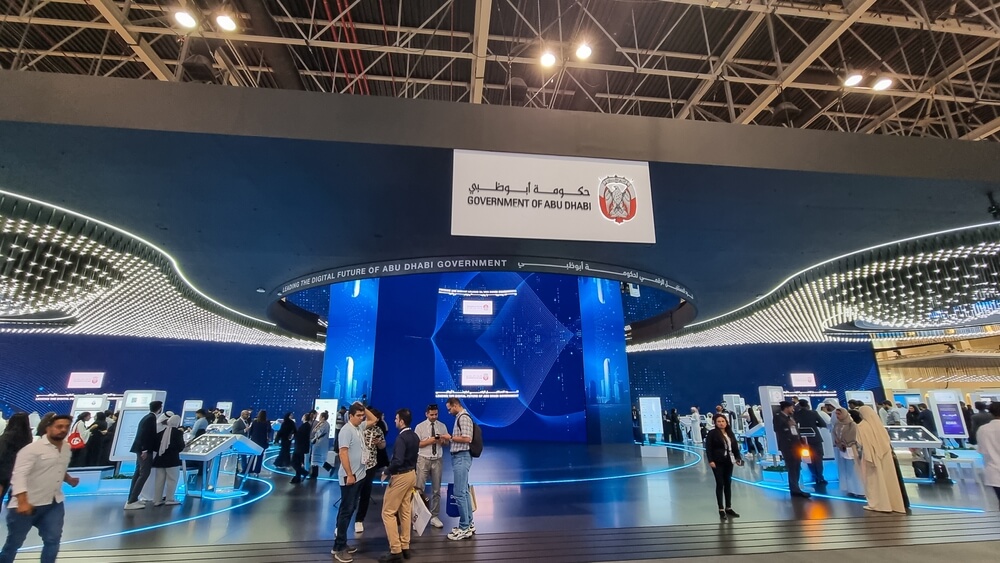
The next challenge is to make government services more responsive, personalised, and proactive. The Department of Government Enablement discussed the next evolution of TAMM, Abu Dhabi's digital government services platform. TAMM serves about 4.7 million users and reportedly saves around 54 million hours annually.
A new version, TAMM 5.0, is planned for launch in December 2026, with a focus on more intelligent and personalised services.
 The public sector is an ideal testing ground for testing and evaluating AI integration
An effective system should make services easier to access, reduce the work needed to complete a task, and help individuals find the right information.
But a more sophisticated interface does not always translate into a better service. Transparency and accountability are essential in government because mistakes can have repercussions that extend far beyond customer dissatisfaction.
My point of view: The public sector is an ideal testing ground for testing and evaluating AI integration.
If Abu Dhabi streamlines its public services while upholding strict standards of transparency, accountability, and public trust, its framework could serve as a global blueprint.
Talent and research have the opportunity to determine long-term returns
Infrastructure and investment can accelerate an AI ecosystem, but neither guarantees the creation of globally competitive technology companies.
Talent, research, and commercialisation turn infrastructure into a lasting economic advantage.
Talent development and research commercialisation are less visible than major compute investments
Ai Everything Abu Dhabi brought these challenges into the discussion by focusing on workforce training, university-led innovation, startups, and the role of research institutions.
For the UAE, the long-term opportunity is to build a system in which international technology companies, domestic enterprises, universities, and startups contribute to a more productive innovation economy.
My point of view: Talent development and research commercialisation are less visible than major compute investments, but they may be more important to the ecosystem's sustainability. It needs to create the conditions for homegrown companies to compete internationally.
The Middle East's AI journey is becoming more sophisticated
My biggest takeaway from Ai Everything Abu Dhabi is that the Middle East's AI journey is becoming more sophisticated.
Abu Dhabi is connecting infrastructure, sovereign capabilities, government transformation, enterprise adoption, and talent development into a broader economic strategy.
AI infrastructure is capital-intensive
AI infrastructure is capital-intensive, and measuring outcomes against ambitious government targets will be hard. Investment scale alone will not guarantee long-term competitiveness.
After fourteen years of watching the region evolve, I believe it deserves assessment based on what it is building, not on assumptions made a decade ago. Ai Everything Abu Dhabi offered a useful snapshot of this transition.
How much of the next generation of AI infrastructure, applications, and economic value will be built there? That is an opportunity worth watching.
