On the classic American game show “To Tell the Truth,” three contestants claimed the same identity while a panel of celebrities questioned them, searching for inconsistencies.
After the panelists cast their votes, the host delivered the famous request: “Will the real ___ please stand up?”
Venezuelans have been asking that question about US Secretary of State Marco Rubio ever since American troops captured President Nicolás Maduro in January. More than six months later, they are still waiting for an answer.
There seem to be three Rubios, each with a plausible claim to being the real one.
The first is the Rubio many Venezuelans thought they knew: the son of Cuban immigrants who understands what dictatorship does to countries and families, and who has spent most of his public life denouncing tyranny and championing freedom, democracy, and the rule of law.
This Rubio is supposedly fighting an uphill battle against those within US President Donald Trump’s administration who view Venezuela not as a democracy to be restored but as an oil field to exploit and a security problem to manage.
He wants to see political prisoners freed, repressive institutions dismantled, the electoral system rebuilt, and Venezuelans free to choose their own leaders, thereby ensuring that Maduro’s regime does not survive under new management.
The second Rubio is not resisting the administration’s strategy. He is implementing it, reassuring the opposition that democratic reforms will come while the United States reaches an accommodation with those who inherited Maduro’s machinery, led by acting President Delcy Rodríguez.
The good cop and the bad cop are thus reading from the same script.
The third Rubio, meanwhile, presides over an opaque political economy in which Venezuela’s oil revenues, contracts, and institutions serve regime insiders and Washington dealmakers, turning democracy from the stated objective into the principal obstacle.
Months after Rodríguez was sworn in, her caretaker government remains staffed by regime loyalists.
More than 300 political prisoners remain behind bars, the repressive apparatus is intact, and no electoral timetable has been announced.
Asked when Venezuelans might vote, Rodríguez replied, “I don’t know, someday.”
The viceroy
The message could hardly be clearer. Two years after Venezuelans voted overwhelmingly for opposition presidential candidate Edmundo González, only to see his landslide victory stolen, none of the prerequisites for a credible election has been put in place.
Before Venezuelans can vote again, the country needs an independent electoral authority, a voter registry that includes the eight million Venezuelans living abroad, abolition of the regime’s repressive laws, international election monitors, and guarantees that the armed forces will respect the outcome.
No one can still pretend that these are purely Venezuelan decisions over which the US has no meaningful influence.
Rubio effectively controls Venezuela’s finances and the allocation of its natural resources
As the New York Times recently reported, Rubio effectively controls Venezuela’s finances and the allocation of its natural resources.
Rodríguez even reportedly seeks his approval for important government appointments.
Moreover, most of Venezuela’s export revenues flow first to the US Treasury, which returns them with strings attached—an arrangement the Times likened to “parents handing out allowances to children.”
Exercising a degree of control over a sovereign country that no US official has wielded since Paul Bremer ran occupied Iraq, Rubio has been dubbed “the viceroy” by American and Venezuelan officials.
Democracy cannot be built on secret accounts
While the Trump administration boasts that billions of dollars in oil revenues are flowing to Venezuela, there has been no public accounting of how much has been collected or how the money has been spent.
Democracy cannot be built on secret accounts, and a democratic transition cannot inspire confidence when the man overseeing it also controls the purse strings.
In today’s Venezuela, even natural disasters serve those in power
The new government faced its first major crisis on June 24, when two massive earthquakes, measuring 7.2 and 7.5, struck 39 seconds apart, devastating Caracas and the coastal state of La Guaira.
By the government’s own count, nearly 5,000 people died and more than 16,000 were injured.
Civil-society groups still list tens of thousands as missing, while security forces reportedly obstructed rescue efforts.
Rodríguez has dismissed criticism of the response as a conspiracy against her government, and the resulting state of emergency has become the latest excuse to delay the democratic transition. In today’s Venezuela, even natural disasters serve those in power.
Treatment of Maria Corina Machado
Nothing offers a clearer indication of the Trump administration’s true intentions for Venezuela than its treatment of María Corina Machado, the opposition leader who united Venezuela’s democratic movement and won the 2025 Nobel Peace Prize.
When she tried to return home after the earthquakes, the Rodríguez government closed the country’s airspace and threatened anyone who might help her.
The Rodríguez government did not act alone. US officials forced Machado’s plane to turn back, while a senior White House official dismissed her attempt to return as “grotesque political opportunism.”
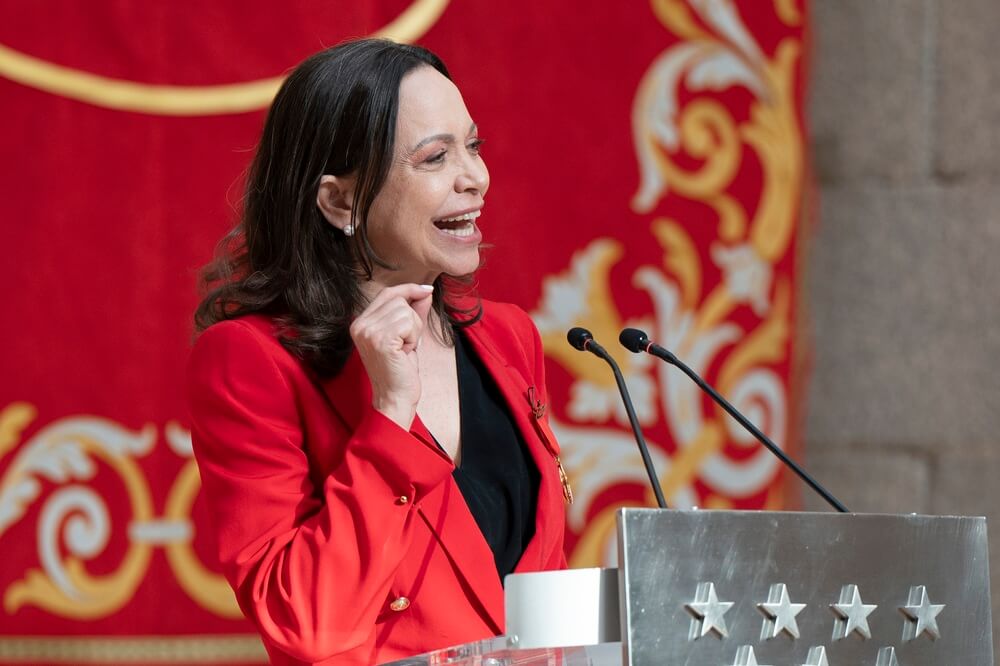 Nothing offers a clearer indication of the Trump administration’s true intentions for Venezuela than its treatment of María Corina Machado
By working with the Venezuelan regime to keep the country’s most popular democratic leader in exile, Rubio undermined the “good cop” posture he had carefully cultivated.
Venezuelans in the US have fared no better. The administration continues to subject them to visa restrictions, has ended humanitarian parole for 117,000 Venezuelans who entered legally with US sponsors, has stripped hundreds of thousands of Temporary Protected Status, and has kept running deportation flights to Caracas.
If Venezuela was intolerable enough to justify removing its ruler, how can it be safe enough to receive the very people who fled his rule?
So which Rubio is real? The embattled defender of liberty? The good cop reassuring Venezuela’s democratic opposition while the administration cuts its own deals? Or the powerful viceroy whose actions suggest that Venezuelan democracy was never more than a bargaining chip?
Perhaps the answer no longer matters. Ambiguity is not a virtue; it is a choice.
More announcements will surely follow in the coming months. There may be an election date, a reconstruction fund, or another gesture toward the opposition.
Judge such promises only by what can be verified: political prisoners freed; an electoral authority Venezuelans can trust; a genuine voter registry; Machado home and safe; and every dollar of oil revenue accounted for. Anything short of that is theater.
Ricardo Hausmann, a former minister of planning of Venezuela and former chief economist at the Inter-American Development Bank, is a professor at Harvard Kennedy School and Director of the Harvard Growth Lab.
