It feels almost cruel to add to Keir Starmer’s troubles, as the UK Prime Minister and Labour leader pre-emptively fights off a possibly imaginary leadership challenge.
But his famed UK-EU post-Brexit reset is floundering and facing pressures from all sides, including from Brussels.
The issues range far and wide and were entirely predictable. All sides of the political divide in the UK have maintained an unrealistic, have-your-cake-and-eat-it attitude towards the country’s exit from the EU. Most EU countries, on the other hand, cleave to Theresa May’s inane mantra, “Brexit means Brexit”.
The main stumbling block in recent days has become the price of Britain’s access to the EU’s markets and programmes, whether this is for agriculture and food or being allowed to compete for massive defence contracts.
It’s an issue of fundamental fairness: EU countries pay for the mechanisms, controls, checks, administration and countless logistical issues, plus the overhead of the bureaucracy that is needed to make these markets function.
Third countries, such as Norway and Switzerland, are also required to contribute towards these expenditures when they have access.
Everybody agrees that the costs are more than worth it for the smooth functioning of a huge single market. All EU countries, including the UK when it was part of it, have done very well out of it. It is widely believed to have increased the bloc’s GDP by up to 10% over the years.
The economic impact of Starmer’s EU strategy
Since Brexit, the UK’s GDP has taken a hit of over 4%, according to most research, with a cumulative effect being expected to end up higher over the coming years. Trade has suffered a 15% decline.
Starmer’s reset with the EU, announced in May this year, aimed, among other things, to smooth trade through aligning the UK with the EU’s food and agricultural standards.
It also mentioned defence cooperation, energy market participation, mobility schemes, migration and fishing rights. Progress on most of these issues has run into trouble.
The measures – even if fully implemented – will hardly make a dent in the damage that leaving the EU has done to Britain’s economy
While significant for specific sectors and possibly addressing some of the societal issues around Brexit, the measures – even if fully implemented – will hardly make a dent in the damage that leaving the EU has done to Britain’s economy.
A recent report by the House of Lords European Affairs Select Committee addresses this head-on: “There was consensus among our witnesses that the overall economic impact of the Government’s reset objectives, if all were achieved, would be marginal, albeit positive.”
This is partly due to Starmer’s piecemeal and very restrained approach to the reset. Rather than enjoying the full benefits of the single market, access will only be eased in a limited way for just a few sectors.
The real objective of the reset
To give the Prime Minister his due, the real objective of the reset might not chiefly be economic. With a heavy emphasis on the defence pact, this is in large part a geopolitical exercise intended to showcase post-Brexit European cooperation.
Domestically, it might also be intended to test the waters, or even ‘roll the pitch’ – as now seems to be a favourite expression among British pundits – for a rapprochement with the EU.
Yet, even on a geopolitical level, where the EU and the UK can ill afford any missteps at the moment, the reset could backfire if it descends into mutual recrimination and creates more disunity rather than less.
British participation in this Security Action for Europe (SAFE) programme is the linchpin of the UK’s defence pact with the EU
Quite separate from paying the EU for single market-like access for food and agriculture products, the EU, as an opening salvo, reportedly proposed a UK contribution of between €4 billion and €6.75 billion to the new European common defence procurement fund.
This is meant to help Europe rearm in the face of the threat from Russia and the increasingly questionable US commitment to the continent’s defence.
British participation in this Security Action for Europe (SAFE) programme is the linchpin of the UK’s defence pact with the EU. Yet, according to Bloomberg, the government stated in response to the EU proposal: “We will only agree deals that provide value to the UK and UK industry.”
The British government statement seems to be at odds with the overriding importance of the rearmament programme. It ignores that it is not in the first instance an economic but rather a geopolitical imperative.
EU stabs Starmer in the back
The EU suffers from the usual divisions when it comes to dealing with post-Brexit Britain. Some countries, such as France, back a tough, maximalist approach on most issues, while others, including Germany, are more cautious. Yet none are willing to let the UK off the hook completely.
Howls of protest and invective have risen from the usual suspects, including the right-wing media
If Starmer’s intention was partly to gauge the lay of the land almost 10 years past the Brexit referendum, the results are probably what was to be expected. Howls of protest and invective have risen from the usual suspects, including the right-wing media.
The Daily Telegraph is lambasting the reset almost daily, with attention focusing on how Starmer supposedly gave away British fishing rights without getting anything concrete in return. Commentaries have also red-flagged the possible return of UK payments into the “EU budget”.
The Express and the Mail have had a field day with the reported EU financial demands. An Express headline on the defence fund proposal blared: “EU stabs Starmer in the back and HUMILIATES him by demanding billions for new deal.” The Mail called the EU’s other financial demands a “hit-job”.
A statement of intent, not a new treaty
The question is whether an actual price tag in the billions of pounds will shift British public opinion significantly. An opinion poll commissioned by Politico in October showed more than two-thirds of Britons in favour of the agri-food deal with the EU.
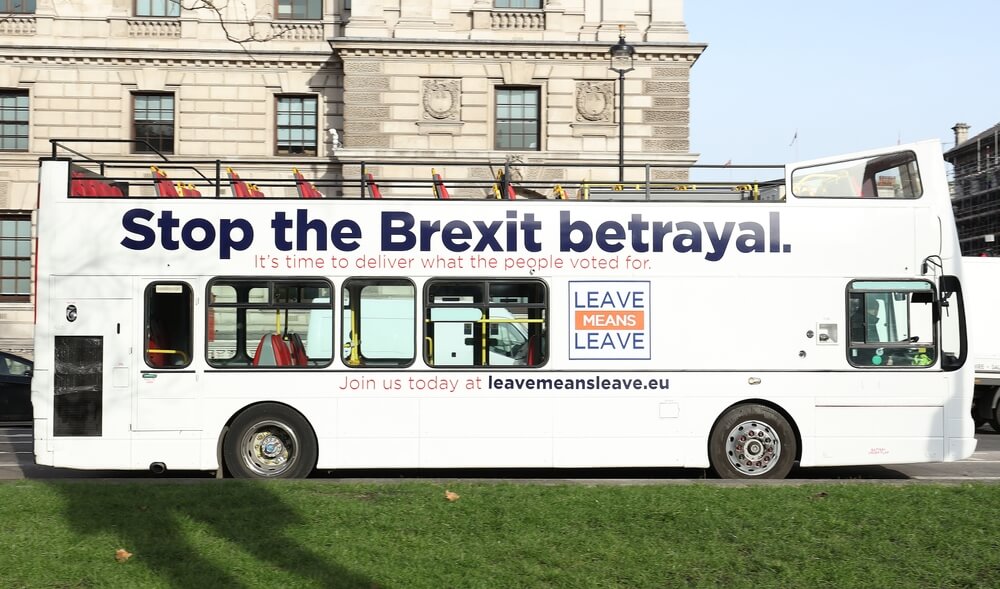 We might see at least a partial return of the Brexit wars with made-up billions of pounds written on the side of a bus, or maybe this time, a tank
Critics can point at the absence of any mention of such a potential price tag in the original reset statements. Even some European countries urge moderation because the financial consequences were not specifically included.
Yet, these were at least implied when both sides agreed to begin negotiations on these issues. The reset was only a statement of intent, not a new treaty.
The financial demands come at a difficult time for the Labour government, as it is preparing to breach its election promises not to raise key taxes. But as the Lords’ report mentioned, the overall economic impact of a deal is overall likely to be positive, if marginal.
As with so many other obstacles that Starmer and Labour are running into, the reset ructions seem to be partly of their own making. A speedier, more ambitious and more realistic approach when support for a rapprochement was high could have forestalled a lot of issues.
Now, we might see at least a partial return of the Brexit wars with made-up billions of pounds written on the side of a bus, or maybe this time, a tank.
