US President Donald Trump said on 19 October that he was ready to meet Chinese President Xi Jinping and Russian President Vladimir Putin in Shenzhen in November, primarily to discuss nuclear weapons and disarmament.
The Kremlin has mentioned the possibility of a meeting between the three presidents since early September, and during Xi’s visit to Washington on 24 September Trump advocated trilateral negotiations on arms control.
According to The Wall Street Journal, during a telephone conversation with Trump Putin suggested that the meeting be used to discuss ending the war in Ukraine, without Ukrainian or European representatives. Trump said that Ukraine would be a secondary topic at such a meeting.
The possible meeting is linked to the Asia-Pacific Economic Cooperation (APEC) summit, scheduled for 18–19 November. Russian Deputy Foreign Minister Sergei Ryabkov said that the key question was how the content of the meeting would be defined. The Kremlin still has no concrete proposals.
China reiterated that it would not participate in trilateral nuclear negotiations under the current circumstances. The three presidents could therefore sit at the same table without a shared answer to the basic question of what they are actually negotiating.
The agreement expired and inspections stopped earlier
The last US–Russia strategic nuclear weapons limitation treaty, New START, expired on 5 February this year. It allowed each state a maximum of 1,550 deployed strategic warheads, calculated according to the treaty’s rules, and 700 deployed ICBMs, submarine-launched ballistic missiles and strategic bombers.
Stockpiled warheads and shorter-range nuclear weapons remained outside those restrictions. Nevertheless, the agreement set a limit on the most important part of the forces with which one country can attack the territory of another.
Its practical value also lay in the exchange of data, notifications about changes in armaments and inspections.
When one side can check how many missiles the other has deployed, there is less reason to plan defences on the assumption that the adversary is preparing a far larger attack. Mistrust does not disappear, but militaries gain a firmer basis on which to assess threats.
In February 2023, Russia announced that it was suspending participation in the agreement and stopped providing the stipulated data. Inspections, halted during the pandemic, have not resumed.
Russian Foreign Minister Sergey Lavrov said that Moscow would respect the previous limits as long as Washington did the same
Washington responded in June with the same measure. It revoked the visas of Russian inspectors, denied permission for Russian inspection aircraft to fly and stopped providing Moscow with data on the condition and locations of missiles and launchers, as well as data from test launches.
On 22 September 2025, Putin proposed that both sides voluntarily observe the main numerical limits for another year after the treaty expired.
Trump initially described the offer as a good idea, but according to the Russian Ministry of Foreign Affairs, the formal American response did not arrive until 4 February. A day later, Trump called for a new, improved and modernised agreement.
On 11 February, Russian Foreign Minister Sergey Lavrov said that Moscow would respect the previous limits as long as Washington did the same. Such a promise does not restore either the legal obligations or the inspections.
Both countries keep thousands of warheads in storage. Many of their missiles can carry more warheads than they currently do.
If either decided to increase its forces, it would not have to wait for new missiles, the construction of which takes years. It would be enough to place the warheads from storage on the missiles and bombers already available. The agreement that prevented this is no longer in force.
China refuses negotiations with Russian support
According to an estimate by the Stockholm International Peace Research Institute (SIPRI), China had approximately 620 nuclear warheads in early 2026. This is an estimate of the total arsenal, whereas the New START limit of 1,550 applies only to deployed strategic warheads.
The US and Russia together possess about 83 per cent of the world’s warheads in military stockpiles, whether deployed or in reserve. Their arsenals are each much larger than China’s, although Beijing is currently expanding its arsenal the fastest.
China’s refusal has persisted for years. Beijing did not even join the talks that the first Trump administration tried to organise in 2020. Now the Chinese position is backed by explicit Russian support. In a joint statement released during Putin’s visit to China in May, Moscow said it respected China’s position on trilateral arms control.
Both countries regard the US Golden Dome missile-defence project as a threat to strategic stability. There is little basis for Washington to expect that Putin will help it put pressure on Beijing at the negotiating table.
In the same statement, Russia and China agreed on one further point. China supports the Russian proposal that the US and Russia continue to respect the main limitations of New START even without a treaty. Both countries resent Washington for refusing that proposal.
Trump said he would make a deal with Russia without China, although he believed it would be appropriate for China to participate as well
Washington therefore insists on negotiations in which China refuses to participate, even though Moscow is offering an agreement on restrictions and Beijing supports this agreement.
No one has yet proposed how many warheads each of the three countries should be allowed to keep. If the arsenals were frozen at current levels, the US and Russia would retain a large advantage over China, which Beijing rejects.
If the same upper limit were established for all three countries and this limit were higher than the current Chinese arsenal, China could continue to arm itself up to that threshold.
Any deal would therefore depend on how far Washington and Moscow were willing to reduce their arsenals and what Beijing was prepared to offer in return.
Washington must reckon with two nuclear adversaries, Russia and China, whose power is growing. If an agreement were to limit only US forces while allowing China to continue arming itself, the US and its allies would face greater risk in the long run.
However, Trump did not make China a condition. In a January interview with The New York Times, he said he would make a deal with Russia without China, although he believed it would be appropriate for China to participate as well.
Measures that do not require equal arsenals
A de-risking agreement could precede numerical limits. Since 1988, the US and Russia have had an agreement to announce the launch of intercontinental and submarine-launched ballistic missiles, separate from New START. There is no such obligation with China.
During the September summit, Washington asked Beijing for earlier announcements of ballistic tests, so an agreement on regular notifications would be the most concrete outcome of the US–Chinese talks in Shenzhen.
A military telephone link between the two countries has existed since 2008, but the ability of officials to speak to each other in a crisis does not replace a pre-agreed obligation to share specific information.
None of the three powers has caried out a publicly acknowledged nuclear test since 1996
A separate topic could be nuclear tests. In early October 2025, Putin said that Russia would conduct a test if another nuclear power did so, and on 30 October Trump ordered the US to begin testing nuclear weapons ‘on an equal basis’ with other countries.
In February this year, Washington accused China of conducting a covert test in June 2020, which Beijing rejects. The Comprehensive Nuclear-Test-Ban Treaty Organization (CTBTO) announced that two very weak seismic events had been registered at the time of the alleged test, but that their cause could not be reliably determined from the data.
None of the three powers has caried out a publicly acknowledged nuclear test since 1996. The first such blast would probably trigger a response from the other two. The Joint Comprehensive Plan of Action is one of the few agreements that does not require consensus on the size of the arsenal.
Moscow also wants to talk about Ukraine
Putin would gain from the meeting even if no nuclear agreement were reached. According to The Wall Street Journal, he proposed meeting with Trump and Xi to discuss ending the war in Ukraine, without representatives of Kyiv or European governments.
Washington and Beijing have not yet agreed to this format. Nevertheless, if the meeting takes place, Putin will discuss Ukraine and European security with the presidents of the US and China, as one of the leaders of the three great powers.
Putin proposed the meeting on 9 October, in the same conversation in which he agreed with Trump on deliveries of Russian diesel. On 16 October, Trump exempted Moscow from key sanctions.
European governments would have grounds to reject any agreement on their security reached without their participation
Ukrainian President Volodymyr Zelenskyy criticised both moves and warned that they would encourage Putin and prolong the war.
Washington and Moscow are already moving closer through trade, sanctions and talks on Ukraine. If nuclear negotiations take place, they will begin only after the Kremlin has already received a series of concessions from Washington.
By attending the meeting, China would strengthen its diplomatic role, but it would not agree to nuclear restrictions or to the Russian plan for Ukraine. Ukraine would not be obliged to accept terms agreed by the three presidents without its participation.
Kremlin spokesman Dmitry Peskov acknowledged this on 20 October, stating that a final solution was not possible without the involvement of someone from Kyiv. European governments would have grounds to reject any agreement on their security reached without their participation.
Moscow is demanding that both British and French warheads be counted
With the Northwood Declaration of July 2025, Britain and France opened the possibility of coordinating their independent nuclear forces. French President Emmanuel Macron announced on 2 March this year an increase in the French arsenal and the end of the practice of publishing its size.
His new approach to deterrence also envisages the temporary deployment of French nuclear aircraft to European partners, with decisions on the use of the weapons taken solely in Paris.
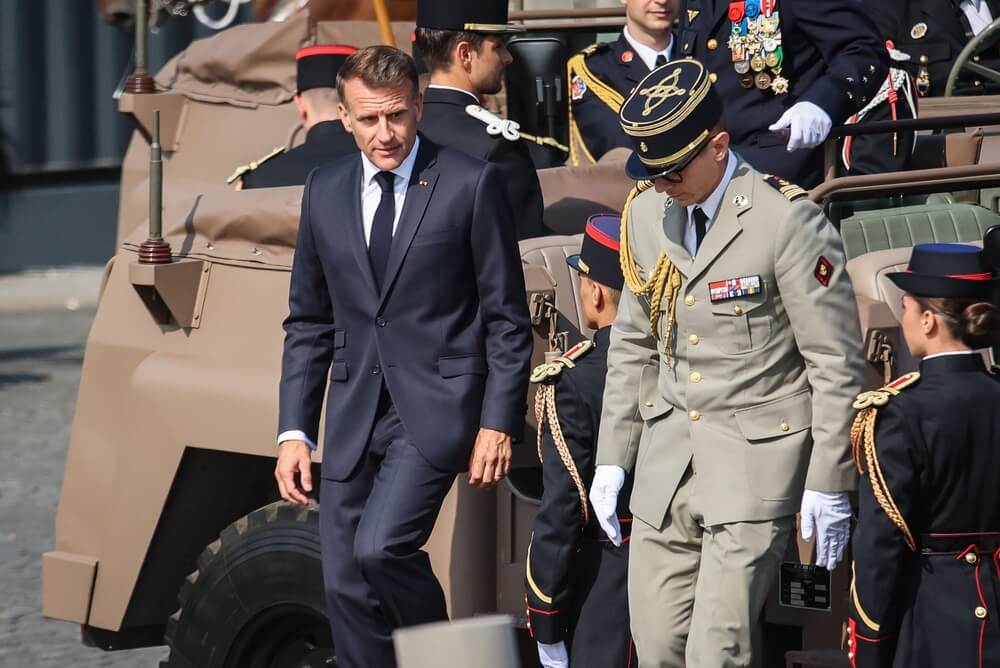 Emmanuel Macron announced an increase in the French arsenal and the end of the practice of publishing its size
On the same day, Macron and German Chancellor Friedrich Merz announced the establishment of a joint nuclear deterrence group to supplement existing NATO protection.
At the annual meeting of the Valdai Discussion Club in Sochi in October 2025, Putin asked why future restrictions should include China but exclude the nuclear weapons of Britain and France.
The growth of the French arsenal and increased British–French coordination give him an additional argument.
However, such a demand does not make negotiations easier; it makes them more difficult. Britain and France would have to agree to the negotiations independently, and all parties would then have to agree which weapons would fall under the restrictions and how they would be verified. Trump, Xi and Putin cannot impose obligations on London and Paris at the Shenzhen meeting.
A statement is more likely than an agreement
Washington, Moscow and Beijing do not agree on who should negotiate or on what. A broader international framework does not offer a solution either.
The Review Conference of the Parties to the Treaty on the Non-Proliferation of Nuclear Weapons, in which almost all countries of the world participate, ended in May for the third time in a row without a joint document.
The most that can be expected from Shenzhen is a general statement that nuclear war must be avoided
That is why smaller, separate steps, such as US–Russia talks on strategic forces and a US–China agreement on the notification of missile launches, are more realistic.
The most that can be expected from Shenzhen is a general statement that nuclear war must be avoided and an instruction for experts to continue talks, without any figures on China’s arsenal.
Putin will get what he asked for: a conversation about Ukraine with Trump and Xi. Trump will be able to say that he initiated nuclear negotiations with Russia and China.
The two largest arsenals in the world will remain without limits and checks, even though the US and Russia could have renewed them without China.
