Admiral Brad Cooper, commander of US Central Command, which is responsible for the Middle East, ordered the formation of the Iron Gate Group on 7 November.
Around 20 military and civilian officials in Tampa, Florida, where the command’s headquarters are located, will coordinate the work of US institutions tasked with preventing arms and other sanctioned goods from reaching Iran by land and via the Caspian Sea.
Dual-use equipment, which is used in civilian industry but can also be employed for weapons production, is also targeted.
The group will also track the funds with which Iran, according to Washington, pays for these purchases despite the sanctions.
On the same day, the command announced that a US aircraft had disabled the cargo ship Huda in the Gulf of Oman.
According to the command, the ship was flying the flag of Saint Kitts and Nevis, a Caribbean island nation, and had attempted to leave the blockade area after calling at an Iranian port, despite repeated warnings.
The Gulf of Oman lies at the exit of the Strait of Hormuz, through which ships from the Persian Gulf sail towards the Indian Ocean. On 13 April, the US began blocking shipping to and from Iran’s ports.
It lifted the blockade on 18 June after a temporary agreement brokered through Pakistani mediation, then renewed it on 14 July.
In negotiations via Qatar, Tehran continues to demand that Washington lift the blockade that limits its oil exports, its main source of foreign exchange.
In the Caspian, however, the US Navy cannot do what it did in the Gulf of Oman.
Iranian acquisitions continued during the war
A journalistic investigation published on 29 October, based on customs and shipping documents, company registers and banking records, traced procurement carried out by a network of organisations linked to the Iranian Ministry of Defence.
From January 2025 to June 2026, a single entity in that network, identified in the documents as MOD 346428, imported military equipment worth $2.3 billion.
The goods arrived by ship from Russia across the Caspian, by trucks from Central Asia and by aircraft from China.
The data also covers purchases made before the outbreak of the war on 28 February, when the US and Israel attacked Iran, and runs through to June, before the blockade was renewed in July.
In June, a consignment of Russian detonators worth $1.9 million arrived, the fifth since the start of 2025, bringing the total value of all five shipments to $7.6 million.
When the Americans sanction one carrier, the Iranian buyer charters another and pays a higher fee
The Iranian network also procured ingredients for rocket fuel and precision metalworking machinery, similar to those used in civilian industry.
The network’s monthly imports fell to $54 million in March, the first month of the war, but rebounded to $77 million in May, even as US and Israeli strikes hit facilities involved in the production of missiles and drones.
The most valuable intelligence to US agencies concerns parts and materials that Iranian factories can obtain only from a small number of manufacturers.
When the Americans sanction one carrier, the Iranian buyer charters another and pays a higher fee.
When a spare part fits only a specific machine and no replacement is available from an alternative supplier, a single delay in delivery can bring the entire production line to a standstill.
Moscow has reason to protect navigation
The Caspian Sea has no natural outlet to the ocean. Navigable routes from the Black and Baltic Seas pass through Russian rivers and canals, with the route from the Black Sea running through the Volga–Don Canal.
A vessel sailing from the Russian ports of Astrakhan or Makhachkala to the Iranian ports of Anzali or Amirabad never leaves the Caspian.
Intercepting a vessel in those waters would require entering an area where Washington has no forces and where Russia controls the navigable approaches.
The five littoral states signed a convention in 2018 excluding the armed forces of non-littoral states from the Caspian Sea, although Iran has not yet ratified it.
In July, the government in Tehran requested that the ratification bill be considered under an urgent procedure, and the Iranian parliament confirmed receipt of the draft legislation in September. Moscow has urged Tehran to expedite the process.
Moscow has already used the corridor for military procurement during the war in Ukraine.
In September 2024, the US Treasury Department placed four Russian cargo vessels operating between Russia and Iran on its sanctions list.
According to the department, the Russian Ministry of Defence used the vessel Port Olya-3 to transport short-range ballistic missiles from Iran.
While sanctions may have disrupted shipping outside the Caspian, loading and unloading along this route remain solely under the authority of Moscow and Tehran
While sanctions may have disrupted shipping outside the Caspian, loading and unloading along this route remain solely under the authority of Moscow and Tehran.
According to data from Lloyd’s List Intelligence, which tracks global maritime trade, there were 21 per cent more active vessels sailing under the Russian or Iranian flags in the Caspian in August than a year earlier.
Traffic cannot expand significantly, however, because shallow waters limit vessel draught and regional ports lack capacity.
Moscow is also investing in a land link with Iran. On 5 November, the Russian government announced that documentation for field surveys along the route of the Rasht–Astara railway had been signed.
The 162-kilometre section is the missing link on the western branch of the North–South Corridor, a planned transport route running from St Petersburg through Azerbaijan and Iran to the Indian Ocean.
In 2023, Russia agreed to provide a loan of €1.3 billion (around $1.5 billion) for its construction. Russian Railways now expects work to begin in 2027 and take three years.
For Moscow, completing the railway would allow it to route freight through Azerbaijan even when shallow waters constrain maritime cargo capacity.
Washington has more influence in Kazakhstan than in Russian ports
On 29 September, the US Department of the Treasury imposed sanctions on Iran's military procurement representative in Beijing and on a Hong Kong company it says supplied electronic components to an intermediary for Iranian drone and missile manufacturers.
These sanctions freeze the assets of those individuals and entities in the US and prohibit American firms and banks from doing business with them.
For foreign banks that knowingly execute larger transactions for them, the US can restrict or bar access to the correspondent accounts through which they conduct business with American banks, which, for most institutions, means losing access to the dollar.
For a supplier operating across multiple markets, even the risk of a bank refusing payment can be reason enough to abandon sales.
Iran has long relied on intermediaries to sustain military procurement under sanctions.
Customs records show that 97 per cent of the consignments analysed were settled without transferring foreign currency out of Iran, as intermediaries drew on funds already held abroad.
A bank sees only a payment between two companies outside Iran and cannot determine from the transfer instruction who will ultimately use the goods.
Once US intelligence agencies link the payment, the consignment and the end customer, they can alert the bank or ask the authorities of the transit state to inspect the cargo.
The network secured funding for these purchases well before the war. Bank records show that the 36 organisations in the network held a total of $1.2 billion in foreign currency accounts at the end of 2024.
While the blockade of oil exports is reducing Iran’s new revenue, buyers who already hold funds in foreign accounts can continue ordering goods for some time.
Tracking the money gives Washington the ability to stop a transaction at the point of payment, before the goods head to port
Tracking the money gives Washington the ability to stop a transaction at the point of payment, before the goods head to port.
A free trade agreement between Iran and the Eurasian Economic Union, an economic bloc of five former Soviet republics led by Russia, came into force on 15 May 2025.
When Washington requests scrutiny of specific cargoes, Russia and Kazakhstan, both members of the bloc, face very different calculations.
Among the major US investments in Kazakhstan is Tengiz, the country’s primary oilfield, operated by a joint venture in which Chevron and ExxonMobil hold stakes.
Kazakh banks are keen to protect their access to the US financial system. Astana therefore has reason to intercept a specific consignment for inspection on the basis of evidence of a military buyer, while maintaining regular trade with Iran.
By offering such cooperation, however, Moscow would jeopardise the route it relies on for its own procurement.
The action taken on 6 November demonstrated what cooperation with a willing government can achieve.
The US Treasury Department imposed sanctions on eight money services and currency exchange businesses based in Canada.
According to the department, they helped transfer funds linked to Iran, including through cryptocurrencies.
The Canadian agency that monitors suspicious financial transactions, the Financial Transactions and Reports Analysis Centre of Canada (FINTRAC), also helped to prepare the measures. Washington cannot expect similar assistance from Moscow.
Moscow gains influence if alternative routes become more costly
Iron Gate will most likely make Iranian procurement more expensive and slower, but shipping between Russian and Iranian ports will continue.
The harder it becomes to arrange delivery or payment through third countries, the more valuable the transport links that Moscow can provide will be to Tehran.
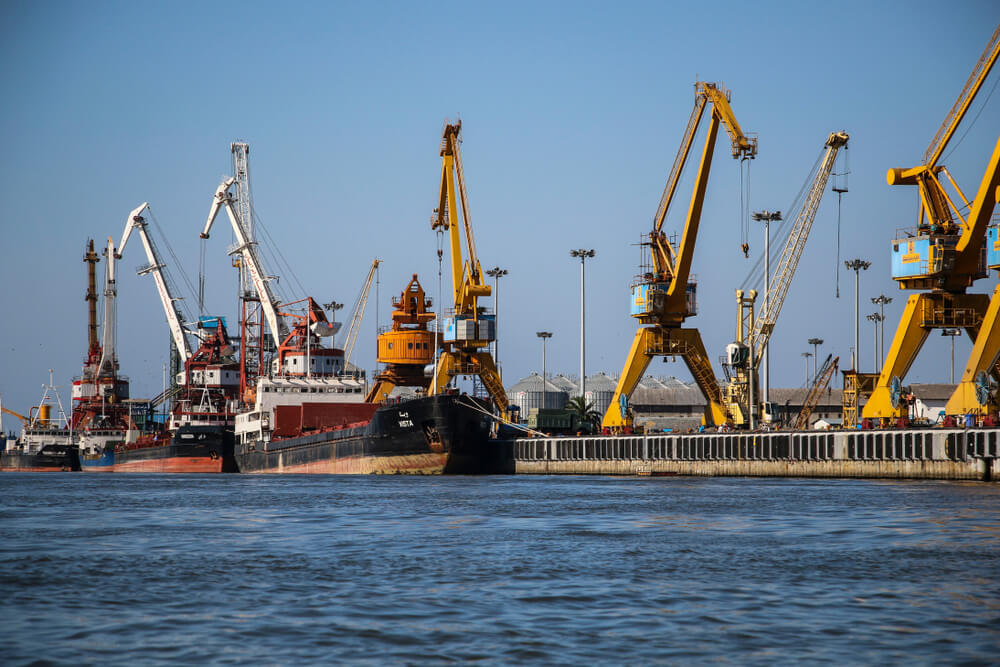 Iran’s defence industry now risks becoming increasingly dependent on Russian ports and suppliers - Anzali Port
Shallow ports limit the volume of goods Iran can divert along that route, but Russia does not need high tonnage to become indispensable if it supplies critical components Iran cannot obtain elsewhere.
A Hormuz agreement would ease oil exports for Tehran, but arms factories would remain under sanctions, meaning Iran would still have to procure manufacturing equipment through circuitous routes.
This would reverse the dynamic of 2022, when Iranian drones and missiles were arriving in Russia via the same maritime corridor for the war in Ukraine, leaving Moscow reliant on Tehran.
Iran’s defence industry now risks becoming increasingly dependent on Russian ports and suppliers.
For Tehran, this remains a precarious source of support: Russia itself is expending vast quantities of weapons and munitions in Ukraine and is even procuring supplies from North Korea.
Washington cannot close the Caspian, but this leaves Iran reliant on whatever Moscow can spare from its own war effort, at a price and on terms dictated by Moscow.
