Saudi Arabia and the United Arab Emirates have rapidly invested in artificial intelligence infrastructure over the past year. In recent days, they have further accelerated cooperation with American AI companies despite growing regional instability and tensions with Iran.
The focus is no longer solely on technology start-ups and digital services, but now also includes large data centres, long-term contracts for the supply of Nvidia chips, cloud infrastructure, and partnerships with the largest American technology companies.
Riyadh and Abu Dhabi are seeking to establish a position in the global AI economy before the market becomes fully divided between the US and Chinese technology blocs.
To this end, they are investing capital that Europe cannot currently mobilise, providing the energy required for hyperscale data centres, and aiming to become key partners of American companies in the next phase of artificial intelligence development.
Saudi Arabia and the UAE are investing large sums in AI infrastructure, but a key part of the technology remains under American control.
Advanced Nvidia GPU systems, cloud infrastructure, the most powerful artificial intelligence models, and complete software still depend on American companies and US export licences.
This means Saudi Arabia and the UAE are not building independent AI systems today but are seeking privileged access to the US AI system. That distinction is crucial.
The US Department of Commerce approved the export of advanced AI chips to the Saudi company HUMAIN and the Emirati G42 late last year, imposing strict security conditions and oversight of the technology’s end use.
The requirement for political approval from Washington to access the most advanced chips demonstrates how much the nature of the global technology market has changed.
Until a few years ago, advanced processors were considered commercial goods. Today, they form part of American security policy towards China, as well as towards partners such as the Gulf states.
Washington no longer separates technological dominance from foreign policy. Control of AI infrastructure has become an instrument of strategic influence, just as energy resources or the financial system were used in previous decades.
The Gulf possesses wealth and energy but lacks technology
Saudi Arabia and the UAE understand this need for change well. Therefore, alongside investments in infrastructure, they are forging strong relationships with American technology companies, investment funds, and political structures.
Their aim is not only to gain access to technology, but also to ensure long-term political security so that this access is not disrupted.
US companies require capital, energy, and space to develop the next generation of AI infrastructure
This explains why partnerships with Microsoft, Oracle, Nvidia, and other American companies in the Gulf are advancing much more rapidly today than comparable projects in Europe.
US companies require capital, energy, and space to develop the next generation of AI infrastructure.
The Gulf can provide these without the significant regulatory obstacles, slow political processes, or energy limitations faced by Europe.
Access to American technology requires distancing from China
Saudi Arabia, in particular, is seeking to capitalise on this opportunity. Through the company HUMAIN and state investment funds, Riyadh is planning major investments in data centres and computing infrastructure, including cooperation with Elon Musk's xAI and the purchase of hundreds of thousands of Nvidia chips in the coming years.
The UAE already holds a significant advantage through the company G42 and its long-standing ties to the US technology sector. However, the G42 case demonstrated how crucial the political dimension of AI infrastructure is.
In recent years, the Emirati company was required to sever ties with Chinese partners and technology to maintain access to American systems and chips.
In doing so, Washington effectively established a model that will likely apply to other countries as well: access to the most advanced AI infrastructure will depend on security and political alignment with the US.
The Gulf is seeking to position itself as a reliable American partner
This means the global AI market will be much less open in the coming years than it is today.
The most advanced systems will not expand solely according to market logic, but also according to Washington's political priorities. Countries that maintain close technological ties with China will face serious difficulties in accessing America's top-tier AI infrastructure.
In this context, the Gulf is seeking to position itself as a reliable American partner.
Riyadh and Abu Dhabi rely on their political and security cooperation with the US to secure long-term access to technology that other states may not be able to obtain.
This is why current Gulf investments in the AI sector have much broader significance than simple technological modernisation.
It is an attempt to secure a position in the future hierarchy of the global economy.
Control of AI technology is shifting from the market to politics
Artificial intelligence is still viewed by much of the public through apps, chatbot systems and software. However, the real concentration of power lies deeper – in the control of computing infrastructure, energy, chips and data centres.
This is where future economic and political power is currently being allocated.
Saudi Arabia and the UAE have the capital and energy required for this process but lack the technology to achieve full independence.
Therefore, they are seeking to position themselves within the US AI system before the global market is definitively divided between the US and Chinese technology blocs.
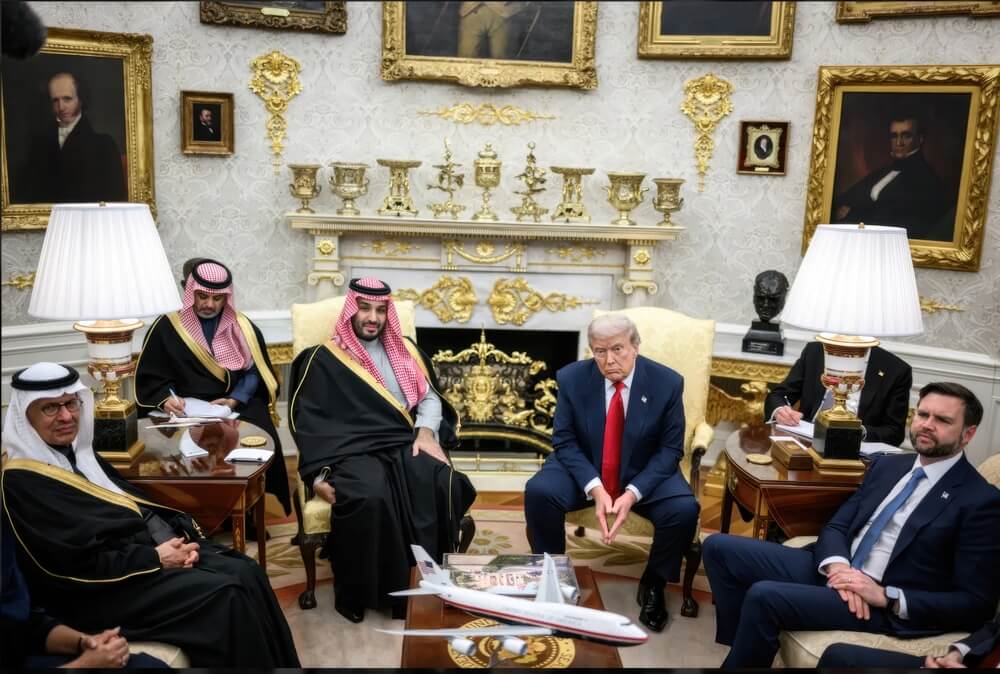 The US administration makes clear that it has no intention of handing over control of the most advanced systems, even to close partners - Donald Trump with Mohammed bin Salman
For now, Washington supports these developments because it is comfortable with strengthening partners who can finance and accelerate the development of American AI infrastructure outside US territory.
At the same time, the US administration makes clear that it has no intention of handing over control of the most advanced systems, even to close partners.
This creates a new type of dependency that will become more apparent as the AI economy grows.
Saudi Arabia and the UAE are trying to reduce dependence on an oil-based economy, but in doing so they are entering a system where key technological resources remain under the political control of Washington.
In other words, energy dependence is gradually being replaced by technological dependence.
Europe enters the race without its own infrastructure
At present, Europe does not have a clear response to this process. While the Gulf is investing tens of billions of dollars in infrastructure and partnerships with American companies, European states remain largely engaged in regulatory discussions without a serious joint industrial strategy.
The European market lacks its own Nvidia equivalent, does not have a unified energy policy for the AI sector, and lacks the political agility that the Gulf monarchies currently demonstrate.
Access to the most advanced AI infrastructure will depend less on the market and more on political relations with the United States
This will further increase US dominance in the global AI system in the long term.
The Gulf is seeking to extract maximum benefit from this dominance. However, current developments indicate that access to the most advanced AI infrastructure will depend less on the market and more on political relations with the United States.
