On 5 November, France extended the mission of its patrol aircraft in Romania after its crew detected three naval drones approaching the merchant vessel Contship Jet a week earlier.
The Bulgarian authorities and the crew were warned about an hour before impact.
The vessel, sailing under a Liberian flag and carrying 421 containers from Haifa to Constanța, Romania, was hit three times and sank, while all 18 sailors were rescued.
The commander of the French Atlantique 2 aircraft explained that during that mission his crew could detect naval drones but had no means of intercepting them.
The warning enabled people to leave the ship, and the sinking demonstrated how much depends on whether the notification reaches a military unit in time to intervene.
For Romania and Bulgaria, two NATO members whose port approaches are increasingly under attack, this has become a matter of the security of their trade.
The war follows Ukrainian exports to the Danube
According to data published at the end of October, more than 570 merchant vessels have been struck in the Black Sea since the beginning of 2026, 387 of them between July and September.
Russia attacks ships and ports linked to Ukrainian exports, while Ukraine targets vessels supporting Russian trade, including tankers from the so-called shadow fleet that Moscow uses to circumvent restrictions imposed on its oil exports.
According to an estimate by maritime security firm Ambrey, Russia was responsible for approximately 90 per cent of attacks on merchant vessels in the six weeks to the end of October.
Russian strikes have largely halted exports from the ports around Odesa, so Ukrainian goods are diverted to the Danube ports and then through the Romanian Sulina Canal to the Black Sea.
The Danube’s share of total cargo handled in Ukrainian ports rose from about 10 per cent in the first half of the year to 74 per cent in August.
Ships wait for days at the entrance to the canal, often at anchor, which increases their exposure to drones.
Ukraine’s grain exports through the ports fell to 810,000 tonnes in September, down from 2.1 million tonnes in the same month in 2025
Ukraine’s grain exports through the ports fell to 810,000 tonnes in September, down from 2.1 million tonnes in the same month in 2025.
For Ukrainian producers, this means slower repayment for goods sold and additional transport costs, and it also makes it more difficult for customers to plan deliveries.
At least nine merchant vessels were attacked off the Romanian and Bulgarian coasts in October, and around 34 sailors were killed or are missing.
On 20 October, NATO announced additional patrol aircraft, radars, drones and intelligence experts.
Eight days later, the Contship Jet’s crew received a timely warning, but no published Alliance decision provided for the continuous armed escort of ships passing along these routes.
An hour between warning and impact
On 28 October, the Bulgarian Navy recorded strikes on the Contship Jet and, immediately after the first strike, deployed three warships to rescue the crew.
By 1.45 pm, all sailors were safe. There is no public information on whether there was a unit in the vicinity equipped with weapons capable of stopping the three unmanned attack craft before the first strike.
A maritime drone sits low in the water, has a small radar profile and can blend in with other objects and civilian vessels.
Even when it is detected, a ship or aircraft with suitable weapons must be close enough, the crew must confirm the target, and an order to open fire must be received.
An hour may be enough for an evacuation, but not enough for an armed unit to arrive from a distant location.
Romania has demonstrated that its military can target naval drones
Romania has demonstrated that its military can target naval drones. At the Neptun Alpha platform on 20 August, a Romanian F-16 shot down an explosive-laden drone, which the navy then completely destroyed.
On 17 October, Romanian fighters also shot down two drones in the air above their territorial waters.
The Minister of Defence estimated that they were probably Russian Geran-4 aircraft.
These examples confirm the ability to act, but the availability of assets and the circumstances of each attack remain decisive for the outcome.
The coast of a NATO member state, but without automatic military protection
The Contship Jet was attacked in Bulgaria’s exclusive economic zone, beyond the band of territorial waters that, as a rule, extends up to 12 nautical miles, or about 22 kilometres, from the coast.
In the exclusive economic zone, Bulgaria has sovereign rights over natural resources and installations, while ships of other countries retain freedom of navigation.
Because the vessel sailed under the Liberian flag, the attack itself does not automatically trigger collective defence under Article 5 of the North Atlantic Treaty.
NATO members can jointly protect merchant shipping without invoking Article 5
NATO members can jointly protect merchant shipping without invoking Article 5, but for such an operation they must agree on command, tasks and rules of engagement.
When the warning is sent by a French aircraft and the rescue is organised by Bulgaria, the speed and accuracy of data exchange directly affect what can be done before a strike.
Romanian President Nicușor Dan linked the sinking of the Khoryv on 23 October to Russian aggression against Ukraine, and a NATO military source attributed the attacks on two tankers near the Sulina Canal to Russian drones.
Ambrey experts assessed that the drone captured during the attack on the Contship Jet resembled a Russian design.
The origin of that design does not in itself prove who was operating a particular drone, and the Alliance as a whole has not released a joint conclusion on responsibility for all the October attacks.
Ship protection measures, however, can be implemented while the perpetrators are being identified.
Insurers have already priced in the risk
On 16 September, the London committee that assesses war risks in marine insurance extended the area of increased risk to almost the entire Black Sea.
The territorial waters of Romania, Bulgaria, Turkey and Georgia are exempt, but the sea routes to their ports are often exposed to danger.
By the end of October, the additional war-risk premium on routes to Romania and Bulgaria generally amounted to between 0.4 and 1 per cent of a ship’s value.
Insurance was significantly more expensive for certain Russian and Ukrainian ports.
Romania is concerned about protecting the Neptun Deep gas project, where production is expected to start in 2027
French shipping company CMA CGM has announced that from 9 November it will introduce an additional charge of $35 for each standard container unit of around six metres in length on shipments to and from Black Sea ports, including Constanța, Varna and Burgas.
In some markets, due to regulatory requirements, implementation will begin on 1 December.
The additional cost is included in the transport price and may be passed on to exporters, importers and end customers, even when the ship arrives safely at its destination.
Romania is also concerned about protecting the Neptun Deep gas project, where production is expected to start in 2027.
In August, a naval drone carrying explosives was found near work on the project.
Meanwhile, the Contship Jet was carrying lithium-ion batteries and hazardous chemicals.
Any leakage of such cargo would threaten the sea and the coasts of countries that did not take part in the attack.
Sofia still has no answer to the next attack
The defence ministers of Romania, Bulgaria and Turkey met in Sofia on 28 October, the day of the Contship Jet attack.
They discussed strengthening data exchange and cooperation between their navies, and Romania requested stronger NATO support for early warning and countering drones.
They did not announce a joint combat command or a military escort system for merchant ships.
In July, the three countries agreed to expand the duties of their joint sea mine-clearance group to include the protection of underwater infrastructure.
Intercepting naval drones requires a specific plan with designated forces and clear rules of engagement.
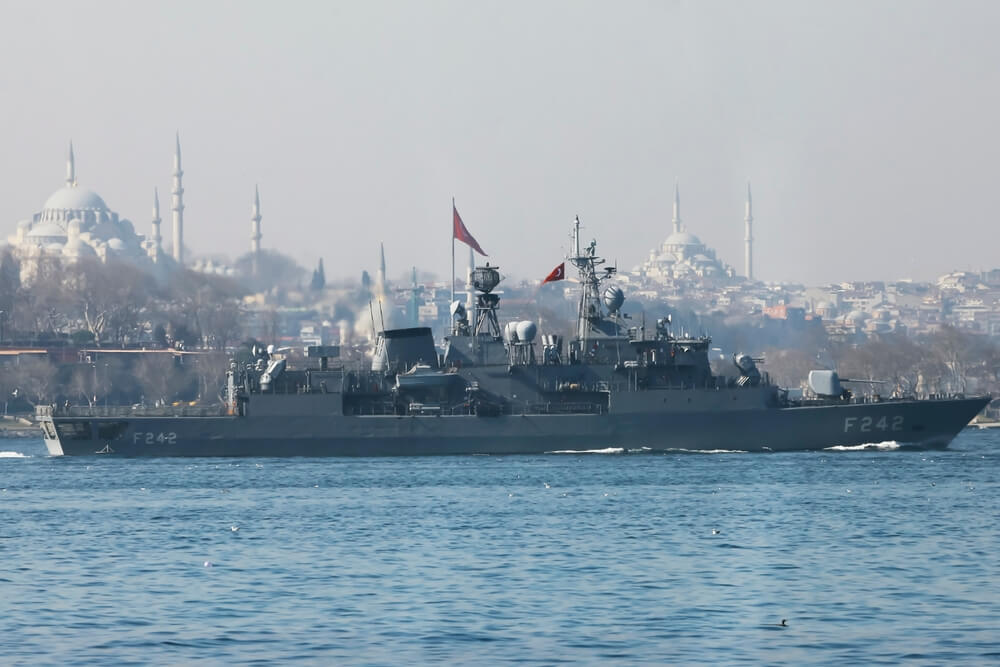 Turkey has a special role because the Montreux Convention restricts the passage of warships through the Bosphorus and the Dardanelles
.
Warships from non-Black Sea states, including the US, Great Britain and France, can remain there for a maximum of 21 days.
This further increases the importance of the Turkish, Romanian and Bulgarian navies for the permanent protection of maritime routes.
Ankara has proposed an agreement to end attacks on merchant ships. Ukraine has shown readiness for talks, while Moscow has not yet agreed to such a limited naval truce.
For the three Black Sea members of the Alliance, the immediate protection of the approaches to Constanța, the Sulina Canal and Varna is a task they can plan for without waiting for a diplomatic agreement.
Romania, Bulgaria and Turkey are most likely to begin by strengthening protection of selected approaches to ports, because permanently escorting every merchant ship would require significantly more warships and crews.
Such a choice would allow them to safeguard traffic in the most important areas without deploying the fleet across the entire Black Sea at all times.
If the attacks continue, shippers will seek more reliable measures, and transport costs will place an even greater burden on Ukrainian exports and regional trade.
The French warning on 28 October helped save 18 lives. For the next ship to reach port, NATO members will have to decide where to deploy interceptors, how to include them in joint surveillance, and who will give the order when the next threat arises.
