For decades, Western governments have limited the issue of reparations to historical memory, education, and symbolic recognition.
Commemorations, museums, statesmen’s speeches, and carefully worded expressions of regret have kept this discussion within the realm of moral responsibility, without direct implications for budgets, debts, development banks, or the rules of international finance.
The conference in Accra, which concluded on 19 June, showed that African and Caribbean countries are seeking to broaden this framework and translate the demand for reparations into the language of contemporary politics.
Ghana supports a 19-point framework that calls for formal apologies, financial compensation, debt relief, reforms of international financial institutions, restitution of looted cultural heritage, and climate finance from states and institutions linked to the transatlantic slave trade.
The document is political rather than legally binding, but its significance lies in the joint action of the African Union and the Caribbean Community. CARICOM had its own reparative justice plan as early as 2014.
In November 2023, the African Union endorsed a proclamation on reparations in Accra, and its Council confirmed the conclusions in February 2025. Now, these two initiatives are converging on a broader platform before the United Nations.
The reason for this step arose a few months earlier. On 25 March 2026, the UN General Assembly adopted a resolution designating the trade in enslaved Africans and racially based slavery as the most serious crime against humanity.
One hundred and twenty-three countries voted in favour, while the United States, Israel and Argentina opposed, and 52 countries abstained.
The resolution itself does not create a financial obligation, but it has opened a political space in which African and Caribbean states are now seeking to link historical responsibility to contemporary power relations.
A political account of former empires
Western countries have a developed vocabulary for recognising historical suffering but provide a much narrower space when such recognition leads to material demands.
A formal apology can be incorporated into a state ceremony, but financial compensation, debt relief, or changes in international financial institutions initiate a completely different political struggle.
This is why Western resistance to reparations is rarely based on denial of historical facts; it is rooted in fear of precedent, questions of legal continuity, and domestic politics, where governments would find it difficult to explain to voters why today’s budgets should bear the consequences of crimes committed centuries ago.
African and Caribbean states do not regard slavery and colonialism as distant history confined to museums
Western governments continue to argue that responsibility for crimes committed during the colonial period cannot be attributed to today’s generations. However, an increasing number of African and Caribbean countries maintain that the consequences of these crimes continue to affect their economies and societies.
African and Caribbean states do not regard slavery and colonialism as distant history confined to museums.
They link them to the long-term accumulation of wealth in Europe and America, the destruction of societies from which millions of people were forcibly taken, colonial economies that served the metropolises, and the current position of countries facing high borrowing costs, the consequences of climate change, and limited influence in international financial institutions such as the IMF and the World Bank. Therein lies the central conflict.
Western governments are generally willing to discuss historical memory, racism, and education. African and Caribbean countries emphasise the economic consequences of the colonial past and their impact on contemporary relations between rich and poor countries. The Accra conference gave this difference an institutional form.
European weakness in Africa
Europe is the most sensitive aspect of this story. Great Britain, France, the Netherlands, Portugal, and Spain played distinct but significant roles in the transatlantic slave trade and the colonial economy.
Today, those same states, along with the European Union, are trying to restore influence in Africa through investments, energy arrangements, access to critical minerals, migration agreements, and political cooperation in the UN.
Europe now seeks partners, investment, raw materials, and political support in Africa. This gives African states bargaining power they lacked during much of the post-colonial period.
European diplomacy has spoken of an equal partnership with Africa for years, but this expression loses value when confronted with the question of historical responsibility.
European negotiating position will be weaker whenever it tries to reduce historical responsibility to protocol
African states can set a simple political condition: if Europe seeks a different relationship with Africa, it must accept a conversation about what has determined that relationship for centuries.
The issue of reparations will gradually enter negotiations on debts, climate finance, market access, cultural restitution, and the position of African states in international financial institutions.
For Europe, competition from China and Russia is an additional problem. Beijing and Moscow do not have a morally sound attitude towards weaker states, but in Africa they effectively use anti-colonial rhetoric against the West.
Any European refusal to discuss reparations can be presented as evidence that the attitude towards Africa has changed only in form, while the essence remains unchanged.
This does not mean that African countries will automatically align with China or Russia. It means that the European negotiating position will be weaker whenever it tries to reduce historical responsibility to protocol.
Slavery as a US political issue
The United States faces a different but equally challenging problem. The US history of slavery, the Civil War, segregation, and the struggle for civil rights make reparations one of the most sensitive domestic issues.
Any international framework that could serve as a basis for domestic demands for reparations in America provokes strong political resistance.
This is why the US vote against the UN resolution should also be viewed through the lens of domestic political considerations.
However, US refusal comes at a cost to relations with the Global South. The United States is now paying much more attention to Africa than previously, primarily because of China's economic and political presence on the continent.
US refusal to discuss reparations can have political consequences that extend beyond the subject of slavery
Therefore, US refusal to discuss reparations can have political consequences that extend beyond the subject of slavery. A negative stance on an issue that African and Caribbean states present as a fundamental matter of historical justice undermines the US message of partnership.
The United States can reject reparations, but it will find it much more difficult to avoid the political consequences of this position among countries that regard slavery and the colonial legacy as matters of historical justice.
For this reason, the US position is likely to remain defensive. Washington will support development programmes, the fight against racism, educational initiatives, and cooperation with the African diaspora, but will avoid language that could raise the issue of legally or financially binding reparations. That caution will not stop the subject; it will simply shift it to other areas.
Reparations as a language of negotiation
The greatest mistake Western governments could make is to assume that the Accra request will disappear because it has no immediate legal force. Many political processes begin in this way.
First, a common language is established, then it is introduced into international organisations, then it appears in negotiations on other topics, until it finally becomes part of normal diplomatic pressure.
Reparations are likely to develop in this way. Direct payments to the descendants of enslaved people, particularly at the transnational level, remain politically and legally difficult to implement.
A much more realistic approach lies in combining concrete demands that can be presented as development, climate, cultural, or financial policy.
The West will try to steer the discussion towards individual programmes, without accepting a single concept of reparations
Debt forgiveness or restructuring can be justified by arguments of historical injustice. Climate finance is connected to a long history of extraction and uneven industrialisation.
The return of cultural heritage may become a more widely accepted part of a broader reparations package. Educational funds, scholarships, archival cooperation, and citizenship for members of the diaspora can be offered as more politically acceptable forms of response.
The West will therefore try to steer the discussion towards individual programmes, without accepting a single concept of reparations.
African and Caribbean countries will have opposing interests. They will try to keep different demands within a common framework, as it is this framework that gives political weight to the negotiations.
Terminology will not be secondary in this conflict. The party that imposes the language of the discussion will determine the limits of the possible outcomes.
The colonial past in the budgets of the future
The most realistic development will be a prolonged effort, not a grand agreement. Western governments will not accept a historical reckoning expressed in large financial sums.
No major Western capital currently has the political will to make reparations an explicit budget commitment.
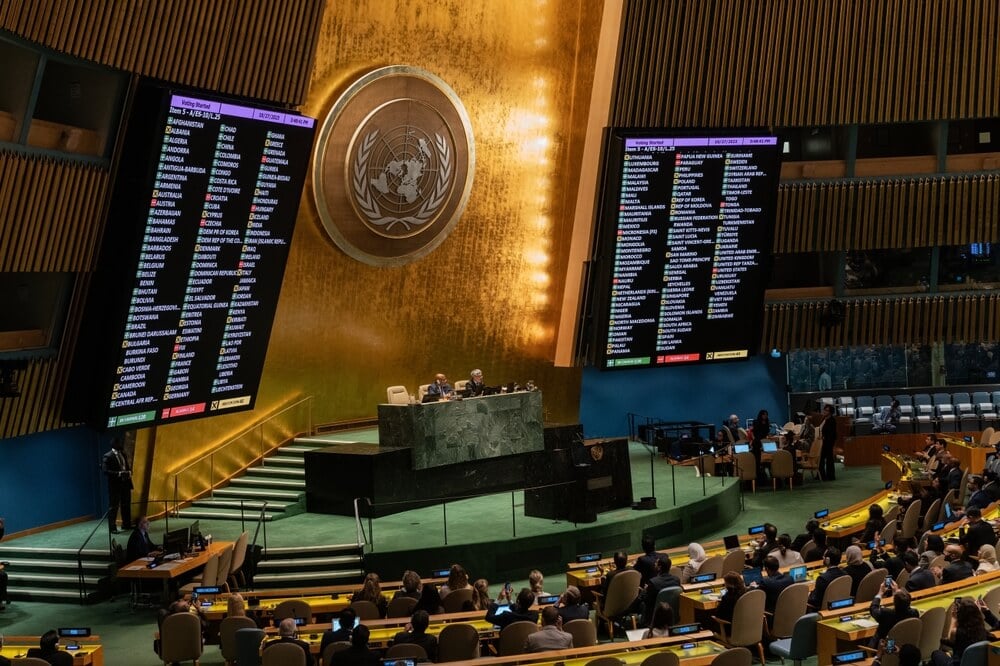 In the coming months, the most important step will be presenting the 19-point framework to the UN General Assembly
However, Accra has shown that African and Caribbean states can move the issue from academic and activist circles into intergovernmental politics.
In the coming months, the most important step will be presenting the 19-point framework to the UN General Assembly and the ability of the African Union and CARICOM to maintain a united front.
The strength of this initiative lies not in the individual demands of separate countries, but in Africa and the Caribbean's joint effort regarding European countries and the United States.
The conference in Accra can therefore mark the beginning of a new phase in these relations. It does not guarantee the payment of reparations, but it changes the context in which negotiations will take place.
The colonial past now enters contemporary discussions about money, influence, and the rules of the global economy. It is a debt the West may not wish to acknowledge in full but can no longer simply dismiss.
