El Salvador’s homicide rate, previously among the world’s highest, has dropped dramatically under President Nayib Bukele’s authoritarian rule.
Bukele argues that there is no alternative to his model of crime reduction, which includes a persistent state of emergency, mass incarcerations, and widespread human-rights violations.
Institutional reforms move too slowly to mitigate the daily harm caused by gangs. No one, he claims, has ever come up with a security model as successful as his.
That is patently false. Though few have noticed, Mexico has reduced its daily homicide count by 41%, from 87 to 51, over the past 18 months—an historic achievement.
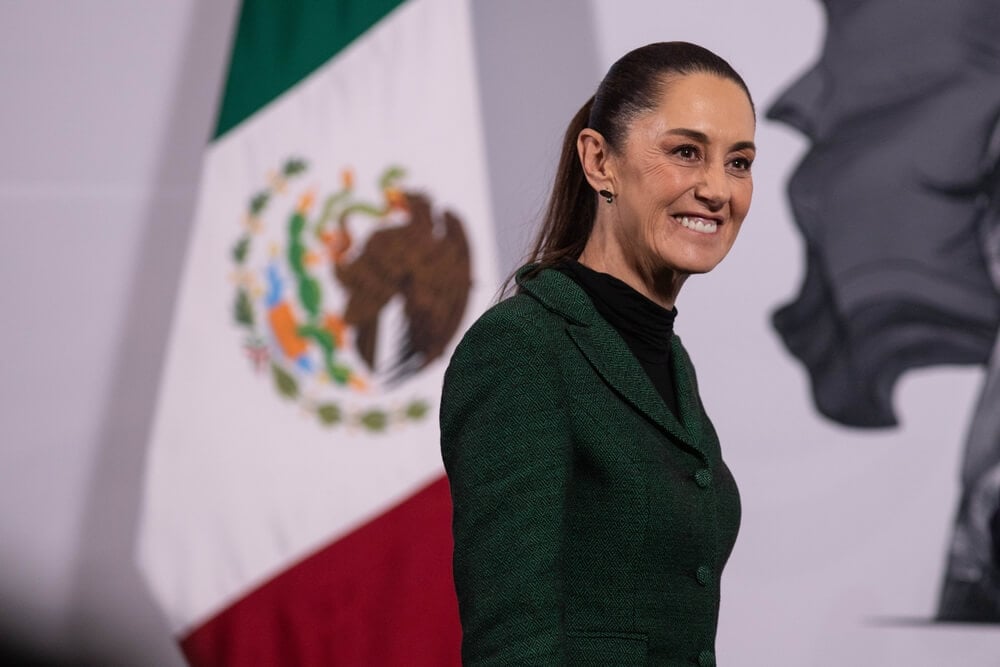
The leading suspected cause for this structural shift is Mexico’s crime-fighting strategy since President Claudia Sheinbaum took office.
Mexico’s progress is all the more remarkable because Sheinbaum’s task is far more difficult than Bukele’s.
Mexico is facing sophisticated transnational organized crime groups (the major drug cartels), not street gangs, and its population is 20 times that of El Salvador.
Whereas Bukele’s state of emergency reduced daily homicides by five over the first 18 months, Mexico reduced them by 36 without resorting to a state of emergency.
Confronting the sources of crime directly
Mexico’s new strategy differs from previous ones in several ways. Perhaps the most important is that it does not shy away from confronting the sources of crime directly.
From 2018 to 2024, former Mexican President Andrés Manuel López Obrador (AMLO) had favored a low-confrontation approach vis-à-vis organized crime, admittedly in an effort to avoid the mistakes of earlier strategies.
His own predecessors had focused on decapitating criminal organizations and imprisoning their leaders, which backfired and led to an exponential growth in violence.
With their leaders removed, criminal organizations fractured into cells that fought one another, creating chaos and driving diversification into other criminal activities.
Sheinbaum has deployed criminal investigative resources to target the main sources of the cartels’ financing and to better coordinate with local authorities
But AMLO’s forbearance strategy did not work, either. The homicide rate fell, but criminals’ power grew more entrenched.
Crime groups developed extensive extortion networks, engaged in vigilantism, press-ganged young people, and relied on hidden mass graves to keep their activities out of the public spotlight.
Sheinbaum found a third path. Unlike past leaders who saw decapitation as a one-size-fits-all strategy for the whole country, she has devised localized strategies to target mid-level commanders, not just the kingpins.
At the same time, she has deployed criminal investigative resources to target the main sources of the cartels’ financing and to better coordinate with local authorities.
Crime cannot be fought with the same tools everywhere
The strategy recognizes that crime operates differently across regions and cannot be fought with the same tools everywhere.
In Mexico’s avocado-growing region, in the state of Michoacán, criminal groups extort farmers. In oil-rich states like Tamaulipas or Tabasco, they smuggle fuel.
Along the Mexico-Guatemala border, they traffic and kidnap migrants. In Cancún and Mexico City, they sell drugs to tourists and domestic consumers. And in Tijuana, they cross the border into the US and get paid in dollars.
Each criminal economy has distinct incentives and organizational structures that can be unwound only with targeted strategies.
Accordingly, Sheinbaum has a separate plan to address fuel smuggling in oil-producing zones, corruption at customs checkpoints, extortion in agricultural areas, and the infiltration and capture of local police forces in southern states.
Mexico is developing its criminal investigation capabilities and using them to apprehend “violence-generating agents,” including mid-level criminal commanders
Perhaps most importantly, Mexico is developing its criminal investigation capabilities and using them to apprehend “violence-generating agents,” including mid-level criminal commanders.
The result has been an increase in arrests, with Mexico’s prison population growing by 11% during the first 15 months of the strategy.
To be sure, Mexico’s incarceration rate remains well below that of Chile, Brazil, and certainly the United States and El Salvador, and one cannot rule out potential abuses.
If the current increase in the incarceration rate continues, by 2030, Mexico will be among the top 25% of countries with the highest incarceration rates.
Furthermore, since trials take ten months, on average, two out of every five people in prison have yet to be sentenced.
Criminal groups moderate their behavior
Without more detailed studies, the reduction in violence may not be entirely attributable to Sheinbaum’s strategy and could instead reflect a shift in criminal groups toward moderating their behavior.
Unlike the old hierarchical organizations that dominated the scene in the past, major groups like the Jalisco New Generation Cartel operate on a decentralized, franchise model that makes decapitation less destabilizing and less likely to trigger violent fragmentation.
Many criminal groups are no less strategic in their thinking than law enforcement.
With Sheinbaum prioritizing crime reduction and facing immense pressure from the US, they know that visible shows of violence will put them in the crosshairs.
 Robberies, kidnappings, extortions, and even aggravated assault have all trended downward under Claudia Sheinbaum
Some commentators, however, suggest that homicides have not actually declined, but that criminals have gotten better at hiding the bodies.
This may be true in part, but it is unlikely to be the main explanation for the reduction.
And although the number of disappeared persons in Mexico has increased in recent years, it has not been enough to offset the decline in homicides.
Another theory is that the government is “erasing” homicides by reclassifying them as accidents or assigning them to other causes. Such practices cannot be ruled out and may occur in some states.
But even if all deaths ruled as accidents or other causes were in fact concealed homicides, the overall homicide rate would still have declined.
It is also not only homicides that have fallen. Robberies, kidnappings, extortions, and even aggravated assault have all trended downward under Sheinbaum.
This suggests that crime as a whole is being contained, a pattern that would not be observed if the only variable at play were the manipulation of homicide classification.
A credible alternative to Bukele’s thuggishness
Of course, Mexico has not brought crime fully under control. Some regions remain highly violent, and the country still lacks a professional, non-militarized police force.
Mexican citizens consistently rank insecurity as one of the country’s main problems, and it is unlikely to disappear as long as the United States and Europe—the world’s largest illicit drug markets—continue to demand what the cartels are selling.
If a country facing as many challenges as Mexico can achieve improvements of this magnitude, there may be a credible alternative to Bukele’s thuggishness
Moreover, Mexico has a severe corruption problem that leads local authorities either to turn a blind eye or to openly allow organized crime to operate with impunity.
Just last week, the US requested the extradition of a sitting governor, alleging that he collaborated with a cartel.
Mexican authorities are investigating the case, but contend that they have not been given sufficient evidence to act against him.
Still, governments around the world should take notice. If a country facing as many challenges as Mexico can achieve improvements of this magnitude, there may be a credible alternative to Bukele’s thuggishness.
Viri Ríos, a political scientist, is Head Editor of Mexico Decoded.
