Due to extraordinary circumstances, following the Iranian attack on the RAF base in the south of the island, Cyprus has appeared to be a true member of NATO since the beginning of March.
The Iranian kamikaze drone attack on the Akrotiri base near Limassol on the night of 1 March was part of Iran's armed response to the US-Israel attacks, with Tehran retaliating against allied military installations in the region.
The combat solidarity of partner armies with Cyprus was swift and far from symbolic. RAF planes took off the same night and intercepted the incoming drones.
The very next day, Greece deployed two frigates and four F-16 fighters to support Cyprus, while France, Italy, and Spain also sent naval forces.
French President Emmanuel Macron personally travelled to Cyprus as a sign of support, meeting with Cypriot President Nikos Christodoulides and Greek Prime Minister Kyriakos Mitsotakis.
Even the northern part of Cyprus, whose statehood is recognised only by Turkey, did not go without military support during the crisis. Ankara sent six F-16 fighters to north Cyprus and announced the deployment of surface-to-air missiles in that part of the island.
Thus, several heavy-weight NATO members quickly came to the defence of a non-member of the Alliance when it became exposed to air attacks by Iran and/or its proxies in the Mediterranean.
Everything resembles an informal application of Article 5 of the North Atlantic Treaty, which states that an attack on one NATO member is considered an attack on all. Except that this was not an attack on a NATO member.
Turkish obstacle
The crisis caused by the US-Israel attack on Iran and Tehran's military response across the wider Middle East, including Cyprus, has reactivated the discussion on whether Cyprus should join NATO.
After the missile attacks, President Christodoulides told Greek television that his government would submit an application to join NATO "even tomorrow if it were possible".
The pro-Western Cypriot president admits that the current political circumstances do not allow such a step. Simply, Turkey does not recognise the state of Cyprus, but only its northern part, which is inhabited by Turks. Acceptance of new members into the Alliance requires the consent of all 32 members.
Cyprus has been a divided island for more than 50 years, and there have been attempts to bring the positions of the two sides (Greek and Turkish) closer together, but without much success.
Nevertheless, the Cypriot leader, although aware of the insurmountable obstacle, is quite adamant that, if Cyprus does not join, he will at least bring his country closer to NATO membership.
The progress would be reflected in Turkey's agreement for Cyprus to become part of NATO's Partnership for Peace programme
Cyprus currently holds the six-month presidency of the EU Council, and Mr Christodoulides announced at the end of last year that he would use this period to ease tensions with Turkey and, in return, seek its consent to move closer to NATO.
According to the Cypriot president's plan, that progress would be reflected in Turkey's agreement for Cyprus to become part of NATO's Partnership for Peace programme, which is a step towards full membership.
"We can envision a step-by-step approach with steps by Turkey on Cyprus joining the PfP and in parallel positive steps on EU-Turkey relations, always in conjunction with the resumption of talks for a solution to the Cyprus problem within the agreed framework," said the president of Cyprus at the time.
Diplomatic rapprochement
Ankara did not shift from its firm position on that occasion. However, it will not oppose small steps that could ease the long-standing stalemate and, perhaps, pave the way for new strategic agreements.
One such step will take place later this week, when President Christodoulides and moderate Turkish Cypriot leader Tufan Erhurman will meet with the UN Secretary General's special envoy. There has not been a meeting in this format for years.
Opportunity for rapprochement will arise on 23 and 24 April, when Cyprus hosts an informal EU summit
An even more favourable opportunity for rapprochement will arise on 23 and 24 April, when Cyprus hosts an informal EU summit, to which President Christodoulides has announced he will also invite Turkish leader Recep Tayyip Erdogan.
However, while diplomacy can only promise long-term and gradual processes of normalisation, the suddenly complicated security situation in Cyprus means that changes must be considered much more rapidly.
Exposure to the Middle East crisis
The war in Iran has suddenly raised concerns not only about the security of the wider Middle East region but also about the southern members of the EU and NATO, among which Cyprus is the most exposed.
Located only about 100 miles from Lebanon, Cyprus is vulnerable not only to direct airstrikes from Iran but even more so to attacks from Iranian proxy positions in Lebanon and Syria.
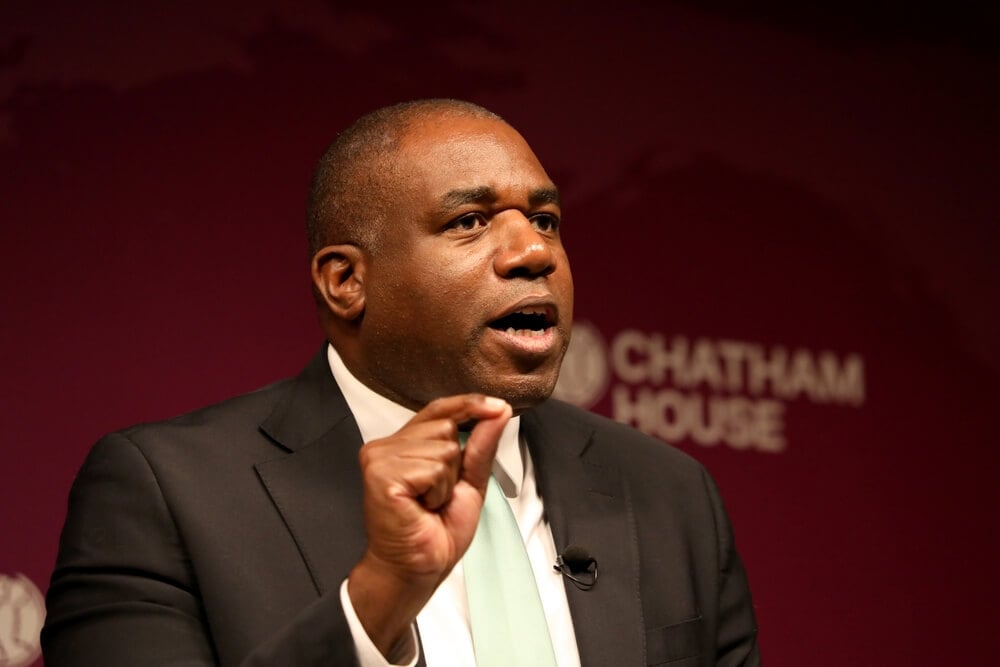 David Lammy, in a recent interview, referred to Cyprus as "part of NATO" and a "NATO country"
The Cypriot authorities believe that the kamikaze drones that targeted the British bases on the island originated from that area.
The escalation of the conflict suggests that the Mediterranean members of NATO must prepare for long-term instability in their immediate Middle Eastern neighbourhood.
For Cyprus, this may provide an impetus to intensify its efforts to join NATO, which would make its security guarantees more stable and long-term.
Support for NATO membership is gradually increasing, from around 43% four years ago to about 46% now.
This is a positive sign for proponents of this path in the government, but it also suggests that they should pursue membership in cooperation and agreement with Ankara, rather than in confrontation.
The current crisis has shown that Cyprus and its security enjoy significant support among the most influential European NATO members.
So much so that British Deputy Prime Minister David Lammy, in a recent interview, referred to Cyprus as "part of NATO" and a "NATO country".
