On 12 August, India and the five countries of the Southern African Customs Union (SACU) agreed to restart negotiations on a preferential trade agreement.
After a sixteen-year standstill, New Delhi is again trying to secure lower tariffs on cars, pharmaceuticals, machinery and electrical equipment in a market that includes South Africa, Botswana, Namibia, Lesotho and Eswatini.
SACU is seeking better access to India’s market and higher exports of goods from the region.
The negotiations begin with far higher economic stakes than in 2010, when the previous round ended without agreement. India now exports significantly more manufactured goods and is seeking new markets for cars, pharmaceuticals, machinery and chemicals.
Southern African countries, however, are trying to move away from a model in which they export raw materials and import finished products.
The dispute will be over how far India is willing to match trade privileges with investment in the region, and how far SACU is willing to open its market to Indian industry.
Negotiations renewed after sixteen years
India and SACU have been negotiating this agreement since 2002. By 2010, five rounds had been held without an agreement. An attempt to restart the process was made in 2020, but it did not generate new negotiating momentum.
More substantive contacts were renewed in 2025, and the document signed on 12 August now defines the scope, goals and procedures for the new talks.
This is a preferential trade agreement, not a broad free trade agreement. This means that lower tariffs will be negotiated on agreed groups of products, while services, investment and intellectual property do not have to be included.
Such a format is politically easier for the five SACU members, as it allows them to protect sectors they consider sensitive.
Cars and car parts were worth about $1.7 billion and were India’s second-largest export category to SACU, behind petroleum products
In the 2025/26 fiscal year, India exported goods worth $7.5 billion to the SACU states, while imports totalled $9.2 billion. South Africa accounts for the largest share of this trade, with about $7 billion of Indian exports and $8.5 billion of imports.
New Delhi will seek preferential treatment for cars and car parts, pharmaceuticals, machinery, electrical equipment, chemicals and textiles. In the last financial year, cars and car parts were worth about $1.7 billion and were India’s second-largest export category to SACU, behind petroleum products.
Cars will be the hardest part of the deal
At the same time, South Africa is considering increasing the tariff on cars from India and China from 25 to 50 per cent. New Delhi is therefore negotiating lower tariffs on a product for which Pretoria is considering doubling the duty.
South African data explain why the government is focusing on tariffs. In 2025, India was the source of 56.2 per cent of imported light vehicles in South Africa, while China increased its share to 23.3 per cent.
Cheaper imported models are reshaping a market in which the domestic car industry employs large numbers of people, exports extensively, and attracts production by global companies.
At the same time, rising sales of Indian and Chinese cars show that some South African buyers increasingly favour lower prices and more generous standard equipment. Pretoria therefore has little reason to unconditionally open to India a sector it is trying to preserve as one of its most important industries.
Cars will be the first test of how willing New Delhi is to turn its export success into investment beyond India’s borders
If New Delhi insists on a substantial cut in tariffs on finished cars, the South African side will almost certainly demand concessions in return. The most logical request would be increased local production, more components manufactured in South Africa, or new investment by Indian carmakers.
For Pretoria, tariff preferences are politically much easier to defend when they are accompanied by domestic production than when they only increase the number of imported vehicles.
Local production would give Indian companies more stable access to the SACU market and reduce the risk that the next tariff increase would send them back to square one.
Cars will be the first test of how willing New Delhi is to turn its export success into investment beyond India’s borders. If it sticks to a model based on selling finished vehicles, Pretoria will find it difficult to justify significant concessions.
Developing manufacturing capacity and supply chains in the region would give the South African government a reason to reduce tariffs.
Minerals are a key Indian interest
In the negotiations, India is also seeking more reliable access to platinum-group metals, manganese and copper from the SACU states.
This is part of a much broader Indian policy that in recent years has sought to reduce vulnerability arising from imports of raw materials needed by the automotive, electronics, energy and battery industries.
In early 2025, Narendra Modi’s government approved the National Critical Mineral Mission, a seven-year programme to boost domestic mining, processing and recycling of critical minerals, as well as to secure deposits abroad.
The government has earmarked 163 billion rupees (about $1.7 billion) for the programme, while additional investment of about 180 billion rupees (about $1.9 billion) is expected from state-owned companies and other participants.
The programme covers exploration, exploitation, processing, recycling and the purchase of mineral deposits abroad. India is already investing in lithium projects in Argentina through the state-owned company KABIL and is negotiating for resources in Australia and other countries.
New Delhi could increase exports of industrial goods and secure a larger share of the raw materials its industry lacks
South Africa is one of the world’s most important sources of platinum-group metals. The SACU region also has large reserves of manganese, and copper is an important part of mineral production in wider southern Africa.
With the same trade relationship, New Delhi could increase exports of industrial goods and secure a larger share of the raw materials its industry lacks.
For the SACU states, the situation is different. Selling larger quantities of ore alone does not solve their problem of industrial development.
South Africa, Namibia and Botswana have for years sought to keep most of the processing and added value at home. If India wants long-term contracts for minerals, it will be expected to do more than buy the raw material at the mine gate.
Because of minerals, some of the real negotiation will almost certainly go beyond tariff tables. Indian investment in processing, industrial equipment, logistics or joint ventures could follow the agreement even if the formal text of the PTA remains limited to goods and tariffs.
Such a package would give SACU members a more tangible benefit than an agreement that primarily facilitates the sale of Indian cars and pharmaceuticals.
China has already granted South Africa a trade privilege
India is not negotiating alone in South Africa. On 1 May this year, China introduced a temporary zero-tariff regime for eligible exports from South Africa, which will remain in force until 30 April 2028.
Since 1 June, the South African Revenue Service has been issuing certificates of origin that allow exporters to make use of this benefit.
Certain tariff lines are still subject to quotas and special rules. However, for qualifying South African products, entry into the Chinese market has been cheaper since May.
India is therefore negotiating with partners that already have more favourable access to the Chinese market, Chinese investment, and strong trade ties with Beijing. Pretoria, Gaborone, Windhoek, Maseru, and Mbabane will have no reason to lower tariffs on Indian goods without sufficiently valuable concessions from India.
Chinese car companies are already increasing sales in South Africa
Pharmaceuticals is one of the sectors in which India is well placed. Its generic drug manufacturers can offer lower costs to the region’s health systems. Industrial machinery and electrical equipment are linked to infrastructure and manufacturing projects.
At the same time, China will continue to raise India’s cost of entry. Chinese car companies are already increasing sales in South Africa, with Chery taking over Nissan’s factory in Rosslyn, near Pretoria, in July.
Chery’s move further increases pressure on Indian manufacturers. The Chinese competitor is no longer only supplying vehicles to the South African market, but is taking over the existing plant and shifting to local production.
An agreement is possible, but it will not be comprehensive
India’s Commerce Minister, Piyush Goyal, has said he expects the deal to be finalised in the coming months. Such a deadline is ambitious. The five SACU members must align their interests; South Africa wants greater protection for its automotive industry, and India is seeking the largest possible scope for growth in that sector.
The most likely outcome is a limited agreement covering carefully selected tariff lines. Pharmaceutical products, parts of machinery, electrical equipment and products for which SACU does not have substantial domestic production could receive lower tariffs relatively quickly.
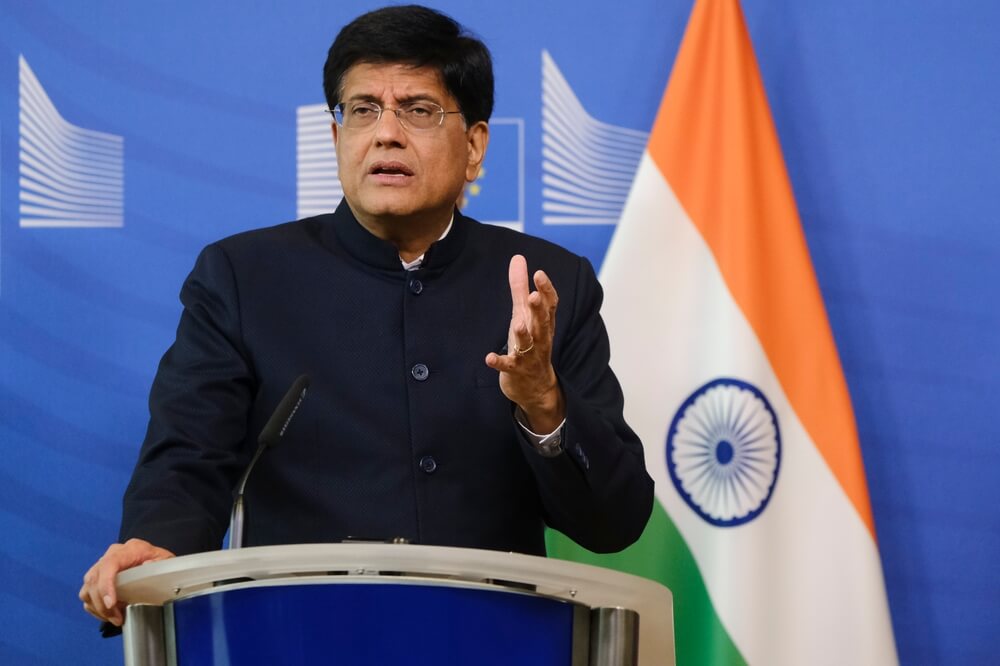 India’s Commerce Minister, Piyush Goyal, has said he expects the deal to be finalised in the coming months
Cars are likely to face a slower regime, quotas, special rules or concessions linked to local production. Minerals will be important during the negotiations, although most of them may not appear in the actual text of the agreement.
If the deal is reached, New Delhi will secure its first major trade arrangement with an African regional bloc and strengthen its position in a part of the world where China already has a deep presence.
SACU will gain access to the large Indian market and the ability to turn India’s demand for minerals into investment that leaves more value in the region.
If New Delhi adheres to a formula of more Indian exports in return for more African ore, the agreement will remain a narrow tariff deal.
Southern African countries will seek factories, processing facilities and access to the Indian market, while India will try to secure buyers for its industries and a more reliable supply of minerals.
Both sides have plenty to trade, but the cost of India’s market access will be determined by the investment that stays in the region.
Negotiations with SACU will be a useful test of India’s much broader ambitions. New Delhi has gained political weight among countries of the Global South in recent years, but economic space in Africa still largely belongs to others.
A trade agreement with five southern African countries would show that India is starting to translate political influence into a lasting commercial presence.
After two decades of failed attempts, the value of the new negotiations will be measured very simply: by whether India’s diplomacy in Africa finally begins to deliver the deals it previously failed to secure.
