Would you trust a humanoid robot to handle your luggage at the airport? In my younger days, I worked for over a decade at one of the busiest airports in the world, so this news sparked my curiosity.
The humanoid robotic trials at Tokyo's Haneda Airport with GMO AIR are gaining attention. It's another step and validation of robotics as deployment moves from controlled environments into more complex operational environments.
Airports are among the most difficult real-world situations because of their heavy traffic, erratic workflows, safety restrictions, and human variability.
Humanoid robots do have the potential to grow elsewhere if they can function effectively in this setting.
We've seen robotics step into human spaces. Warehouses, hospitals, airports, and retail floors are now acting as testing grounds.
The humanoid form factor is where the hype comes from, as it fits into spaces designed for humans, sparking the controversial conversations. It uses tools built for human hands. It reduces the need for infrastructure redesign.
It is the outcome of years of research and development in AI, motion control, and perception. Systems that balance, traverse, and control items with ever-increasing precision are now used by businesses. Is a lengthy adoption curve just getting started?
Companies making a splash in humanoid robotics
Five companies are leading the way. Each one approaches the challenges of humanoid robots differently.
Tesla leads with its Optimus humanoid robot. The company leverages its AI and manufacturing expertise. It trains robots using real-world data collected from its vehicles. Tesla aims to deploy robots in its own factories first. It validates performance before external rollout.
Boston Dynamics is still a leader in control and mobility. Its humanoid and semi-humanoid robotics exhibit exceptional agility and balance. Robots are already used for inspection and logistics duties. The technical benchmark for stability and mobility is Boston Dynamics.
Companies already deploy or test their systems in real environments
Warehouse automation is the main emphasis of Agility Robotics. Digit, its robot, is in charge of material handling. The company uses robots in real-time operations in collaboration with logistics companies. The transition from prototype to commercial application is being facilitated by Agility Robotics.
Figure AI positions itself as a general-purpose provider of humanoid platforms. It collaborates with industrial partners to test robots in manufacturing environments. Figure AI is a fast mover aiming to scale quickly through partnerships.
Sanctuary AI combines humanoid hardware with cutting-edge AI. Its systems emphasise task execution and human-like reasoning. The business uses robots in trial projects in the retail and service industries. Instead of concentrating only on mechanics, Sanctuary AI emphasises cognitive ability.
These companies already deploy or test their systems in real environments. None operate at full scale yet, but I expect gradual expansion over the next five years as reliability improves.
Benefits, challenges, and the reality of humanoid robotics
The advantages of promoting adoption are obvious. Demand is immediately created by labour shortages. Filling repetitive or physically demanding positions is a challenge for many sectors. This gap is directly addressed by humanoid robots. They can work nonstop, lower the chance of injury, and improve consistency.
Since it is a costly activity, cost efficiency should increase over time. Early deployments are expensive up front. Unit pricing should drop when production is scaled up.
Additionally, software updates ought to increase capability without requiring new hardware. Widespread adoption should be fuelled by long-term cost benefits.
One major benefit is flexibility, as software updates allow a humanoid robot to switch between tasks. Unlike classical automation, which often locks into a particular function.
Robots will handle repetitive and physically demanding work, while humans will oversee, manage exceptions, and focus on higher-value tasks
There are challenges, as usual. Because real-world environments introduce variability that robots must handle, reliability remains the primary concern.
The weight, texture, and shape of objects vary. Robots are going to have to adjust in real time since human behaviour is unpredictable. The extent to which deployment can scale will depend on developments in power systems.
Adoption will be influenced by safety and regulations, no compromise here because robots working in close proximity to people will also have to adhere to tight guidelines.
Businesses should prioritise showing that their systems are safe to use.
Public opinion is another factor. Any time when innovators brought new ideas to the world, we can always look back. Because trust takes time to develop, people's reactions to humanoid machines vary.
Acceptance is going to be influenced by tangible benefits and open communication.
Humanoid robotics are part of a very realistic new era. We should not expect full autonomy across all tasks in the near term, but we should see more hybrid models that combine human and robotic collaboration.
Robots will handle repetitive and physically demanding work, while humans will oversee, manage exceptions, and focus on higher-value tasks.
The fear of job loss and the reality of job creation
In every automation cycle, we hear the same worry. People are afraid of losing their jobs, and news outlets around the world frequently talk about it. The response is legitimate because humanoid robots resemble human workers and highlight the new phase.
Why not try thinking about it in a new way? Technology modifies jobs. While certain tasks are and will be eliminated by automation, new responsibilities are and will also be created. All we need to do is look back at historical trends.
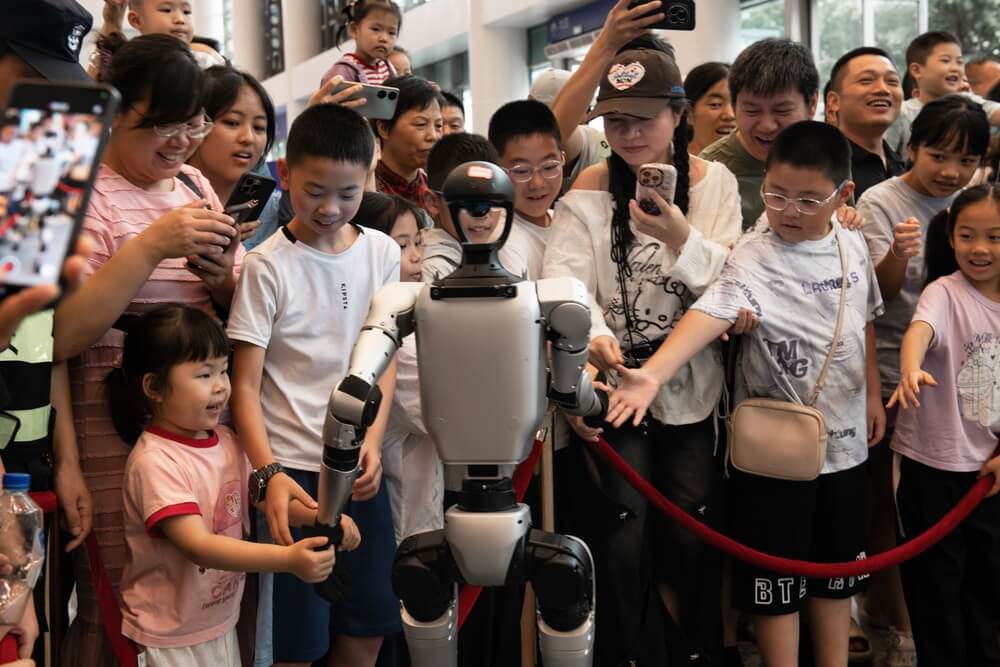 We should see a workforce transformation rather than a reduction
Do you recall the time when industries used less manual labour due to industrial automation? It produced jobs in operations, logistics, and engineering. Clerical work was decreased by digital transformation. It produced jobs in cybersecurity, data analysis, and IT.
Humanoid robotics should follow a similar path, even if it's hard to process right now. Companies will need operators, trainers, and technicians. They will require specialists in robotics software, hardware maintenance, and AI systems. Overall, we should see a workforce transformation rather than a reduction.
The biggest challenge will always be transition. Workers who will need reskilling, organisations that will need to invest in training, and governments that should support workforce development.
With every challenge comes opportunity. For those who fear change or the unknown, we just need a better understanding that humanoid robots could take over hazardous and repetitive tasks whilst humans can move towards roles that require creativity, judgement, and interpersonal skills.
Where does this leave us?
With the trial at Haneda Airport in motion, humanoid robots now step into environments that demand reliability and adaptability. It is a reminder of how rapidly technology improves.
As use cases expand, the pace should accelerate as early deployments prove value.
Humanoid robots will not replace humans. But they will redefine how work gets done
Let's be realistic: humanoid robots will not replace humans. But they will redefine how work gets done. They will augment capabilities and reshape industries.
But how will we design a workforce where humans and humanoid robots operate side by side?
The future is changing, and as a society, we need to be open to what comes next. Let's not let fear cloud our thinking.
