At the end of 2025, India’s government announced that the country’s gross domestic product would reach approximately $4.18 trillion, making India the fourth largest economy in the world and overtaking Japan.
This is not just a statistic; it marks a significant shift in the global economic order, with Asia increasingly setting the pace of growth, while traditional powers like Japan lose ground due to demographic and structural challenges.
India, which was the tenth largest economy in 2014, now demonstrates how rapid growth can push boundaries but also introduce new risks to stability.
The International Monetary Fund confirms this trend in its latest forecasts. According to IMF data from October 2025, India’s GDP in 2026 will be around $4.51 trillion, while Japan’s will be $4.46 trillion.
This means India will consolidate its position ahead of Japan, with a margin likely to widen in the coming years.
The government in New Delhi notes that this rise is the result of reforms, increased domestic consumption, foreign investment, and a favourable global environment that have enabled the export of services and products.
The fastest-growing major economy
India's growth is not a coincidence. In 2025, the economy grew at about 6.6 per cent, according to revised IMF forecasts, making India the fastest-growing major economy in the world.
Factors such as digitisation, infrastructure development, and labour sector reform have contributed to this pace. For example, India has attracted record foreign investment in technology and renewable energy, with companies such as Apple and Google moving some production from China to India due to geopolitical tensions.
Modi's government hails this as a "golden age" of high growth and low inflation, but critics warn that inequality and youth unemployment remain major challenges.
Japan, by contrast, faces the opposite problems. Its economy is growing slowly, with a forecast of just 1.1 per cent in 2026, due to an ageing population, low birth rate, and decades of deflation.
A weak yen has further reduced the nominal dollar value of Japan's GDP, making it vulnerable to currency fluctuations.
The Government of India predicts that by 2030, GDP will reach $7.3 trillion, making India the third largest economy behind the US and China
While Japan was once a symbol of economic miracle, it is now losing ground in the global race, where Asia is leading thanks to its young workforce and rapid urbanisation.
India's next target is to overtake Germany. According to IMF forecasts, Germany will have a GDP of about 5.33 trillion dollars in 2026, which is still ahead of India.
However, if India maintains annual growth of 6 to 7 per cent, it could overtake Germany as early as 2027 or 2028.
By 2028, India's GDP could reach $5.58 trillion, according to some estimates, while Germany's growth would remain at around 1.5 per cent due to energy problems and dependence on exports.
The Government of India predicts that by 2030, GDP will reach $7.3 trillion, making India the third largest economy behind the US and China.
The fragile future of global supply chains
While most of the media presents this rise as a triumph for India, the reality is more complex and full of risks. India's growth depends on fragile global supply chains due to tensions between the US and China.
As the largest exporter of services, India is profiting from the digital economy, but climate change threatens its agriculture, which employs half the workforce. Floods and droughts already cause losses of billions of dollars a year, and without strong adaptation, growth may be slowed.
In addition, inequality is deep – while urban elites benefit from the technological boom, rural areas lag behind, which can lead to social unrest and political instability.
Geopolitically, this shift strengthens India as a key player in Asia. With a higher GDP, India can invest more in defence and infrastructure to counter China's influence in the region.
India must address issues such as bureaucracy and infrastructure to sustain this momentum
Partnerships with the West, such as the QUAD alliance with the US, Japan and Australia, are gaining significance as India becomes an alternative to China for manufacturing.
However, this could heighten tensions with Beijing, particularly over borders and trade. China already views India as a rival, and India's growing economic influence could shift the balance of power in the Indo-Pacific, where both countries compete for resources such as rare metals needed for technology.
Economically, India's move ahead of Japan is changing global supply chains. Companies are relocating factories to India because of lower costs and a large market, weakening Japan, which relies on auto and electronics exports.
However, India must address issues such as bureaucracy and infrastructure to sustain this momentum. If successful, this may encourage other developing countries to follow a similar model, creating a multipolar world dominated by Asia.
The uncertainties behind India’s rise
The forecast for overtaking Germany is uncertain. Germany, with its focus on exports and engineering, faces its own challenges – the energy crisis and demographic decline – but has stronger institutions and innovation.
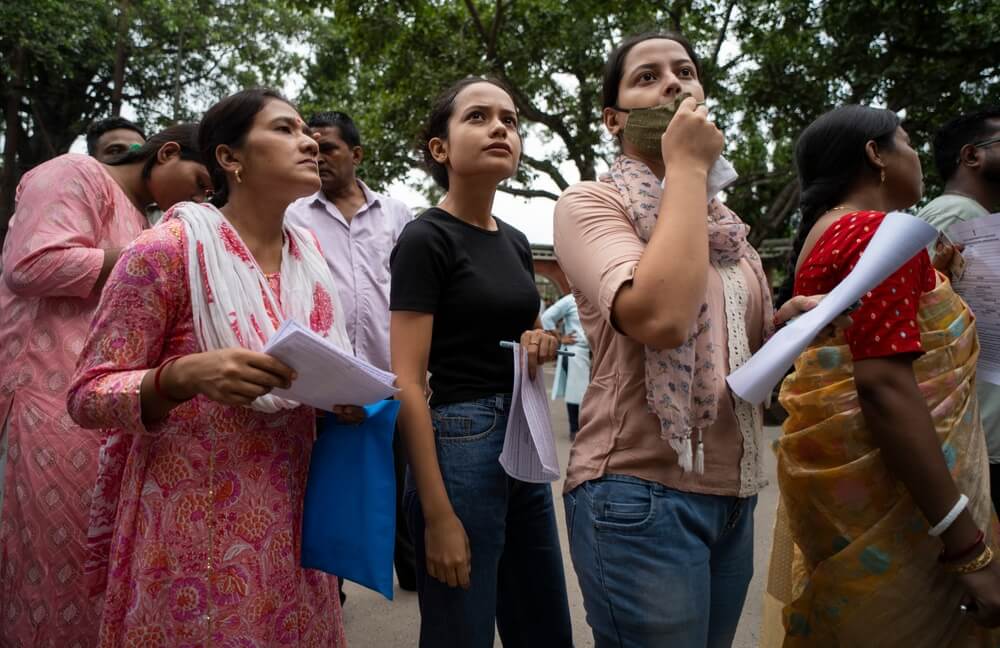 India could fall behind if a global recession occurs or if it does not address domestic problems such as youth unemployment
India could fall behind if a global recession occurs or if it does not address domestic problems such as youth unemployment.
According to Moody's, India's growth may be 6.2 per cent in 2026, but risks from inflation and climate shocks remain high. By 2028, if India reaches $5.58 trillion, it will overtake Germany, but only if it avoids the pitfalls that have slowed other Asian economies.
In essence, India's rise demonstrates how quickly demographics and decisive reforms can change the global economic landscape.
At the same time, this example reminds us how fragile and dependent such growth is on a stable environment.
Rather than being seen as just another statistic, this shift should be understood as a clear signal for global actors to adapt to the new reality – India is no longer merely a vast market for sales but a country that increasingly influences the global rules of trade, investment and technological development.
