The coming weeks promise great excitement for 54 million Colombians, unlike anything they have experienced in years.
The national football team will compete in the World Cup after an eight-year absence, and expectations are high.
Led by world stars James Rodriguez and Luis Diaz, "Los Cafeteros" hope to bring joy to their football-obsessed nation, as is the case throughout Latin America.
While preparing for matches in Mexico and the US, Colombians will face another major "game" at home.
On Sunday, 31 May, they will participate in a crucial presidential election, which will most likely proceed to a runoff three weeks later, in the middle of the World Cup.
Colombians are choosing a president in a heated atmosphere and a polarised political scene, primarily seeking a leader who will provide greater security and improve social protection.
Tired of prolonged internal conflicts with guerrillas and criminal groups, Colombians now consider security the top priority for candidates, who are attempting to address this issue.
Ideological differences, although significant among the main contenders, play a secondary role.
"Colombia cannot continue surrendering territory to criminals and terrorists. The state must recover authority in every corner of the country," said Abelardo de la Espriella, a right-wing candidate, referencing the radical anti-crime measures implemented by Nayib Bukele, the authoritarian president of El Salvador, at a pre-election rally.
Cepeda, promoter of continuity
The candidate with the best chances, Iván Cepeda, a leftist and political successor to outgoing President Gustavo Petro, promises to continue the "Total Peace" strategy initiated by his political mentor.
However, this model of negotiating with militants and criminal gangs has not produced results.
Moreover, during the years it was implemented, Colombia became even less safe, maintaining its global lead in cocaine production.
Paradoxically, President Petro's negotiating strategy has led to Colombia recording steady growth in coca production and acreage, culminating in an annual output of a staggering 3,000 tonnes.
Iván Cepeda is confident he will inherit his predecessor's expanding electorate
Nevertheless, Senator Iván Cepeda is confident he will inherit his predecessor's expanding electorate, gained primarily through improvements in social conditions and the economy, mainly through budget grants.
Furthermore, Cepeda advocates a model that simultaneously addresses crime and supports the poor by redistributing arable land from cocaine clans to farmers.
Critics warn of his left-wing populism, the capture of democratic institutions, and even fear the country's slide into Cuban-style communism.
Certain runoff
Few doubt the polls, which indicate that Iván Cepeda will lead in Sunday's elections (with around 40% support), ahead of right-wing lawyer Abelardo de la Espriella and Senator Paloma Valencia.
Few believe the elections will be decided on 31 May
At the same time, few believe the elections will be decided on 31 May, as it is expected that on 21 June Colombians will vote again for the two strongest candidates, since none is likely to win more than 50% in the first round.
In that case, Iván Cepeda's prospects diminish, as the predominantly conservative electorate will likely unite in support of his opponent, whoever that may be.
Referendum on future relations with the US
The significant shadow of future relations with the US, traditionally Colombia's most influential political and economic partner, hangs over the upcoming elections.
The outgoing president, Petro, leaves behind a poor record, and his successor faces many unresolved issues with the Donald Trump administration.
The future Colombian president will certainly not be able to expect concessions from Washington regarding the fight against drug cartels, but rather a more aggressive approach.
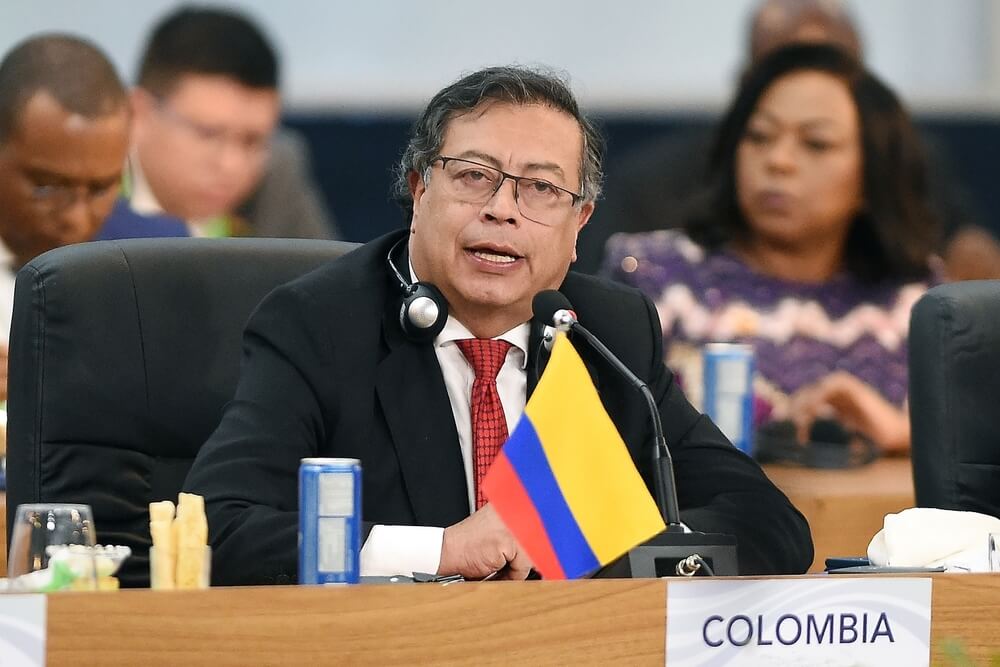 Continuing Gustavo Petro's policy would mean the continuation of rapid rapprochement between Colombia and China
"Colombia's next president may seek a positive relationship with the US government, as the United States remains Colombia's top economic partner and a source of security and humanitarian support," the Congressional Research Service notes regarding the upcoming elections in Colombia.
The electoral success of Petro's successor, Cepeda, would indicate that most Colombians wish to continue a policy of some resistance to Trump's aggressive anti-cartel stance towards Latin America.
However, if a right-wing or centrist candidate wins, Colombia will signal to Washington that it is changing course and accepting greater cooperation than Gustavo Petro has demonstrated so far.
In some areas, the upcoming elections in Colombia are viewed as a "referendum" on the future relationship with the US and Trump, not only in relation to the fight against drug crime, but also more broadly, particularly in economic cooperation.
Continuing Petro's policy would also mean the continuation of rapid rapprochement between Colombia and China, as seen in the growth of Chinese investment and trade, which has increased up to fifteenfold over the past two decades.
The strengthening of ties, both economic and political, is evident in Colombia's accession to the Belt and Road Initiative, and particularly in Colombia's entry into the BRICS New Development Bank last year.
Conversely, Colombia's central role in American political, security, and economic strategies in Latin America provides the future Colombian leader with the opportunity to balance interests and focus more on addressing domestic issues.
