On 21 October, Zhang Han, spokesperson for the Taiwan Affairs Office of the State Council of the People's Republic of China, said that the Chinese Coast Guard operating around the Pratas Islands in the South China Sea was lawfully maintaining order and navigational safety.
A day earlier, Chinese patrol vessel had entered an area Taiwan regards as restricted, with its automatic identification system (AIS) – through which ships broadcast their position – switched off. The Taiwanese patrol boat Taichung approached and ordered it to leave.
The Chinese crew radioed that “the so-called Republic of China does not exist”, and the Taiwanese crew replied that the Republic of China (Taiwan) is a sovereign, independent country.
Since the beginning of the year, the Taiwanese Coast Guard has driven away Chinese ships 15 times in 12 separate operations.
The day before Zhang Han’s statement, the head of Taiwan’s Mainland Affairs Council, Chiu Chui-cheng, judged that Beijing is trying to portray relations with Taiwan as an internal matter and to create the appearance of actual jurisdiction over the waters and islands administered by Taipei.
He described this policy as the “implementation of jurisdiction before unification”. As a result, the question of whether a ship’s captain will obey the orders of the Chinese or Taiwanese coastguard is becoming increasingly important.
For Beijing, compliance with its orders at sea would be the practical confirmation of a political claim that Taiwan rejects.
Chiu links such policies to the 2027 party congress, where Xi Jinping is expected to secure a fourth term. Beijing’s de facto jurisdiction over Taiwan’s remote islands could then serve as tangible evidence of progress towards unification, without the risk of overt military action.
Kinmen has already gone through the same process
Two years ago, China showed how far it was prepared to go by using the coastguard. Off Kinmen, a group of Taiwanese islands a few kilometres from the Chinese coast, a speedboat carrying Chinese nationals capsized on 14 February 2024 while trying to avoid inspection by the Taiwanese coastguard.
Two people died. On 18 February, Beijing announced increased patrols around Kinmen, and the very next day six members of the Chinese coastguard boarded a Taiwanese tourist vessel with 23 passengers and 11 crew, checking documents and the sailing plan for about half an hour.
Taiwan’s coastguard then escorted the ship back to port and said it had veered towards the Chinese side because of shallow water. There was no armed conflict.
Chinese ships conducted 52 patrols around Kinmen in 2024, a further 46 in 2025 and 19 in the first five months of this year
According to Taiwan Coast Guard data compiled by the Jamestown Foundation, Chinese ships conducted 52 patrols around Kinmen in 2024, a further 46 in 2025 and 19 in the first five months of this year. The patrols continued long after the February 2024 crisis had passed.
Although Kinmen is very close to the Chinese coast and has residents and regular tourist traffic, Pratas lies more than 400 kilometres from Taiwan’s main island and has no permanent civilian population.
The same method, however, allows Beijing to challenge the jurisdiction of Taiwan’s authorities without seizing the island itself.
Taiwan already enforces its own rules
Pratas, known as Dongsha in Taiwan, has a pier, an airport runway and a permanent coastguard crew. After reconstructing the pier, Taiwan announced in September that it had deployed a new patrol vessel there and that it regularly sends larger patrol vessels into the surrounding waters.
Taiwanese authorities have seized nine Chinese fishing boats in the waters around the island since the beginning of the year. On 1 October, they used a water cannon against a Chinese fishing boat which, according to their account, had ignored warnings.
Chen Binhua, spokesperson for the Information Bureau of the Taiwan Affairs Office of the State Council, said on 14 October that Taiwan would bear the consequences. Beijing also asserts its authority through its own fishermen.
In March 2025, while the Taiwanese coastguard was removing a Chinese fishing vessel from the waters around Pratas, members of the Chinese patrol vessel 3101 boarded it.
Taiwan’s coastguard later said the aim had been to monitor the schedules of its ships and create the appearance of Chinese law enforcement. Both sides are therefore already issuing orders and attempting to carry them out.
The presence of a Chinese ship, its patrolling and an attempt to inspect another vessel are not legally the same thing
The territorial sea extends up to 12 nautical miles from the coastal baselines. In the contiguous zone, which may extend to 24 nautical miles, the state may enforce compliance only with customs, fiscal, immigration and sanitary regulations.
The presence of a Chinese ship, its patrolling and an attempt to inspect another vessel are not legally the same thing.
According to research by the US Center for Strategic and International Studies (CSIS), two Chinese government ships entered the Pratas territorial sea in 2024. Taiwan also maintains its own restricted and prohibited areas around the island, and China disputes its right to enforce the rules there.
In a study published on 30 March, CSIS found that Chinese official patrols in the territorial sea and adjacent waters off Pratas were not recorded in 2021, but that there were patrols on 25 days in 2024 and 60 days in 2025.
A ship with AIS turned off can evade such tracking. What the Chinese crews say over the radio is also repeated. The same patrol boat, 3101, broadcast the claim that the Republic of China does not exist as early as 27 June, and in May a stand-off between the Chinese and Taiwanese coastguards in the area lasted for more than 30 hours. The October radio exchange simply continues established practice.
Police ships in military deployment
Since 2018, the Chinese Coast Guard has been part of the People’s Armed Police and under the command of the Central Military Commission.
In a statement issued in February to mark five years of implementing the Coast Guard Law, China’s coast guard cited patrols around “Taiwan Island and related islands” as part of building a new management system for the Taiwan Strait under China’s one-China principle.
Chinese law also grants the service the right to use weapons in certain circumstances. Beijing thereby provides its crews with a domestic legal basis for measures that Taiwan considers an encroachment on its jurisdiction.
Pratas is just one of the outlying Taiwanese positions that Beijing is testing simultaneously
Chinese patrols have also appeared during large-scale military exercises. According to CSIS, ship 3102 was at Pratas during the Joint Sword exercise in May 2024, and ship 3105 entered the island’s territorial sea during the Strait Thunder exercise in April 2025.
Taiwan registered 244 Chinese coastguard ships, research vessels and other vessels around the main island in July, up from 58 in July 2025. Taiwan’s coastguard reported simultaneous operations on 18 October, involving 16 Chinese vessels on multiple routes.
In June, the Chinese state-owned ships Sansha Zhifa 301 and Sansha 2 also entered restricted areas around Taiping Island, another Taiwanese outpost in the South China Sea, for the first time. Pratas is just one of the outlying Taiwanese positions that Beijing is testing simultaneously.
How presence turns into control
Off Scarborough Shoal, a group of coral reefs and rocks about 220 kilometres west of the Philippine island of Luzon, China has maintained a permanent coastguard presence since its 2012 dispute with the Philippines and has gradually begun to dictate the conditions under which Filipino fishers can access those waters.
In September 2025, Beijing declared part of Scarborough Shoal a national nature reserve and restricted use of the surrounding sea under Chinese regulations. The constant presence of Chinese ships thus became the basis for Chinese administration of those waters.
In 1999, the Philippines deliberately ran aground an old warship there and has maintained a small military crew on it ever since
Pratas already has the status of a national park under Taiwanese law, so the introduction of Chinese rules on fishing or nature protection would immediately bring the two administrations into conflict.
On the question of resupply, the case of Second Thomas Shoal in the Spratly archipelago, about 200 kilometres west of the Philippine island of Palawan, is more instructive. In 1999, the Philippines deliberately ran aground an old warship there and has maintained a small military crew on it ever since.
During 2024, the Chinese Coast Guard interfered with Philippine ships delivering food and equipment to that crew.
In June, there was a violent clash in which a member of the Philippine Navy was injured, and in July the two countries reached an interim resupply agreement. The case shows how quickly police obstruction of navigation can turn into a serious security crisis, and how much diplomatic effort is then needed to restore freedom of passage.
The uncertainty of the American response
The US Taiwan Relations Act of 1979 lists only the main island and the nearby Penghu Islands as Taiwan’s territory, and does not mention Pratas. The statute, however, also applies to the Taiwanese government, not just the islands.
This is why Washington can respond even if the Taiwanese government presence on Pratas is threatened, despite the island not being mentioned in the text.
Any action that endangered the lives of Taiwanese coastguard personnel or cut off supplies to Pratas would, nevertheless, make American restraint much more costly
However, the act does not provide for the automatic entry of the United States into war, even in relation to the main island, and leaves the decision on how to respond to threats to the President and Congress.
Such a framework leaves room for pressure that Washington can address politically, for example through greater support for Taipei, without military intervention.
Any action that endangered the lives of Taiwanese coastguard personnel or cut off supplies to Pratas would, nevertheless, make American restraint much more costly.
The next step will be a civilian ship inspection
Beijing has already declared that its patrols around the Pratas are lawfully maintaining order. The next step that would bring it a visible political result would be an attempt to inspect a Taiwanese fishing or research vessel, coupled with a demand that the Taiwanese coastguard accept the actions of the Chinese crew.
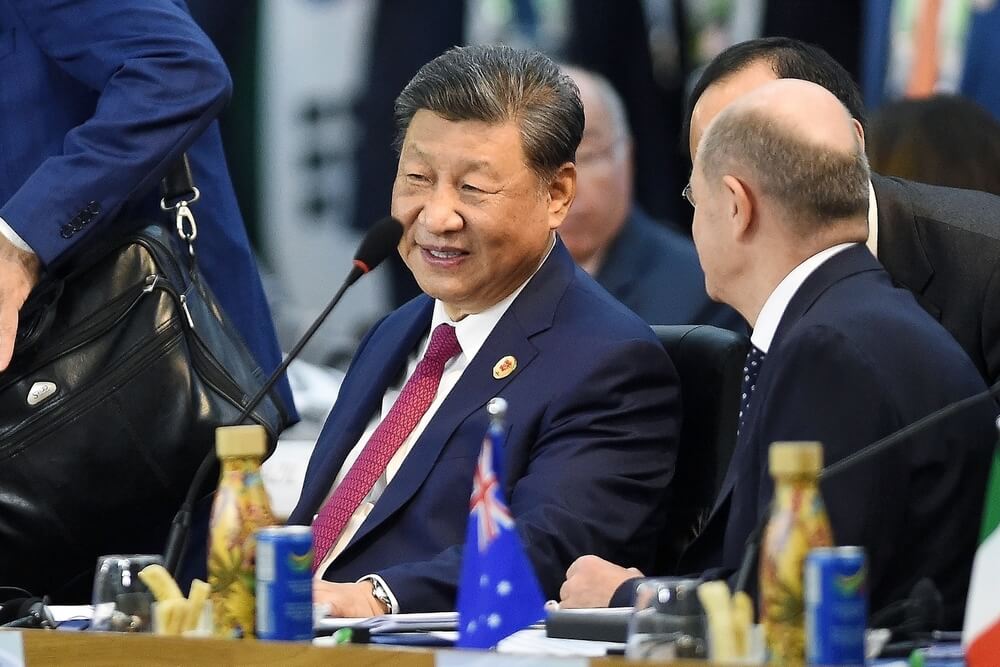 For Xi Jinping, it is crucial how many Taiwanese or foreign ships follow the orders of the Chinese crew rather than the Taiwanese
Such a move is more likely in the coming months than an attempt to cut off the island’s supplies immediately. Kinmen shows that a civilian ship can be inspected with little risk of armed conflict, while Second Thomas Shoal warns how risky it would be to systematically stop supply ships.
Taiwan will try to prevent such inspections through patrols and direct monitoring of Chinese vessels. Washington would probably respond to the inspection of a ship with diplomatic pressure and by strengthening Taiwan’s capabilities, but the detention of a Taiwanese crew or more serious injuries could provoke a harsher American response.
Under Donald Trump, however, this is not certain. The American president conducts foreign policy as a series of deals and measures relations with Beijing primarily through trade, so even the Pratas would not be exempt from negotiations with Xi Jinping.
Until the party congress in 2027, when each such case will serve as proof of progress towards unification, Beijing will multiply situations in which its coastguard issues orders as if they were already valid.
For Xi, it is crucial how many Taiwanese or foreign ships follow the orders of the Chinese crew rather than the Taiwanese. When this becomes regular practice, the Pratas will still have a Taiwanese flag and a Taiwanese crew, but the sea around them will have started listening to Beijing.
