According to the latest available data from Brazil's central bank, in the first quarter of 2025, about 40% of total bilateral trade between Brazil and China was settled in yuan, without the dollar as an intermediary.
Bilateral trade reached a record $171 billion in 2025 – more than double the US figure of $83 billion.
This is no longer an experiment; it is a functional payment system that is already operating and now expanding.
How the system actually works
The mechanism is technically straightforward. A Brazilian exporter sells soybeans to China and receives payment in reais, directly in Brazil. The Chinese importer pays in yuan, in China.
The conversion is made at the direct real/yuan exchange rate, and the central banks guarantee the final settlement. The dollar does not participate in the transaction.
What changes is not the price but the currency in which that price is actually paid
Previously, each transaction involved two conversions – yuan to dollar, then dollar to real – with two bank fees and exposure to exchange rate risk. The new system eliminates this in a single step.
Commodity prices are still mostly negotiated in dollars, as it remains the global reference standard for raw materials. What changes is not the price – soybeans are still quoted in dollars – but the currency in which that price is actually paid.
This is precisely what determines which currency has real, everyday use value and around which banks, clearing houses, credit lines, and payment networks are built.
The capital behind the system
The system also has a strong liquidity base. In 2025, Brazil's central bank and the People's Bank of China renewed a mutual credit line agreement worth 157 billion Brazilian reais, or 190 billion yuan (about $27.7 billion), for five years, with the possibility of extension.
The agreement guarantees that Brazil can obtain the yuan needed for current payments to China at any time, without using the US banking system and without the IMF conditionality that accompanies every loan.
The system is designed to function under stressful conditions, not only during periods of stability
If the market runs out of yuan to settle transactions, the People's Bank of China intervenes directly. The reverse also applies.
The system is designed to function under stressful conditions, not only during periods of stability.
Lula in Beijing, May 2025
The current institutional framework was largely established in Beijing in May 2025. This was Brazilian President Luiz Inácio Lula da Silva's fourth visit to the Chinese capital and his first since bilateral relations were elevated to a "community of shared future," Beijing's diplomatic term for top-level strategic partnerships.
Xi Jinping and Lula signed 20 agreements covering the digital economy, finance, agriculture, and infrastructure. The agreements made at that time are now being implemented.
China's BYD already manufactures cars in Brazil at a factory that manages the entire process, from assembly to sales. Great Wall Motors is building its own facility.
Chilli Beans has publicly stated it will no longer use the dollar in its transactions with China
Chinese direct investment in Brazil increased by 113%. This is not only a financial presence but also industrial integration that creates lasting dependencies in the supply chain.
Chilli Beans, the Brazilian eyewear giant with an annual turnover of 1.4 billion reais, has publicly stated it will no longer use the dollar in its transactions with China.
This marks the point at which the system shifts from the institutional framework to everyday business practice.
Obstacles that remain
A fair analysis requires specifying the limitations. The yuan still has limited convertibility, as does the Brazilian real. However, the agreement addresses this directly: the two currencies do not need to be globally interchangeable to function within a payment system designed for that purpose.
The BRICS payment platform, intended to connect all members, is still under development. A consumer version already operates in Russia, and a version for foreign trade is expected by 2030.
Brazil and China together constitute one of the three largest bilateral trade routes globally
The dollar's share of global foreign exchange reserves declined from 65.3% in 2016 to approximately 59.3% in the third quarter of 2024. The yuan remains far behind in absolute terms.
However, the alternative payment network is being developed along the routes with the highest traffic, and Brazil and China together constitute one of the three largest bilateral trade routes globally.
The American response and its limitations
Trump's threat of 100 per cent tariffs on BRICS countries that continue de-dollarisation simply does not add up.
Brazil exports $100 billion in goods to China annually, has a line of credit providing a dollar-free financial backstop, and Chinese companies are already deeply embedded in Brazil's industrial base.
The threat of tariffs serves as an instrument of pressure only while the costs of changing behaviour remain high
Exiting this system would be an economic blow, the consequences of which Washington would struggle to compensate for with any alternative offer.
The US currently has neither a line of credit of comparable scale, nor industrial engagement of similar magnitude, nor a payment system capable of replacing what has already been established.
The threat of tariffs serves as an instrument of pressure only while the costs of changing behaviour remain high. When these costs are already absorbed by the existing infrastructure, the threat loses its leverage.
A system that does not wait for permission from Washington
The yuan's share of Brazil-China trade may realistically exceed 50 per cent within two to three years, especially if the Chinese central bank's digital yuan is included in cross-border payments, which both sides are already testing.
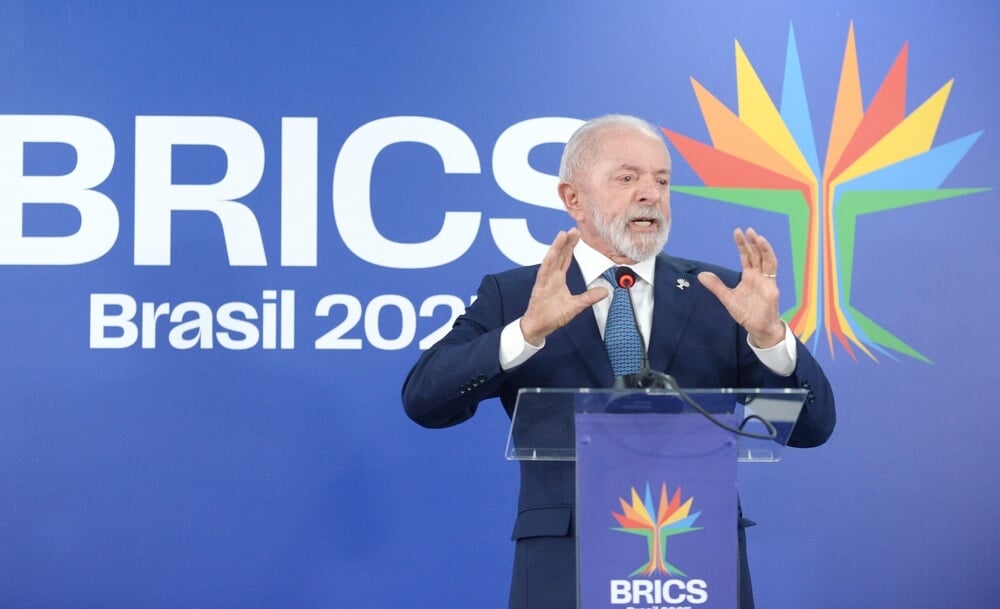 The wider implications depend on how quickly this model is adopted by other BRICS members - Lula da Silva
If the Brazilian real continues to weaken, the pressure for greater reliance on the yuan increases independently, without any new political decision in Brazil or Beijing.
The wider implications depend on how quickly this model is adopted by other BRICS members. India and China have similar interests and a comparable trade base. Russia already operates outside the dollar system, but under compulsion rather than by choice.
If the BRICS payment platform achieves full functionality by 2030 for foreign trade, the series of bilateral agreements so far will develop into a connected system in which the dollar becomes one option, not the only one.
De-dollarisation between Brazil and China is not an ideological project. It consists of a series of practical decisions that, step by step, have built a system strong enough to function without the dollar.
The question is no longer whether it is happening, but at what pace and who will follow.
