No longer is the threat posed by nuclear weapons even tenuously contained by mutually agreed rules and accepted norms.
Instead, it is returning with a vengeance, pushing us all to the edge of the abyss.
For the first time since the end of the Cold War, nuclear arsenals are growing, and the weapons themselves are becoming more lethal, more diverse, and more vulnerable.
Arms-control talks have stalled, and most agreements have expired or been so hollowed out as to have lost all credibility.
Worse, nuclear rhetoric is becoming ever more threatening, and nuclear-armed states more brazenly confrontational.
Just consider several worrying developments seen in 2025: Russian President Vladimir Putin’s nuclear saber rattling over Ukraine; US President Donald Trump’s threat to resume nuclear-weapon tests, and China’s strategic nuclear missile build-up, the world’s largest since the 1960s.
And, most ominously, war nearly erupted between two nuclear-weapon states – India and Pakistan – in May.
These trends are completely out of step with the 1968 Nuclear Non-Proliferation Treaty, the objective of which was to free the world from the constant threat of self-annihilation.
The NPT is almost universal
The NPT requires all parties to renounce nuclear weapons and to subject their nuclear activities to International Atomic Energy Agency (IAEA) inspection.
It also obliges five recognized nuclear-weapon states at the time of its signing – China, France, Russia, the United Kingdom, and the United States – to get rid of their weapons and achieve nuclear disarmament.
With 191 states party to it, the NPT is almost universal. But four of the five exceptions – India, Pakistan, Israel, and North Korea – are nuclear-weapon states (the fifth is South Sudan).
The first three refused to join before developing nuclear weapons; North Korea initially joined but later withdrew amid accusations that it had violated the treaty – and now openly proclaims its growing nuclear ambitions.
The NPT was supposed to be fortified with other agreements, but things did not go as planned
The NPT was supposed to be fortified with other agreements, but things did not go as planned.
The Comprehensive Nuclear-Test-Ban Treaty, for example, never entered into force, owing to a lack of ratifications, though a moratorium on nuclear testing has held for more than three decades (except in North Korea).
The same is true of a treaty banning the production of weapons-grade nuclear materials (and requiring the elimination of existing stocks), which has remained stalled in the Conference on Disarmament in Geneva since 1993.
There have also been proposals to put the sensitive parts of the nuclear fuel cycle under multinational control, some of which gained steam following revelations about Iran’s enrichment program in 2023. But these efforts also fizzled out.
The lack of progress in moving toward nuclear disarmament
From 1972 onward, the two major nuclear-weapon states, Russia (and the Soviet Union before it) and the US – which together account for almost 90% of the global nuclear arsenal – did enter into a series of bilateral agreements to limit the number and types of nuclear warheads and delivery systems.
But only one of these, the New START Treaty of 2010, is still in force, and it is due to expire this February.
Far from having disarmed, nuclear-weapon states possess more than 12,000 nuclear warheads.
Some 4,000 are deployed on missiles and aircraft, with around 2,000 on high alert and ready to launch within a few minutes.
All nine nuclear-weapon states are doubling down by “modernizing” their arsenals to take advantage of emerging technologies
Worse, all nine nuclear-weapon states are doubling down by “modernizing” their arsenals to take advantage of emerging technologies.
In 2020, former US Secretary of Defense William J. Perry and Tom Z. Collina summed up the situation: “Mr. Trump has the absolute authority to start a nuclear war. Within minutes, the president could unleash the equivalent of more than 10,000 Hiroshima bombs. He does not need a second opinion … Yet it would mean the end of civilization as we know it.”
Having grown frustrated with the lack of progress in moving toward nuclear disarmament under the NPT, the majority of non-nuclear states adopted a Treaty on the Prohibition of Nuclear Weapons, which entered into force in 2021.
The TPNW aims to prohibit nuclear weapons and require states to destroy any existing ones. While 74 countries have ratified it, none of the nine nuclear-weapon states has followed their lead.
In fact, the US, Britain, and France responded to the TPNW’s adoption by arguing that nuclear deterrence “has been essential to keeping the peace in Europe and North Asia for over 70 years.”
Nonetheless, they have at least reiterated their commitment, under the NPT, to disarmament, stating that they “believe strongly that the further spread of [nuclear] weapons must be prevented.”
In the not-too-distant past, the original five nuclear-weapon states did work together to prevent the spread of nuclear weapons in the cases of North Korea, Iraq, and Iran.
But North Korea ended up withdrawing from the NPT, and Iraq was invaded by a US- and UK-led “coalition of the willing,” on the false pretext that Saddam Hussein had undeclared weapons of mass destruction.
In the case of Iran, an agreement between that country and the five nuclear-weapon states aimed to build trust through cooperation and enhanced transparency, but it unraveled when the first Trump administration withdrew from the deal, known as the Joint Comprehensive Plan of Action, in 2018.
Then, despite the IAEA reporting that there are “no credible indications of an ongoing, undeclared structured nuclear program” in Iran, Israel and the second Trump administration took it upon themselves to launch airstrikes against Iran’s nuclear-fuel-cycle infrastructure, assassinating Iranian nuclear scientists in the process.
Chain reaction
Notwithstanding statements and assurances by the five original nuclear-weapon states that their arsenals are only for defensive purposes, and that a “nuclear war cannot be won and must never be fought,” some have begun to emphasize the value of nuclear weapons and espouse the principle of might makes right.
Former Russian President Dmitry Medvedev, for example, warns that a “defeat of a nuclear power in a conventional war may trigger a nuclear war,” adding that “nuclear powers have never lost major conflicts on which their fate depends.”
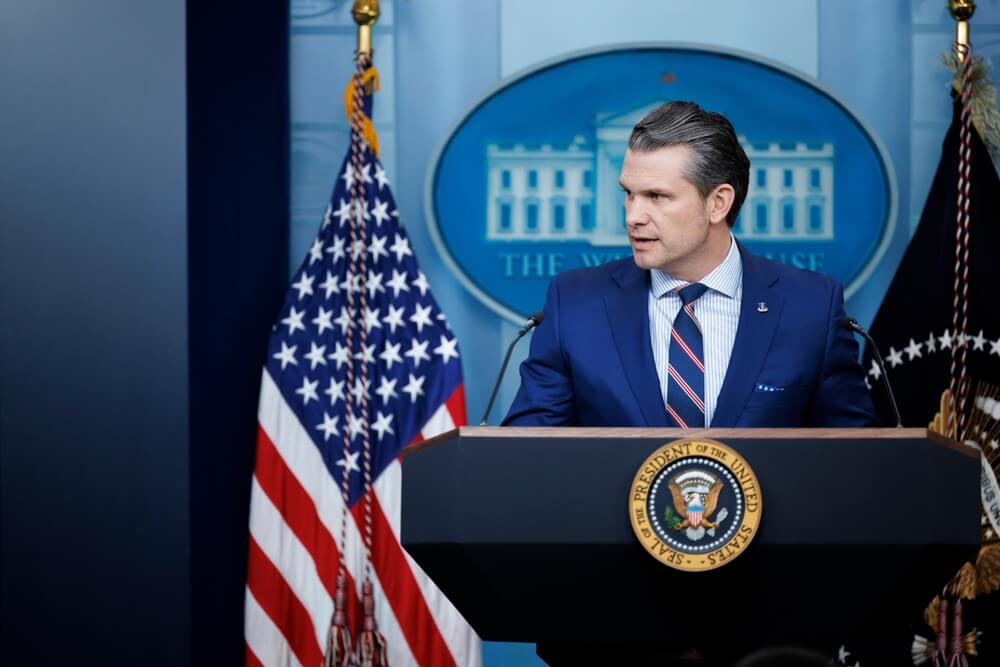 We’re not building for peacetime; we are pivoting the Pentagon and industrial base to a wartime footing - Pete Hegseth
Similarly, US Secretary of Defense Pete Hegseth recently stated that, “We’re not building for peacetime; we are pivoting the Pentagon and industrial base to a wartime footing.”
The Trump administration has coupled such rhetoric with threats or the actual use of force (or US weapons) against a wide range of countries and territories, including Iran, the occupied Palestinian enclaves, Denmark, Canada, Venezuela, and Nigeria.
In this fraught new environment, some US allies are starting to doubt the reliability of the US nuclear umbrella.
While Japan has long taken the position that it will not possess nuclear weapons, there is an intensifying debate about how it can defend itself in a more dangerous world.
South Koreans are holding a similar debate, and polls suggest that many would support the country acquiring its own nuclear-weapons capability.
And in Germany, Chancellor Friedrich Merz previously stated an openness to talks with France and the UK about “sharing” nuclear weapons in Europe to boost “the US shield” (though his government subsequently said that it “has no immediate plans to acquire nuclear weapons”).
More nuclear weapons will mean more vulnerabilities
Thus, geopolitical developments are leading to the steady crumbling, if not outright demolition, of the international architecture for maintaining peace and security.
Major nuclear-weapon states are casting aside international and humanitarian law, democratic values, and international institutions as they pursue unilateral action.
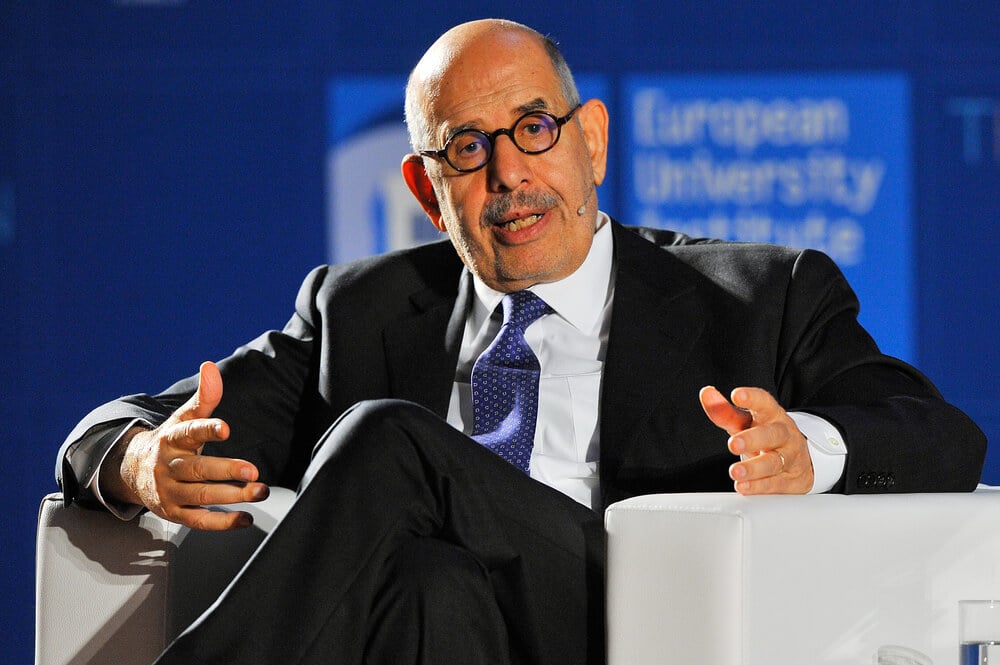 The nuclear-weapon states have clearly reneged on their commitment to nuclear disarmament and are now rushing in the opposite direction - Mohamed ElBaradei
The power conferred by weapons that could easily wipe out civilization is becoming the ultimate arbiter in statecraft and international affairs.
So, the message is that, if you want the ultimate security guarantee, you must have the bomb; and that if you do have it, you can get away with murder.
Ukraine, a country that agreed to give up its nuclear weapons in exchange for security guarantees, understands this all too well.
Whatever they say, the nuclear-weapon states have clearly reneged on their commitment to nuclear disarmament and are now rushing in the opposite direction.
Sophisticated technologies – including autonomous weapons – and global tensions have brought the world to an extraordinarily dangerous place.
The current nuclear arms-control regime always had to treat some as being more equal than others. But it can no longer be sustained.
Soon, others will shake off its yoke and develop their own “deterrence.”
More nuclear weapons will mean more vulnerabilities, owing to growing cyber capabilities, shaky command-and-control systems, and the age-old risk of sleepwalking into conflict.
There has never been a greater or more urgent need for dialogue, trust-building among major powers, a rules-based system, and new efforts at disarmament.
Mohamed ElBaradei, Director General Emeritus of the International Atomic Energy Agency and a former vice president of Egypt, received the Nobel Peace Prize in 2005, jointly with the IAEA.
